 VIPSolutions
Give step-by-step solution with explanation and final answer:haf \ FE Auth 0 dl (ER YF 11-11 Consider a heavy car submerged in water in a lake with a flat bottom, The driver's side door of the car is 1.1 m high and 0.9 m wide, and the top edge of the door is 10 m below the water surface. Determine the net force acting on the door (normal to its surface) and the location of the pressure center if (a) the car is well-sealed and it contains air at atmospheric pressure and (b) the car is filled with water. DR ET TC TONE [HUSPIMSIS BON ay JR Ee ees Ee
Question:
Give step-by-step solution with explanation and final answer: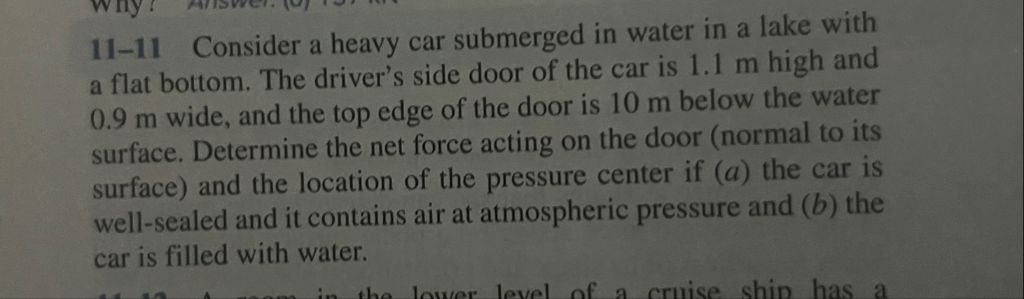 haf \ FE Auth 0 dl (ER YF
11-11 Consider a heavy car submerged in water in a lake with
a flat bottom, The driver's side door of the car is 1.1 m high and
0.9 m wide, and the top edge of the door is 10 m below the water
surface. Determine the net force acting on the door (normal to its
surface) and the location of the pressure center if (a) the car is
well-sealed and it contains air at atmospheric pressure and (b) the
car is filled with water.
DR ET TC TONE [HUSPIMSIS BON ay JR Ee ees Ee
This is AI generated Response.
Asked by: Rahul
Created at: 2026-01-15 05:55:29
Asked by: Rahul
Created at: 2026-01-15 05:55:29
Final Answer:
Rendered
Raw Text
Did you like this answer?
Let's break down the problem step by step:
---
## Problem Restatement
A car door (1.1 m × .9 m) is submerged vertically in water, with the top edge 10 m below the surface.
**Find:**
- The net force on the door (normal to its surface)
- The location of the center of pressure
For two cases:
(a) The car is well-sealed, contains air at atmospheric pressure
(b) The car is filled with water
---
## **Step 1: Data and Assumptions**
- Height of door, \( h = 1.1\,\text{m} \)
- Width of door, \( w = .9\,\text{m} \)
- Top edge depth, \( d_{\text{top}} = 10\,\text{m} \)
- Area, \( A = h \times w = 1.1 \times .9 = .99\,\text{m}^2 \)
- Density of water, \( \rho = 100\,\text{kg/m}^3 \)
- Atmospheric pressure, \( P_{\text{atm}} = 101,325\,\text{Pa} \)
- Gravitational acceleration, \( g = 9.81\,\text{m/s}^2 \)
---
## **Step 2: Hydrostatic Pressure**
### Pressure at depth \( d \) below surface:
\[ P = P_{\text{atm}} + \rho g d \]
### For the door:
- Top edge: \( d_{\text{top}} = 10\,\text{m} \)
- Bottom edge: \( d_{\text{bot}} = d_{\text{top}} + h = 10 + 1.1 = 11.1\,\text{m} \)
---
## **Step 3: Net Force on the Door**
### **Case (a): Car is well-sealed (air inside at atmospheric pressure)**
- Outside: Water pressure
- Inside: Atmospheric pressure
- **Net pressure:** \( (P_{\text{atm}} + \rho g d) - P_{\text{atm}} = \rho g d \)
#### **Force on door (integrate pressure over area):**
Let \( y \) be measured downward from the water surface (\( y= \) at surface).
- Top of door: \( y_1 = 10\,\text{m} \)
- Bottom of door: \( y_2 = 11.1\,\text{m} \)
At depth \( y \): \( P(y) = \rho g y \)
Total force:
\[
F = \int_{y_1}^{y_2} \rho g y \cdot w\,dy
\]
\[
F = \rho g w \int_{y_1}^{y_2} y\,dy = \rho g w \left[ \frac{y^2}{2} \right]_{y_1}^{y_2}
\]
\[
F = \rho g w \left( \frac{y_2^2 - y_1^2}{2} \right)
\]
Plug in values:
- \( w = .9 \)
- \( y_1 = 10 \)
- \( y_2 = 11.1 \)
\[
y_2^2 = (11.1)^2 = 123.21
\]
\[
y_1^2 = (10)^2 = 100
\]
\[
y_2^2 - y_1^2 = 123.21 - 100 = 23.21
\]
\[
F = (100)(9.81)(.9) \left( \frac{23.21}{2} \right)
\]
\[
F = 100 \times 9.81 \times .9 \times 11.605
\]
\[
F = 100 \times 9.81 \times 10.4445
\]
\[
F = 100 \times 102.499845
\]
\[
F \approx 102,500\,\text{N}
\]
---
### **Center of Pressure**
\[
y_{cp} = \frac{\int y P(y) dA}{\int P(y) dA}
\]
For a vertical surface:
\[
y_{cp} = \frac{1}{A \bar{P}} \int_{A} y P(y)\, dA
\]
But for a vertical rectangle submerged from \( y_1 \) to \( y_2 \):
\[
y_{cp} = \frac{\int_{y_1}^{y_2} y (\rho g y) w\, dy}{F}
= \frac{\rho g w \int_{y_1}^{y_2} y^2 dy}{F}
= \frac{\rho g w \left[ \frac{y^3}{3} \right]_{y_1}^{y_2}}{F}
\]
\[
\left[ \frac{y^3}{3} \right]_{y_1}^{y_2} = \frac{y_2^3 - y_1^3}{3}
\]
\[
y_2^3 = (11.1)^3 = 1369.221
\]
\[
y_1^3 = (10)^3 = 100
\]
\[
y_2^3 - y_1^3 = 369.221
\]
\[
\frac{y_2^3 - y_1^3}{3} = 123.07
\]
So:
\[
y_{cp} = \frac{\rho g w (123.07)}{F}
\]
Plug in the values:
\[
\rho g w \times 123.07 = 100 \times 9.81 \times .9 \times 123.07 = 100 \times 9.81 \times 110.763
\]
\[
= 100 \times 1086.55 = 1,086,550
\]
Recall \( F \approx 102,500 \):
\[
y_{cp} = \frac{1,086,550}{102,500} \approx 10.6\,\text{m}
\]
---
### **Case (b): Car is filled with water**
Inside and outside pressure are both hydrostatic and equal.
**Net force = ** (since pressure cancels at every point).
---
## **Final Answers**
### **(a) Car is well-sealed (air inside at atmospheric pressure):**
- **Net force on door:** \(\boxed{102,500\,\text{N}}\) (toward inside)
- **Center of pressure:** \(\boxed{10.6\,\text{m}}\) below the water surface
### **(b) Car is filled with water:**
- **Net force:** \(\boxed{\,\text{N}}\)
- **(Center of pressure is irrelevant, as net force is zero.)**
---
### **Summary Table**
| Case | Net Force (N) | Center of Pressure (m below surface) |
|------|---------------|--------------------------------------|
| (a) | 102,500 | 10.6 |
| (b) | | -- |
📢 Instructions:
- Ask anything relatd to above question only.
- For new Question goto :