 VIPSolutions
Give step-by-step solution with explanation and final answer:Equations of motion. For the folowing er mechanical ssc da fed lg for coc cri ae fd he otis) of kino th postion (1) (x ut. le). ec here se lie aes) as Fact of the pple foe 1), [yre——— EE a s f eae oe hsp 0d ampere 3 bot rr 1) Bien cil syst 2. Ottis 1 o pe we otic E Tr
Question:
Give step-by-step solution with explanation and final answer: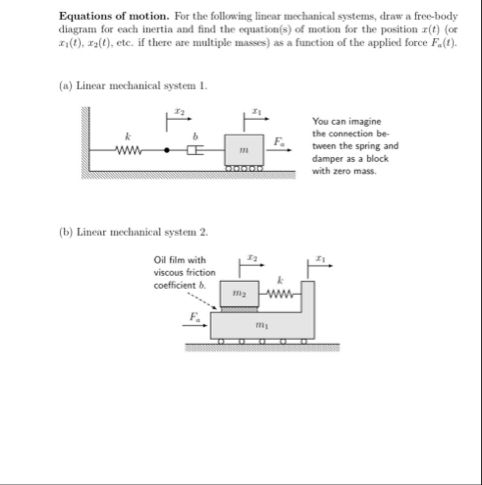 Equations of motion. For the folowing er mechanical ssc da fed
lg for coc cri ae fd he otis) of kino th postion (1) (x
ut. le). ec here se lie aes) as Fact of the pple foe 1),
[yre———
EE a
s f eae
oe hsp 0d
ampere 3 bot
rr
1) Bien cil syst 2.
Ottis 1 o
pe we
otic
E Tr
This is AI generated Response.
Asked by: Rahul
Created at: 2026-01-15 02:47:46
Asked by: Rahul
Created at: 2026-01-15 02:47:46
Final Answer:
Rendered
Raw Text
Did you like this answer?
Let's solve both systems step-by-step.
---
# (a) Linear Mechanical System 1
### **Step 1: Free-Body Diagram**
- **For mass \( m \):**
- To the right: Applied force \( F_a(t) \)
- To the left: Spring force \( kx_1 \) (Hooke's law)
- To the left: Damper force \( b\dot{x}_1 \) (damping force proportional to velocity)
### **Step 2: Newton’s Second Law**
\[
\sum F = m\ddot{x}_1
\]
\[
F_a(t) - kx_1 - b\dot{x}_1 = m\ddot{x}_1
\]
### **Step 3: Equation of Motion**
\[
m\ddot{x}_1 + b\dot{x}_1 + kx_1 = F_a(t)
\]
---
## **(b) Linear Mechanical System 2**
### **Step 1: Free-Body Diagrams**
- **For mass \( m_1 \) (bottom block):**
- To the right: Applied force \( F_a(t) \)
- To the left: Damper force \( b(\dot{x}_1 - \dot{x}_2) \) (relative velocity between \( m_1 \) and \( m_2 \))
- **For mass \( m_2 \) (top block):**
- To the right: Damper force \( b(\dot{x}_1 - \dot{x}_2) \)
- To the left: Spring force \( kx_2 \) (assuming \( x_2 \) is measured from the equilibrium position of the spring)
### **Step 2: Newton’s Second Law**
#### **For \( m_1 \):**
\[
m_1 \ddot{x}_1 = F_a(t) - b(\dot{x}_1 - \dot{x}_2)
\]
#### **For \( m_2 \):**
\[
m_2 \ddot{x}_2 = b(\dot{x}_1 - \dot{x}_2) - kx_2
\]
### **Step 3: Equations of Motion**
\[
\boxed{
\begin{align*}
m_1 \ddot{x}_1 + b(\dot{x}_1 - \dot{x}_2) &= F_a(t) \\
m_2 \ddot{x}_2 + b(\dot{x}_2 - \dot{x}_1) + kx_2 &=
\end{align*}
}
\]
---
## **Final Answers**
### (a) **Equation of Motion:**
\[
\boxed{
m\ddot{x}_1 + b\dot{x}_1 + kx_1 = F_a(t)
}
\]
### (b) **Equations of Motion:**
\[
\boxed{
\begin{align*}
m_1 \ddot{x}_1 + b(\dot{x}_1 - \dot{x}_2) &= F_a(t) \\
m_2 \ddot{x}_2 + b(\dot{x}_2 - \dot{x}_1) + kx_2 &=
\end{align*}
}
\]
Let me know if you need the free-body diagrams sketched or further explanation!
📢 Instructions:
- Ask anything relatd to above question only.
- For new Question goto :