 VIPSolutions
Give step-by-step solution with explanation and final answer:4. (30 pts) The following block diagram shows the € amics of a posi- tion ing tem oniving : i I ed a Eiki \ Ket (5) Complete the following. (a) Calculate the natural frequency, @n, and damping ratio, £, for the plant. (b) Calculate the transfer function 2s. © If the integral gain constant, Kr, is set to zero, calculate the value of Kp required for the natural frequency of the closed 100p system to be 6 radls. @ i eral gain constant, Kp is equa 10 20 86 0
Question:
Give step-by-step solution with explanation and final answer: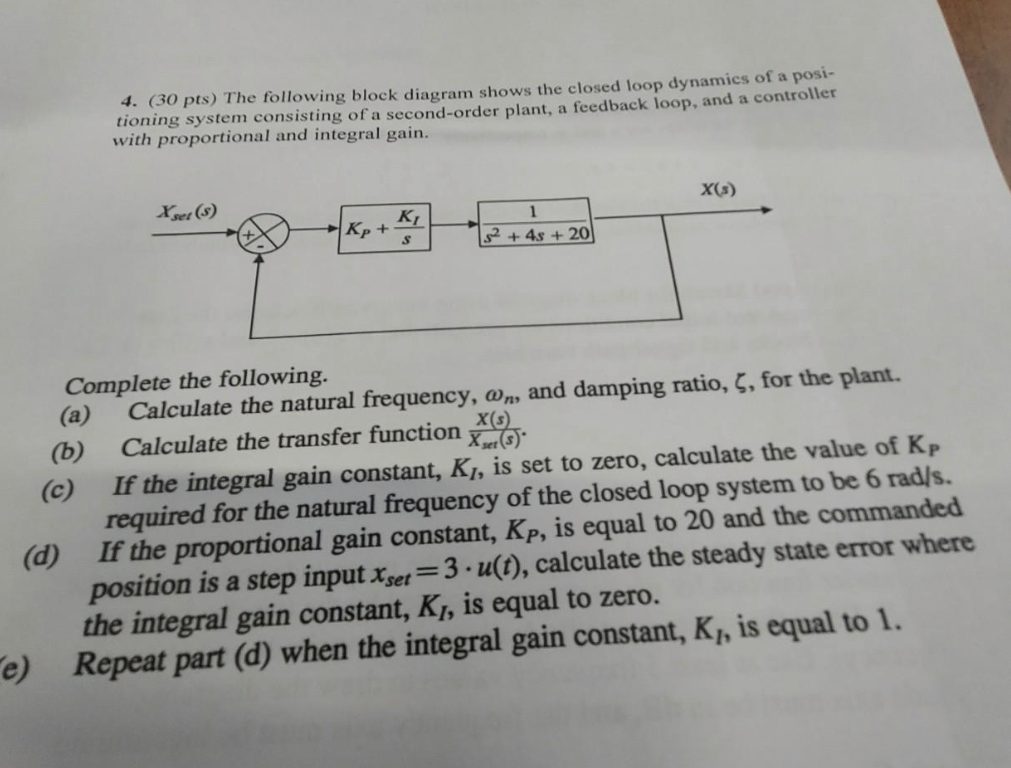 4. (30 pts) The following block diagram shows the € amics of a posi-
tion ing tem oniving : i I ed a Eiki \
Ket (5)
Complete the following.
(a) Calculate the natural frequency, @n, and damping ratio, £, for the plant.
(b) Calculate the transfer function 2s.
© If the integral gain constant, Kr, is set to zero, calculate the value of Kp
required for the natural frequency of the closed 100p system to be 6 radls.
@ i eral gain constant, Kp is equa 10 20 86 0
This is AI generated Response.
Asked by: Rahul
Created at: 2026-01-15 02:31:26
Asked by: Rahul
Created at: 2026-01-15 02:31:26
Final Answer:
Rendered
Raw Text
Did you like this answer?
Let's solve each part step by step.
---
## **(a) Natural Frequency (\(\omega_n\)) and Damping Ratio (\(\zeta\)) for the Plant**
The plant's transfer function is:
\[
G(s) = \frac{1}{s^2 + 4s + 20}
\]
A standard second order system has the form:
\[
G(s) = \frac{\omega_n^2}{s^2 + 2\zeta\omega_n s + \omega_n^2}
\]
Comparing coefficients:
- \(2\zeta\omega_n = 4\)
- \(\omega_n^2 = 20\)
So,
\[
\omega_n = \sqrt{20} = 4.472 \ \text{rad/s}
\]
\[
2\zeta\omega_n = 4 \implies \zeta = \frac{4}{2 \times 4.472} = \frac{4}{8.944} = .447
\]
**Final Answers:**
- \(\omega_n = 4.472 \ \text{rad/s}\)
- \(\zeta = .447\)
---
## **(b) Closed Loop Transfer Function \(\frac{X(s)}{X_{set}(s)}\)**
Let's write the open loop transfer function:
- Controller: \(C(s) = K_P + \frac{K_I}{s}\)
- Plant: \(G(s) = \frac{1}{s^2 + 4s + 20}\)
Open-loop transfer function:
\[
C(s)G(s) = \left(K_P + \frac{K_I}{s}\right) \cdot \frac{1}{s^2 + 4s + 20}
= \frac{K_P s + K_I}{s(s^2 + 4s + 20)}
\]
Closed-loop transfer function:
\[
\frac{X(s)}{X_{set}(s)} = \frac{C(s)G(s)}{1 + C(s)G(s)}
\]
Substituting in:
\[
\frac{X(s)}{X_{set}(s)} = \frac{\frac{K_P s + K_I}{s(s^2 + 4s + 20)}}{1 + \frac{K_P s + K_I}{s(s^2 + 4s + 20)}}
\]
\[
= \frac{K_P s + K_I}{s(s^2 + 4s + 20) + K_P s + K_I}
\]
\[
= \frac{K_P s + K_I}{s^3 + 4s^2 + 20s + K_P s + K_I}
\]
\[
= \frac{K_P s + K_I}{s^3 + 4s^2 + (20+K_P)s + K_I}
\]
---
## **(c) \(K_I = \): Find \(K_P\) for \(\omega_n = 6\) rad/s**
With \(K_I = \), the denominator is:
\[
s^3 + 4s^2 + (20+K_P)s
\]
But since the numerator is \(K_P s\), this is a second order system (since numerator and denominator share a root at \(s=\)), so ignore the \(s=\) mode for natural frequency.
The characteristic equation:
\[
s^2 + 4s + (20+K_P) =
\]
We want the natural frequency \(\omega_n = 6\):
\[
\omega_n^2 = 20 + K_P \implies 6^2 = 20 + K_P \implies 36 = 20 + K_P
\implies K_P = 16
\]
---
## **(d) Step Input, \(K_P = 20, K_I = \): Steady-State Error**
Step input: \(x_{set}(s) = \frac{3}{s}\)
Transfer function (from above, \(K_P=20, K_I=\)):
\[
\frac{20s}{s^3 + 4s^2 + 40s}
\]
Steady-state error for step input (Final Value Theorem):
\[
e_{ss} = \lim_{t \to \infty} [x_{set}(t) - x(t)] = \lim_{s \to } s \left[X_{set}(s) - X(s)\right]
\]
But
\[
X(s) = \frac{20s}{s^3 + 4s^2 + 40s} X_{set}(s)
\]
\[
e(s) = X_{set}(s) - X(s) = X_{set}(s) \left[ 1 - \frac{20s}{s^3 + 4s^2 + 40s} \right]
\]
\[
e_{ss} = \lim_{s \to } s \cdot \frac{3}{s} \left[1 - \frac{20s}{s(s^2 + 4s + 40)}\right]
\]
\[
= 3 \cdot \lim_{s \to } \left[1 - \frac{20}{s^2 + 4s + 40}\right]
\]
At \(s=\):
\[
s^2 + 4s + 40 = 40
\]
\[
1 - \frac{20}{40} = 1 - .5 = .5
\]
\[
e_{ss} = 3 \times .5 = 1.5
\]
---
## **(e) Repeat (d) for \(K_I = 1\)**
Now, the transfer function numerator is \(20s + 1\):
\[
\frac{20s + 1}{s^3 + 4s^2 + 40s + 1}
\]
Repeat the same procedure:
\[
e_{ss} = \lim_{s \to } s \frac{3}{s} \left[1 - \frac{20s + 1}{s^3 + 4s^2 + 40s + 1} \right]
\]
At \(s = \):
\[
1 - \frac{1}{1} =
\]
\[
e_{ss} = 3 \times =
\]
---
## **Summary Table**
| Part | Final Answer |
|------|-------------|
| a | \(\omega_n = 4.472\) rad/s, \(\zeta = .447\) |
| b | \(\frac{K_P s + K_I}{s^3 + 4s^2 + (20+K_P)s + K_I}\) |
| c | \(K_P = 16\) |
| d | \(e_{ss} = 1.5\) |
| e | \(e_{ss} = \) |
Let me know if you need further clarification or details for any part!
📢 Instructions:
- Ask anything relatd to above question only.
- For new Question goto :