 VIPSolutions
Give step-by-step solution with explanation and final answer:Abc nein Bde, hoi sn nly shot the Ach si.To cs own arte. To ic or i tr rr et ees 18 ea eat er Vom crt ms. Th hes dv [stv ewe Tw ET — — = —y frre Contr po ee by te Moe pr gn 1200 ES ————— 2 Tot esr io Glo Ou og tc ge 4 He ac ys eo hr
Question:
Give step-by-step solution with explanation and final answer: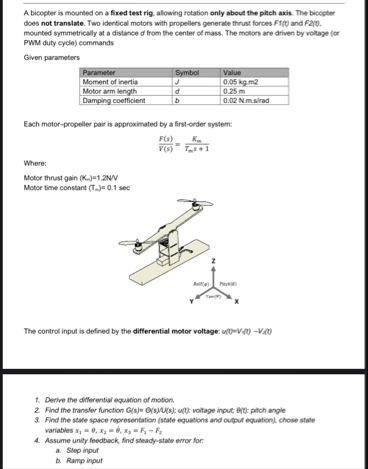 Abc nein Bde, hoi sn nly shot the Ach si.To cs
own arte. To ic or i tr rr et ees 18
ea eat er Vom crt ms. Th hes dv
[stv
ewe Tw
ET — —
= —y frre
Contr po ee by te
Moe pr gn 1200
ES —————
2 Tot esr io Glo Ou og tc ge
4 He ac ys eo
hr
This is AI generated Response.
Asked by: Rahul
Created at: 2026-01-15 02:20:52
Asked by: Rahul
Created at: 2026-01-15 02:20:52
Final Answer:
Rendered
Raw Text
Did you like this answer?
Let's break down and solve the problems step by step as requested:
---
## **Given Data**
| Parameter | Symbol | Value |
|--------------------------|-------------|---------------|
| Moment of inertia | \( J \) | .55 kg·m² |
| Motor arm length | \( d \) | .225 m |
| Damping coefficient | \( b \) | .02 N·m·s/rad |
| Motor thrust gain | \( k_m \) | 1.2 N/V |
| Motor time constant | \( T_m \) | .1 s |
Motor-propeller transfer function:
\[
\frac{F(s)}{V(s)} = \frac{k_m}{T_m s + 1}
\]
Control input (differential voltage):
\[
u(t) = V_1(t) - V_2(t)
\]
---
## **1. Differential Equation of Motion**
The biocopter rotates about the pitch axis only.
- Let the pitch angle be \( \theta(t) \).
- The forces from the motors generate a torque about the pitch axis.
### **Torque Equation:**
\[
J \ddot{\theta} + b \dot{\theta} = d [F_1(t) - F_2(t)]
\]
### **Motor Forces:**
Since each motor's force is:
\[
F_i(s) = \frac{k_m}{T_m s + 1} V_i(s)
\]
So in time domain (using Laplace inverse, it's a first-order lag):
\[
T_m \dot{F}_i + F_i = k_m V_i
\]
---
## **2. State-Space Representation**
Let the state variables be:
- \( x_1 = \theta \) (pitch angle)
- \( x_2 = \dot{\theta} \) (angular velocity)
- \( x_3 = F_1 \) (force from motor 1)
- \( x_4 = F_2 \) (force from motor 2)
### **State Equations:**
- \( \dot{x}_1 = x_2 \)
- \( J \dot{x}_2 + b x_2 = d(x_3 - x_4) \implies \dot{x}_2 = -\frac{b}{J} x_2 + \frac{d}{J}(x_3 - x_4) \)
- \( T_m \dot{x}_3 + x_3 = k_m V_1 \implies \dot{x}_3 = -\frac{1}{T_m} x_3 + \frac{k_m}{T_m} V_1 \)
- \( T_m \dot{x}_4 + x_4 = k_m V_2 \implies \dot{x}_4 = -\frac{1}{T_m} x_4 + \frac{k_m}{T_m} V_2 \)
But, \( u = V_1 - V_2 \).
Assume symmetric operation: \( V_1 = u/2 \), \( V_2 = -u/2 \).
### **State-Space Equations:**
\[
\begin{cases}
\dot{x}_1 = x_2 \\
\dot{x}_2 = -\frac{b}{J} x_2 + \frac{d}{J} (x_3 - x_4) \\
\dot{x}_3 = -\frac{1}{T_m} x_3 + \frac{k_m}{2T_m} u \\
\dot{x}_4 = -\frac{1}{T_m} x_4 - \frac{k_m}{2T_m} u \\
\end{cases}
\]
Output: \( y = x_1 = \theta \)
---
## **3. Transfer Function \( \theta(s)/U(s) \)**
### **Step 1:** Motor Transfer Function for Differential Force
\[
F_1(s) = \frac{k_m}{T_m s + 1} V_1(s)
\]
\[
F_2(s) = \frac{k_m}{T_m s + 1} V_2(s)
\]
\[
F_1(s) - F_2(s) = \frac{k_m}{T_m s + 1} (V_1(s) - V_2(s)) = \frac{k_m}{T_m s + 1} u(s)
\]
### **Step 2:** Torque Equation in Laplace Domain
\[
J s^2 \Theta(s) + b s \Theta(s) = d \left[ F_1(s) - F_2(s) \right]
\]
\[
J s^2 \Theta(s) + b s \Theta(s) = d \frac{k_m}{T_m s + 1} u(s)
\]
\[
\Theta(s) \left[ J s^2 + b s \right] = d \frac{k_m}{T_m s + 1} u(s)
\]
\[
\Theta(s) = \frac{d k_m}{(J s^2 + b s)(T_m s + 1)} u(s)
\]
\[
\boxed{
\frac{\Theta(s)}{U(s)} = \frac{d k_m}{(J s^2 + b s)(T_m s + 1)}
}
\]
---
## **4. Step & Ramp Input: Steady-State Response**
Given \( u(t) \) as input:
### **Step Input \( u(t) = U_ \cdot 1(t) \):**
- \( U(s) = \frac{U_}{s} \)
- Steady-state value (\( t \to \infty \)): use Final Value Theorem
\[
\lim_{t \to \infty} \theta(t) = \lim_{s \to } s \Theta(s)
\]
\[
\Theta(s) = \frac{d k_m}{(J s^2 + b s)(T_m s + 1)} U(s)
\]
Plug in \( U(s) = \frac{U_}{s} \):
\[
\Theta(s) = \frac{d k_m U_}{s (J s^2 + b s)(T_m s + 1)}
\]
\[
\lim_{s \to } s \Theta(s) = \lim_{s \to } \frac{d k_m U_}{(J s^2 + b s)(T_m s + 1)}
\]
As \( s \to \):
- \( J s^2 \to \)
- \( b s \to \)
- \( T_m s \to \)
- So denominator \( \to \)
So, for a step input, the system is **Type 1** (1 integrator, due to the \( s \) in denominator), so the steady-state output for step input is **infinite** -- i.e., the system responds with a ramp to a step input (physically, this makes sense: a constant torque results in ever-increasing angular displacement).
---
### **Ramp Input \( u(t) = U_ t \):**
- \( U(s) = \frac{U_}{s^2} \)
So,
\[
\Theta(s) = \frac{d k_m U_}{s^2 (J s^2 + b s)(T_m s + 1)}
\]
\[
\lim_{t \to \infty} \theta(t) = \lim_{s \to } s \Theta(s) = \lim_{s \to } \frac{d k_m U_}{s (J s^2 + b s)(T_m s + 1)}
\]
As \( s \to \), denominator still goes to zero faster than numerator, so steady-state output is infinite (system is Type 1 for input, so tracks ramp input with constant error).
---
## **Summary of Answers**
### **1. Differential Equation:**
\[
J \ddot{\theta} + b \dot{\theta} = d (F_1 - F_2)
\]
\[
T_m \dot{F}_i + F_i = k_m V_i \qquad (i=1,2)
\]
---
### **2. State-Space Equations:**
Let \( x_1 = \theta, x_2 = \dot{\theta}, x_3 = F_1, x_4 = F_2 \), \( u = V_1 - V_2 \):
\[
\begin{cases}
\dot{x}_1 = x_2 \\
\dot{x}_2 = -\frac{b}{J} x_2 + \frac{d}{J}(x_3 - x_4) \\
\dot{x}_3 = -\frac{1}{T_m} x_3 + \frac{k_m}{2T_m} u \\
\dot{x}_4 = -\frac{1}{T_m} x_4 - \frac{k_m}{2T_m} u \\
\end{cases}
\]
---
### **3. Transfer Function:**
\[
\boxed{
\frac{\Theta(s)}{U(s)} = \frac{d k_m}{(J s^2 + b s)(T_m s + 1)}
}
\]
---
### **4. Steady-State Output:**
- **Step input**: Output ramps to infinity (system is Type 1).
- **Ramp input**: Output grows even faster (infinite steady-state output).
---
📢 Instructions:
- Ask anything relatd to above question only.
- For new Question goto :