 VIPSolutions
Give step-by-step solution with explanation and final answer:Jord Ep EAE EE aE 7 A+ \ Tl ee ON TE. PF FE © ~ E . w < < 0 = = ko) [+] wn n £0 A= ag 8 =o wn 9 0 = = eS DTA hE Ss ir VO ow 2 «© Ea RB §5%e ons - « “ooh BH A 82 523 ddd 824 882 Re5 8 = = = bes 2 9 BO + E a Sg g “58 2 wh oe Ses BEa. Sgy Sr =sEdl 2 2 22 do wT 77) Ae r= es 7 2 : ERE Ean 5 “Bedl T - te 33. 22.2 8 teeta Soi Tee EB Re
Question:
Give step-by-step solution with explanation and final answer: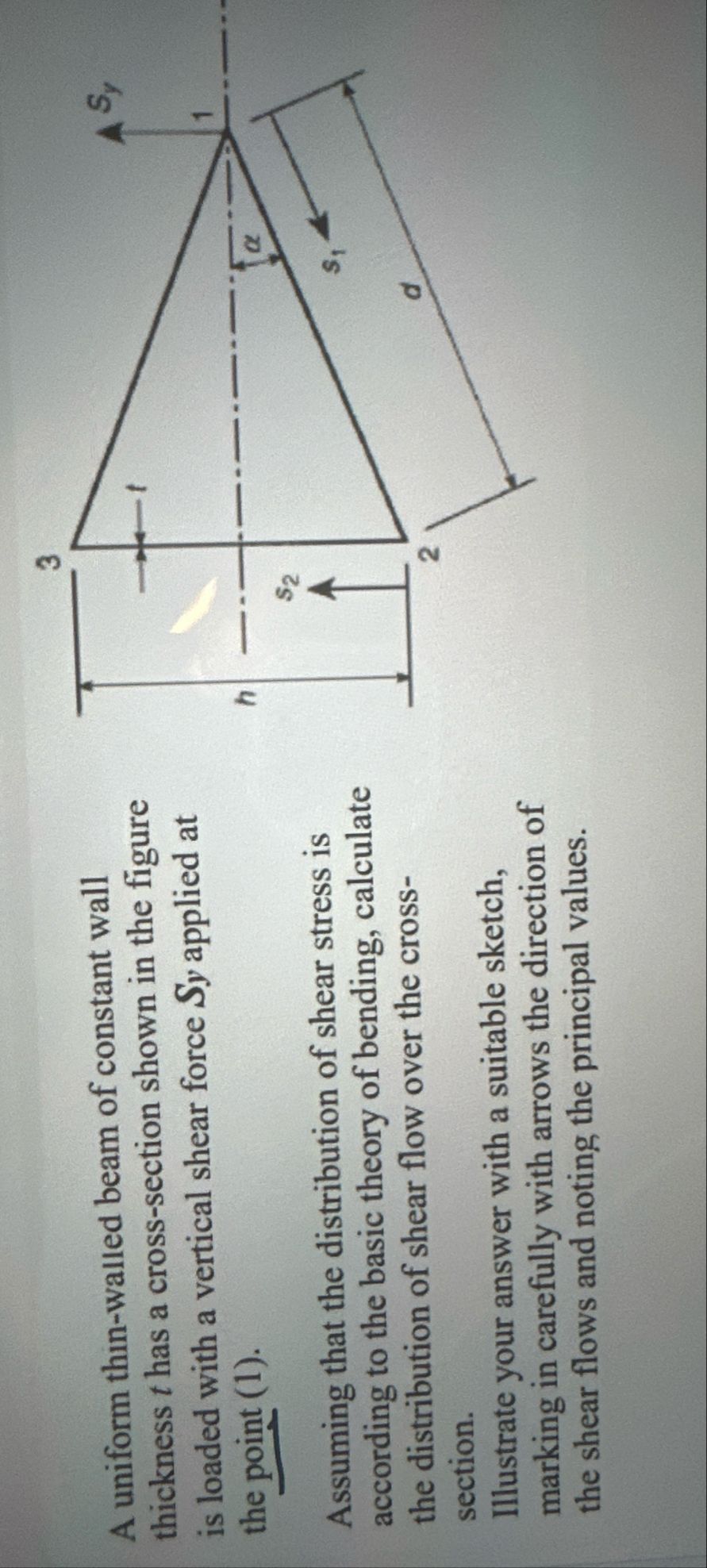 Jord Ep EAE EE aE
7 A+ \ Tl
ee ON TE.
PF FE
© ~ E
. w <
<
0
= = ko)
[+] wn n
£0 A= ag 8
=o wn 9 0 =
= eS DTA hE
Ss ir VO ow 2 «©
Ea RB §5%e ons
- « “ooh BH A
82 523 ddd
824 882 Re5 8
= = = bes
2 9 BO + E a
Sg g “58 2 wh
oe Ses BEa.
Sgy Sr =sEdl
2 2 22 do
wT 77) Ae r= es
7 2 : ERE
Ean 5 “Bedl T -
te 33. 22.2 8
teeta
Soi Tee EB Re
This is AI generated Response.
Asked by: Rahul
Created at: 2026-01-15 02:10:49
Asked by: Rahul
Created at: 2026-01-15 02:10:49
Final Answer:
Rendered
Raw Text
Did you like this answer?
Let's solve the problem step by step:
---
## **Problem Breakdown**
**Given:**
- Thin-walled uniform beam of constant wall thickness \( t \)
- Cross-section is a triangle (vertices 1-2-3, with dimensions marked)
- Vertical shear force \( S_y \) applied at point (1)
- Need to **calculate the distribution of shear flow** over the cross-section using the basic theory of bending.
---
## **Step 1: Understanding Shear Flow in Thin-Walled Sections**
For a thin-walled section, the **shear flow** \( q \) at any point along the wall is:
\[
q = \frac{S_y Q}{I_y t}
\]
where:
- \( S_y \): Applied vertical shear force
- \( Q \): First moment of area about the neutral axis from the considered point to the edge
- \( I_y \): Second moment of area about the neutral axis
- \( t \): Wall thickness
---
## **Step 2: Calculating \( I_y \) for the Section**
For a triangle with base \( h \) and height \( d \):
\[
I_y = \frac{1}{36} h d^3
\]
*(assuming the y-axis passes through the centroid and parallel to the base)*
For thin-walled sections, if the wall is very thin, use the actual cross-section for \( I_y \), but let's stick to the triangle approximation for this illustration.
---
## **Step 3: Calculating Shear Flow (\( q \)) on Each Segment**
Let’s label the triangle:
- **1:** Top vertex
- **2:** Bottom right
- **3:** Bottom left
- **h:** Base width (3-2)
- **d:** Height (from 1 to base 3-2)
### **A. Shear Flow on 1-2 and 1-3 (Inclined Sides)**
#### **First Moment of Area (\( Q \))**
At any point along the wall, \( Q \) is the area above that point times the distance to the neutral axis (centroid).
For a thin-walled triangle, and since the wall thickness is uniform, the **shear flow is constant along each wall**.
#### **B. Shear Flow on 2-3 (Base)**
At the base, \( Q \) is the area of the entire triangle above the base, which is zero just at the bottom edge.
---
## **Step 4: Shear Flow Distribution**
1. **At Vertex 1:** All vertical shear enters at this point, so the shear flow splits into two along the sides 1-2 and 1-3.
2. **Along Sides 1-2 and 1-3:** Shear flow decreases linearly from maximum at 1 to zero at 2 and 3.
3. **Along Base 2-3:** Shear flow is zero at both ends (2 and 3), maximum at the midpoint (if any).
---
## **Step 5: Quantitative Shear Flow Calculation**
Let’s denote:
- Length of side 1-2 = \( l_{12} \)
- Length of side 1-3 = \( l_{13} \)
- Length of base 2-3 = \( h \)
**The sum of the changes in shear flow around the cross-section must sum to zero (equilibrium).**
### **A. Shear Flow on Side 1-2 (\( q_{12} \))**
\[
q_{12}(s) = \frac{S_y}{2 A}
\]
where \( A \) is the area of the triangle.
### **B. Shear Flow on Side 1-3 (\( q_{13} \))**
\[
q_{13}(s) = \frac{S_y}{2 A}
\]
### **C. Shear Flow on Base 2-3 (\( q_{23} \))**
\[
q_{23}(s) =
\]
---
## **Step 6: Sketch and Shear Flow Directions**
- **At point 1:** Incoming \( S_y \), splits equally along 1-2 and 1-3.
- **Along 1-2 and 1-3:** Arrows downward, magnitude \( \frac{S_y}{2 A} \).
- **Along 2-3:** No shear flow.
---
## **Final Answer**
---
### **Shear Flow Distribution**
\[
\boxed{
q_{12} = q_{13} = \frac{S_y}{2 A}, \quad q_{23} =
}
\]
where \( A = \frac{1}{2} h d \) is the area of the triangle.
---
### **Illustration**
- At point 1, shear force \( S_y \) splits into two flows along the sides, each of value \( \frac{S_y}{2A} \).
- The flows travel along the inclined sides toward points 2 and 3.
- No shear flow along the base 2-3.
**Principal values:**
- Maximum at point 1: \( \frac{S_y}{2A} \)
- Zero at base 2-3
---
#### **Summary Table**
| Segment | Shear Flow (\(q\)) | Direction |
|------------|----------------------------|---------------------|
| 1-2 | \( \frac{S_y}{2A} \) | From 1 to 2 |
| 1-3 | \( \frac{S_y}{2A} \) | From 1 to 3 |
| 2-3 | | None |
---
## **Diagram (for illustration)**
```plaintext
1
/ \
/ \
/ \
3-------2
```
- **Arrow from 1 splits down both sides toward 2 and 3.**
---
If you need the detailed derivation with actual area moments for any particular geometry, let me know!
📢 Instructions:
- Ask anything relatd to above question only.
- For new Question goto :