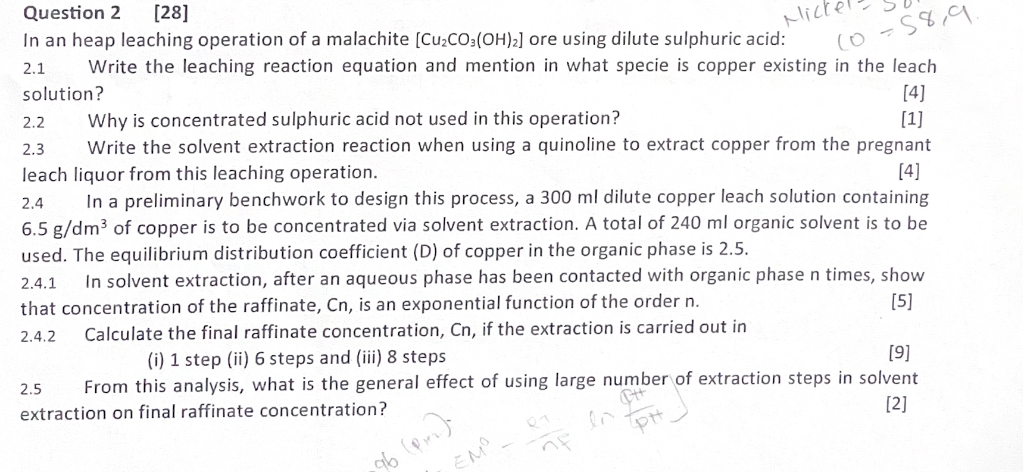
Give step-by-step solution with explanation and final answer:Question2 [28] We 2 Cg aA
In an heap leaching operation of a malachite [Cu,COs(OH);] ore using dilute sulphuric acid: (on? 2
21 Write the leaching reaction equation and mention in what specie is copper existing in the leach
solution? 14]
22 Why is concentrated sulphuric acid not used in this operation? [1]
23 Write the solvent extraction reaction when using a quinoline to extract copper from the pregnant
leach liquor from this leaching operation. [4]
24 In a preliminary benchwork to design this process, a 300 ml dilute copper leach solution containing
6.5 g/dm? of copper is to be concentrated via solvent extraction. A total of 240 ml organic solvent is to be
used. The equilibrium distribution coefficient (D) of copper in the organic phase is 2.5.
241 Insolvent extraction, after an aqueous phase has been contacted with organic phase n times, show
that concentration of the raffinate, Cn, is an exponential function of the order n. [s]
242 Calculate the final raffinate concentration, Cn, if the extraction is carried out in
(i) 1 step (ii) 6 steps and (iii) 8 steps 9]
25 From this analysis, what is the general effect of using large number of extraction steps in solvent
extraction on final raffinate concentration? 5 [2]
Question:
Give step-by-step solution with explanation and final answer:Question2 [28] We 2 Cg aA
In an heap leaching operation of a malachite [Cu,COs(OH);] ore using dilute sulphuric acid: (on? 2
21 Write the leaching reaction equation and mention in what specie is copper existing in the leach
solution? 14]
22 Why is concentrated sulphuric acid not used in this operation? [1]
23 Write the solvent extraction reaction when using a quinoline to extract copper from the pregnant
leach liquor from this leaching operation. [4]
24 In a preliminary benchwork to design this process, a 300 ml dilute copper leach solution containing
6.5 g/dm? of copper is to be concentrated via solvent extraction. A total of 240 ml organic solvent is to be
used. The equilibrium distribution coefficient (D) of copper in the organic phase is 2.5.
241 Insolvent extraction, after an aqueous phase has been contacted with organic phase n times, show
that concentration of the raffinate, Cn, is an exponential function of the order n. [s]
242 Calculate the final raffinate concentration, Cn, if the extraction is carried out in
(i) 1 step (ii) 6 steps and (iii) 8 steps 9]
25 From this analysis, what is the general effect of using large number of extraction steps in solvent
extraction on final raffinate concentration? 5 [2]
This is AI generated Response.
Asked by: Francis
Created at: 2026-01-15 01:07:34
Final Answer:
RenderedRaw Text
Did you like this answer?
Let's solve each part step by step:
---
# **Question 2 Solution**
---
## **2.1 Leaching Reaction and Copper Specie**
**Leaching reaction equation:**
Malachite: \( \ce{Cu2CO3(OH)2} \)
Dilute sulfuric acid: \( \ce{H2SO4} \)
The leaching reaction is:
\[
\ce{Cu2CO3(OH)2 (s) + 2 H2SO4 (aq) -> 2 Cu^{2+} (aq) + 2 SO4^{2-} (aq) + CO2 (g) + 3 H2O (l)}
\]
**Copper specie in solution:**
Copper exists as the **cupric ion (\(\ce{Cu^{2+}}\))** in the leach solution.
---
## **2.2 Why Concentrated Sulphuric Acid Is Not Used**
**Reason:**
Concentrated sulfuric acid is **not used** because it is highly corrosive, poses safety hazards, and can cause excessive dissolution of unwanted gangue minerals, leading to impurities in solution and higher acid consumption. **Dilute acid** is safer, cheaper, and effective for selective copper extraction.
---
## **2.3 Solvent Extraction Reaction with Quinoline**
**General reaction:**
Assume the extractant quinoline (represented as QH) reacts with \(\ce{Cu^{2+}}\):
\[
\ce{Cu^{2+} (aq) + 2 QH (org) <=> CuQ2 (org) + 2 H^+ (aq)}
\]
- Copper(II) ions in aqueous phase react with quinoline in organic phase to form a copper-quinolate complex, which is soluble in organic phase.
---
## **2.4 Benchmark Solvent Extraction**
**Given:**
- Volume of aqueous phase (\(V_a\)) = 300 mL
- Volume of organic phase (\(V_o\)) = 240 mL
- Initial copper concentration (\(C_\)) = 6.5 g/dm³
- Distribution coefficient (\(D\)) = 2.5
---
### **2.4.1 Exponential Equation for Raffinate Concentration**
Let:
- \(C_n\): Copper concentration in aqueous phase after \(n\) stages
- \(C_\): Initial copper concentration
- \(V_a\): Volume of aqueous phase
- \(V_o\): Volume of organic phase
- \(D\): Distribution coefficient (\(D = \frac{\text{[Cu]}_{org}}{\text{[Cu]}_{aq}}\))
**In a single stage:**
Fraction remaining in aqueous phase after one extraction:
\[
\frac{C_1}{C_} = \frac{1}{1 + D \frac{V_o}{V_a}}
\]
**For \(n\) stages:**
\[
\frac{C_n}{C_} = \left( \frac{1}{1 + D \frac{V_o}{V_a}} \right)^n
\]
So,
\[
C_n = C_ \left( \frac{1}{1 + D \frac{V_o}{V_a}} \right)^n
\]
---
### **2.4.2 Calculate Final Raffinate Concentration**
Given:
- \(D = 2.5\)
- \(V_o = 240~\text{ml}\)
- \(V_a = 300~\text{ml}\)
- \(C_ = 6.5~\text{g/dm}^3\)
- \(D \frac{V_o}{V_a} = 2.5 \times \frac{240}{300} = 2.5 \times .8 = 2.\)
So,
\[
\frac{C_n}{C_} = \left( \frac{1}{1 + 2.} \right)^n = \left( \frac{1}{3} \right)^n
\]
- **(i) 1 step (\(n=1\))**
\[
C_1 = 6.5 \left( \frac{1}{3} \right)^1 = 6.5 \times .333 = \boxed{2.17~\text{g/dm}^3}
\]
- **(ii) 6 steps (\(n=6\))**
\[
C_6 = 6.5 \left( \frac{1}{3} \right)^6 = 6.5 \times (.333)^6 \approx 6.5 \times .00137 = \boxed{.00891~\text{g/dm}^3}
\]
- **(iii) 8 steps (\(n=8\))**
\[
C_8 = 6.5 \left( \frac{1}{3} \right)^8 = 6.5 \times (.333)^8 \approx 6.5 \times .000152 = \boxed{.00099~\text{g/dm}^3}
\]
---
## **2.5 Effect of Large Number of Extraction Steps**
**General effect:**
Using a larger number of extraction steps **significantly reduces the final raffinate concentration** (amount of copper left in aqueous phase). Each step removes a fraction of the remaining copper, so more steps mean more complete extraction and lower residual copper in the raffinate.
---
# **Summary Table**
| Steps (\(n\)) | Final Raffinate Conc. (\(C_n\)) (g/dm³) |
|:-------------:|:---------------------------------------:|
| 1 | 2.17 |
| 6 | .00891 |
| 8 | .00099 |
---
**End of Solution.**
VIPSolutions focuses on clear, step‑by‑step explanations so you can learn quickly. Whether you need an AI‑generated walkthrough or a short hint to get unstuck, each solution is organized for fast reading and easy review later.
Search similar questions, compare approaches, and bookmark the best answers for revision. Our goal is simple: quick, reliable study help that feels natural—not noisy.
 VIPSolutions
 Question2 [28] We 2 Cg aA
In an heap leaching operation of a malachite [Cu,COs(OH);] ore using dilute sulphuric acid: (on? 2
21 Write the leaching reaction equation and mention in what specie is copper existing in the leach
solution? 14]
22 Why is concentrated sulphuric acid not used in this operation? [1]
23 Write the solvent extraction reaction when using a quinoline to extract copper from the pregnant
leach liquor from this leaching operation. [4]
24 In a preliminary benchwork to design this process, a 300 ml dilute copper leach solution containing
6.5 g/dm? of copper is to be concentrated via solvent extraction. A total of 240 ml organic solvent is to be
used. The equilibrium distribution coefficient (D) of copper in the organic phase is 2.5.
241 Insolvent extraction, after an aqueous phase has been contacted with organic phase n times, show
that concentration of the raffinate, Cn, is an exponential function of the order n. [s]
242 Calculate the final raffinate concentration, Cn, if the extraction is carried out in
(i) 1 step (ii) 6 steps and (iii) 8 steps 9]
25 From this analysis, what is the general effect of using large number of extraction steps in solvent
extraction on final raffinate concentration? 5 [2]