 VIPSolutions
Give step-by-step solution with explanation and final answer:Q3) The 0.1-1b golf ball is struck by the club and then travels along the trajectory shown. Determine the average impulsive force the club imparts on the ball if the club maintains contact with the ball for 0.5 ms. (15 pts.) So = son E—
Question:
Give step-by-step solution with explanation and final answer: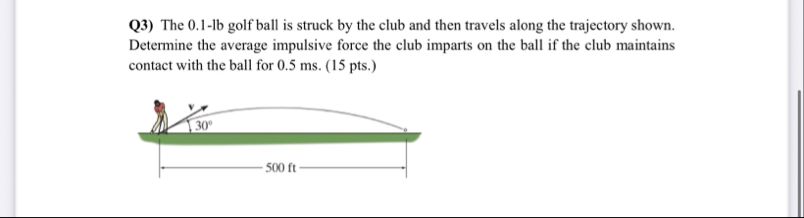 Q3) The 0.1-1b golf ball is struck by the club and then travels along the trajectory shown.
Determine the average impulsive force the club imparts on the ball if the club maintains
contact with the ball for 0.5 ms. (15 pts.)
So =
son E—
This is AI generated Response.
Asked by: Rahul
Created at: 2026-01-14 21:35:37
Asked by: Rahul
Created at: 2026-01-14 21:35:37
Final Answer:
Rendered
Raw Text
Did you like this answer?
Let's break down the problem step by step:
---
## **Given Data**
- Weight of golf ball (\( W \)): **.1 lb**
- Angle of launch (\( \theta \)): **30°**
- Range (\( R \)): **500 ft**
- Time of contact (\( \Delta t \)): **.5 ms = .5 \times 10^{-3} \) s**
---
## **Step 1: Find Initial Velocity (\( v_ \))**
The range for projectile motion is:
\[
R = \frac{v_^2 \sin 2\theta}{g}
\]
Where:
- \( R = 500 \) ft
- \( \theta = 30^\circ \)
- \( g = 32.2 \) ft/s² (standard gravity)
First, calculate \( \sin 2\theta \):
\[
\sin(2 \times 30^\circ) = \sin(60^\circ) = .866
\]
Plug into the range formula and solve for \( v_ \):
\[
500 = \frac{v_^2 \cdot .866}{32.2}
\]
\[
v_^2 = \frac{500 \times 32.2}{.866}
\]
\[
v_^2 = \frac{16100}{.866} \approx 18593.77
\]
\[
v_ = \sqrt{18593.77} \approx 136.34 \text{ ft/s}
\]
---
## **Step 2: Find Change in Momentum (\( \Delta p \))**
First, find the **mass** (\( m \)):
\[
W = mg \implies m = \frac{W}{g} = \frac{.1}{32.2} = .00311 \text{ slugs}
\]
The change in momentum (assuming the initial velocity is ):
\[
\Delta p = m v_
\]
\[
\Delta p = .00311 \times 136.34 \approx .4245 \text{ slug-ft/s}
\]
---
## **Step 3: Average Impulsive Force (\( F_{avg} \))**
Impulse is also:
\[
\text{Impulse} = F_{avg} \Delta t = \Delta p
\]
\[
F_{avg} = \frac{\Delta p}{\Delta t}
\]
\[
\Delta t = .5\, \text{ms} = .0005\, \text{s}
\]
\[
F_{avg} = \frac{.4245}{.0005} = 849 \text{ lb}
\]
---
## **Step 4: Final Answer**
\[
\boxed{F_{avg} = 849 \text{ lb}}
\]
---
### **Summary of Steps**
1. Used range equation to find initial velocity.
2. Converted weight to mass.
3. Used impulse-momentum theorem to find average force.
---
**The average impulsive force imparted by the club to the ball is approximately \( 849 \) lb.**
Question:
Then solved
This is AI generated Response.
Asked by: Rahul
Created at: 2026-01-14 21:36:17
Asked by: Rahul
Created at: 2026-01-14 21:36:17
Final Answer:
Rendered
Raw Text
Did you like this answer?
# Step-by-Step Solution to Impulsive Force of a Golf Club on a Ball
## Given Data
- **Weight of Golf Ball (\( W \))**: 0.1 lb
- **Angle of Launch (\( \theta \))**: 30°
- **Range (\( R \))**: 500 ft
- **Time of Contact (\( \Delta t \))**: 0.5 ms = \( 0.5 \times 10^{-3} \) s
## Step 1: Find Initial Velocity (\( v_ \))
The range formula for projectile motion is given by:
\[
R = \frac{v^2 \sin(2\theta)}{g}
\]
Where:
- \( g \) = 32.2 ft/s² (acceleration due to gravity)
### Calculate \( \sin(2\theta) \)
\[
\sin(2 \times 30^\circ) = \sin(60^\circ) = 0.866
\]
### Solve for \( v_ \)
Substituting known values into the range equation:
\[
500 = \frac{v^2 \cdot 0.866}{32.2}
\]
Rearranging gives:
\[
v^2 = \frac{500 \times 32.2}{0.866}
\]
Calculating:
\[
v^2 \approx \frac{16100}{0.866} \approx 18593.77
\]
\[
v_ \approx \sqrt{18593.77} \approx 136.34 \text{ ft/s}
\]
## Step 2: Find Change in Momentum (\( \Delta p \))
### Convert Weight to Mass
Using the relation \( W = mg \):
\[
m = \frac{W}{g} = \frac{0.1}{32.2} \approx 0.00311 \text{ slugs}
\]
### Calculate Change in Momentum
Assuming the initial velocity is 0, the change in momentum is:
\[
\Delta p = mv_ \approx 0.00311 \times 136.34 \approx 0.4245 \text{ slug-ft/s}
\]
## Step 3: Average Impulsive Force (\( F_{avg} \))
Using the impulse-momentum theorem:
\[
\text{Impulse} = F_{avg} \Delta t = \Delta p
\]
### Solve for \( F_{avg} \)
\[
F_{avg} = \frac{\Delta p}{\Delta t}
\]
Where \( \Delta t = 0.5 \, \text{ms} = 0.0005 \, \text{s} \):
\[
F_{avg} = \frac{0.4245}{0.0005} \approx 849 \text{ lb}
\]
## Final Answer
\[
\boxed{F_{avg} = 849 \text{ lb}}
\]
---
### Summary of Steps
1. Calculated initial velocity using the range formula.
2. Converted weight to mass to find the change in momentum.
3. Applied the impulse-momentum theorem to determine the average force.
**The average impulsive force imparted by the club to the ball is approximately \( 849 \) lb.**
📢 Instructions:
- Ask anything relatd to above question only.
- For new Question goto :