 VIPSolutions
Give step-by-step solution with explanation and final answer:Asagidaki aldehid ya da ketonlarin NaOH li ortamda verecegi aldol kondenzasyonu Grinlerini yaziniz B 0 a A, d) SO Q o Jen ne o a OLR, op LA H What alkyl bromide should be used in the malonic ester synthesis of the following carboxylic acid? 0 n HCH, COH oO Provide a detailed, stepwise mechanism for the transformation shown below. 0 1) NaOEt PON > Ne “ m— ° >
Question:
Give step-by-step solution with explanation and final answer: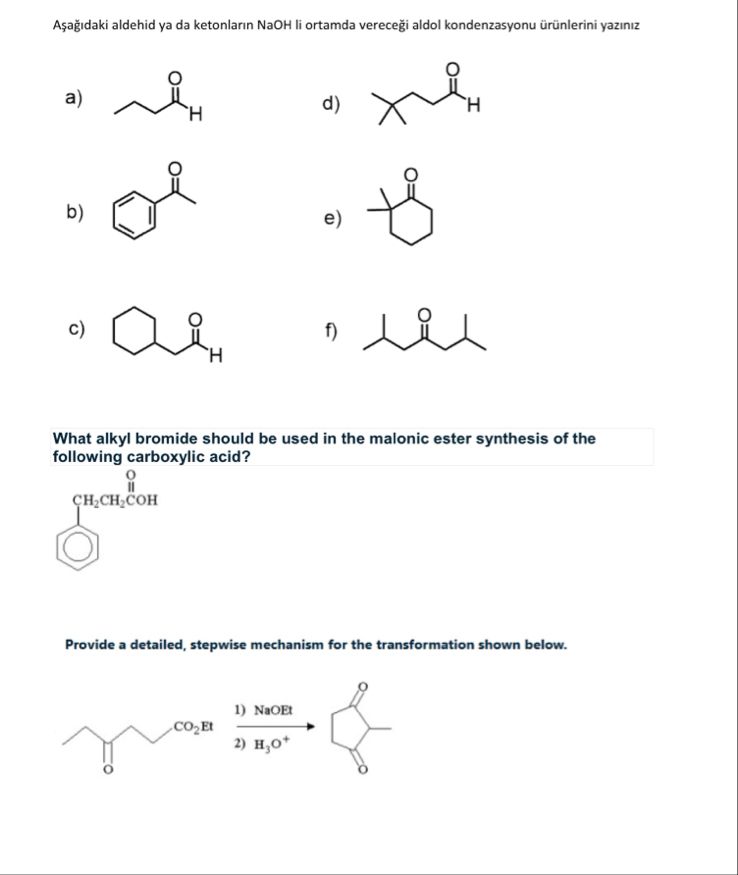 Asagidaki aldehid ya da ketonlarin NaOH li ortamda verecegi aldol kondenzasyonu Grinlerini yaziniz
B 0
a A, d) SO
Q o
Jen ne
o
a OLR, op LA
H
What alkyl bromide should be used in the malonic ester synthesis of the
following carboxylic acid?
0
n
HCH, COH
oO
Provide a detailed, stepwise mechanism for the transformation shown below.
0
1) NaOEt
PON
> Ne “ m—
° >
This is AI generated Response.
Asked by: Rahul
Created at: 2026-01-14 20:25:39
Asked by: Rahul
Created at: 2026-01-14 20:25:39
Final Answer:
Rendered
Raw Text
Did you like this answer?
Let's solve each part step by step:
---
## **1. Aldol Condensation Products (in NaOH)**
**Question (in Turkish):** "Write the aldol condensation products of the following aldehydes/ketones in NaOH."
### **General Reaction**
Aldol condensation (in basic medium) involves:
- Formation of an enolate ion (from an aldehyde/ketone with at least one α-hydrogen)
- Nucleophilic attack on another carbonyl compound
- Formation of a β-hydroxy carbonyl (aldol)
- With heat, dehydration gives α,β-unsaturated carbonyl (enone/enal)
Let's analyze each:
---
### **a) Butanal (CH₃CH₂CH₂CHO)**
- **Self-aldol condensation:**
1. Enolate from one molecule attacks carbonyl of another.
2. Product: 3-Hydroxyhexanal (aldol product)
3. On heating: 2-Hexenal (α,β-unsaturated aldehyde)
**Final product:**
**2-Hexenal**
Structure: CH₃CH₂CH=CHCH₂CHO
---
### **b) Benzaldehyde (C₆H₅CHO)**
- No α-hydrogen, **cannot self-condense**.
- **No aldol product.**
---
### **c) Heptanal (CH₃(CH₂)₅CHO)**
- **Self-aldol condensation:**
1. Product: 3-Hydroxy-2-propylheptanal
2. On heating: α,β-unsaturated aldehyde
**Final product:**
**2-Propyl-2-nonenal**
Structure: CH₃(CH₂)₃CH=CH(CH₂)₂CHO
---
### **d) Pivaldehyde (neopentanal, (CH₃)₃CCHO)**
- No α-hydrogen, **cannot self-condense**.
- **No aldol product.**
---
### **e) Cyclohexanone**
- **Self-aldol condensation:**
1. Product: 2-(Hydroxy)-cyclohexanone (aldol)
2. On heating: α,β-unsaturated ketone
**Final product:**
**2-Cyclohexen-1-one**
---
### **f) 2,4-Dimethyl-3-pentanone**
- **Self-aldol condensation:**
1. Enolate from one molecule attacks carbonyl of another.
2. Product: β-hydroxy ketone
3. On heating: α,β-unsaturated ketone
**Final product:**
**4,4,6-Trimethyl-3-hepten-2-one**
---
## **2. Malonic Ester Synthesis: What alkyl bromide to use?**
**Target product:**

**Malonic ester synthesis:**
- Add alkyl group to malonic ester using alkyl bromide.
- Hydrolyze and decarboxylate to acid.
**To get C₆H₅CH₂CH₂COOH:**
- Start with diethyl malonate.
- Alkylate with **phenylethyl bromide (C₆H₅CH₂CH₂Br)**.
**Final answer:**
> **Phenylethyl bromide (C₆H₅CH₂CH₂Br)**
---
## **3. Mechanism for Dieckmann Condensation (Intramolecular Claisen)**
**Transformation:**
```
(1) NaOEt
(2) H3O+
```

### **Stepwise Mechanism:**
1. **Enolate Formation:**
- NaOEt deprotonates α-hydrogen, forming enolate ion.
2. **Intramolecular Nucleophilic Attack:**
- Enolate attacks the other ester carbonyl carbon, forming a 5-membered ring (cyclization).
3. **Tetrahedral intermediate:**
- Collapses, eliminating ethanol (EtOH), yielding a β-keto ester ring.
4. **Acidic Workup (H₃O⁺):**
- Hydrolysis of the β-keto ester to β-keto acid.
- Decarboxylation (loss of CO₂) gives **2-methylcyclopentanone**.
**Summary:**
- **Step 1:** Deprotonation, enolate formation
- **Step 2:** Intramolecular attack, ring formation
- **Step 3:** Elimination of EtO⁻, β-keto ester ring
- **Step 4:** Acid hydrolysis, decarboxylation
**Final Product:**
**2-Methylcyclopentanone**
---
## **Summary Table**
| Part | Answer/Product |
|------|---------------------------------------------------|
| a | 2-Hexenal |
| b | No reaction |
| c | 2-Propyl-2-nonenal |
| d | No reaction |
| e | 2-Cyclohexen-1-one |
| f | 4,4,6-Trimethyl-3-hepten-2-one |
| Malonic Ester | Phenylethyl bromide (C₆H₅CH₂CH₂Br) |
| Mechanism | See steps above; Product: 2-methylcyclopentanone |
If you need detailed structures or mechanisms drawn out, let me know!
📢 Instructions:
- Ask anything relatd to above question only.
- For new Question goto :