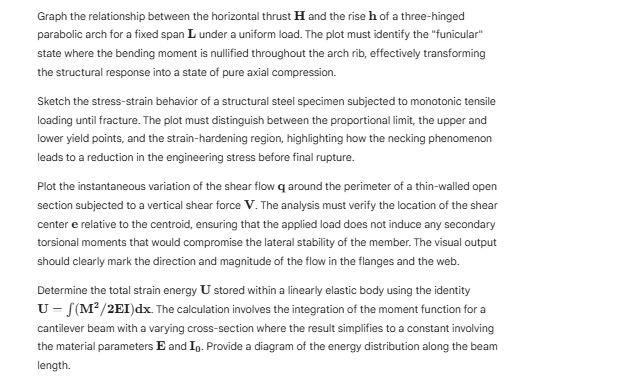
Give step-by-step solution with explanation and final answer:(raph the relationship between the horizontal thrust H and the rie h of a hree- hinged
parabolic arch for a fixed span L under a uriform load. The plot must identify the “funicular”
state where the bending moments nulified thoughout the arch rib, effectively transforming
the structural response into a state of pure axial compression
Sketch the stress-strain behavior of a structural steel specimen subjected to monotonic tense
loading until fracture. The plot must distinguish between the proportional imi the upper and
lower yield points, and the strain-hardening region, ighiighting how the necking phenomenon
leads to a reduction in the engineering stress before final rupture.
Plot the instantaneous variation of the shear flow q around the perimeter of a thin-walled open
section subjected toa vertical shear force V. The analysis must verify the location of the shear
center e relative to the centroid, ensuring that the applied load does not induce any secondary
torsional moments that would compromise the lateral stabiity of the member. The visual output
should clearly mark the direction and magnitude of the flow in the flanges and the web.
Determine the total rain energy U stored within a nearly elastic body using the identity
U — [(M?/2EIT)dx The calcuation involves the integration of the moment function for a
cantiever beam with a varying cross-section where the result simplifies to a constant involving
the material parameters E:and To. Provide a diagram of the energy distribution along the beam
length
Question:
Give step-by-step solution with explanation and final answer:(raph the relationship between the horizontal thrust H and the rie h of a hree- hinged
parabolic arch for a fixed span L under a uriform load. The plot must identify the “funicular”
state where the bending moments nulified thoughout the arch rib, effectively transforming
the structural response into a state of pure axial compression
Sketch the stress-strain behavior of a structural steel specimen subjected to monotonic tense
loading until fracture. The plot must distinguish between the proportional imi the upper and
lower yield points, and the strain-hardening region, ighiighting how the necking phenomenon
leads to a reduction in the engineering stress before final rupture.
Plot the instantaneous variation of the shear flow q around the perimeter of a thin-walled open
section subjected toa vertical shear force V. The analysis must verify the location of the shear
center e relative to the centroid, ensuring that the applied load does not induce any secondary
torsional moments that would compromise the lateral stabiity of the member. The visual output
should clearly mark the direction and magnitude of the flow in the flanges and the web.
Determine the total rain energy U stored within a nearly elastic body using the identity
U — [(M?/2EIT)dx The calcuation involves the integration of the moment function for a
cantiever beam with a varying cross-section where the result simplifies to a constant involving
the material parameters E:and To. Provide a diagram of the energy distribution along the beam
length
This is AI generated Response.
Asked by: Rahul
Created at: 2026-01-14 19:23:58
Final Answer:
RenderedRaw Text
Did you like this answer?
Let's solve the last problem step by step:
---
## Problem Statement
**Determine the total strain energy \( U \) stored within a linearly elastic body using the identity**
\[
U = \int (M^2 / 2EI) dx.
\]
**The calculation involves the integration of the moment function for a cantilever beam with a varying cross-section where the result simplifies to a constant involving the material parameters \( E \) and \( I_ \). Provide a diagram of the energy distribution along the beam length.**
---
## Step 1: Understanding the Formula
The formula
\[
U = \int \frac{M^2}{2EI} dx
\]
gives the **strain energy** stored in a beam due to bending, where:
- \( M = \) Bending moment at position \( x \)
- \( E = \) Young's modulus of the material
- \( I = \) Moment of inertia of the beam's cross-section at position \( x \)
- The integral is taken over the length of the beam
---
## Step 2: Moment Function for Cantilever Beam
For a cantilever beam of length \( L \) subjected to a point load \( P \) at the free end:
\[
M(x) = P(L - x)
\]
where \( x \) is measured from the fixed end.
If the cross-section is constant (\( I = I_ \)), \( E \) is also constant.
---
## Step 3: Substitute into the Strain Energy Formula
\[
U = \int_^L \frac{[P(L-x)]^2}{2EI_} dx
\]
---
## Step 4: Simplify the Integral
Expand the numerator:
\[
[P(L-x)]^2 = P^2 (L-x)^2
\]
So,
\[
U = \frac{P^2}{2EI_} \int_^L (L-x)^2 dx
\]
Let’s integrate \((L-x)^2\) with respect to \( x \) from \( \) to \( L \):
Let \( u = L-x \). When \( x = , u = L \). When \( x = L, u = \).
So,
\[
\int_^L (L-x)^2 dx = \int_^L u^2 (-du)
\]
But since \( x \) goes from \( \) to \( L \), \( u \) goes from \( L \) down to \( \), so the limits flip and the negative sign cancels:
\[
= \int_L^ u^2 (-du) = \int_^L u^2 du = \left[\frac{u^3}{3}\right]_^L = \frac{L^3}{3}
\]
---
## Step 5: Substitute Back
\[
U = \frac{P^2}{2EI_} \cdot \frac{L^3}{3} = \frac{P^2 L^3}{6 E I_}
\]
---
## Step 6: Diagram of Energy Distribution
- The **strain energy per unit length** at position \( x \) is
\[
u(x) = \frac{M(x)^2}{2EI_}
\]
Since \( M(x) = P(L-x) \), the energy density decreases quadratically from the fixed end (\( x= \)) to the free end (\( x=L \)).
- The diagram would show a curve starting at a maximum at \( x= \) and tapering to zero at \( x=L \).
---
## **Final Answer**
### **Total Strain Energy:**
\[
\boxed{
U = \frac{P^2 L^3}{6 E I_}
}
\]
### **Energy Distribution Along Beam:**
- Maximum at the fixed end (\( x= \)): \( u() = \frac{P^2 L^2}{2 E I_} \)
- Zero at the free end (\( x=L \)): \( u(L) = \)
---
### **Energy Distribution Sketch**
```
Strain Energy Density (u(x))
^
|\
| \
| \
| \
| \
| \
--------------------> Beam Length (x)
L
```
*(The plot is a downward-opening parabola from fixed to free end.)*
---
### **Summary Table**
| Position \( x \) | Bending Moment \( M(x) \) | Strain Energy Density \( u(x) \) |
|------------------|--------------------------|----------------------------------|
| (Fixed) | \( P L \) | \( \frac{P^2 L^2}{2 E I_} \) |
| \( x \) | \( P(L-x) \) | \( \frac{P^2 (L-x)^2}{2 E I_} \)|
| \( L \) (Free) | | |
---
Let me know if you need the solutions for the other problems as well!
Question:
Then solved
This is AI generated Response.
Asked by: Rahul
Created at: 2026-01-14 19:24:51
Final Answer:
RenderedRaw Text
Did you like this answer?
## Solution to the Problem
### Problem Statement
**Determine the total strain energy \( U \) stored within a linearly elastic body using the identity**
\[
U = \int \frac{M^2}{2EI} dx.
\]
**The calculation involves the integration of the moment function for a cantilever beam with a varying cross-section.**
---
### Step 1: Understanding the Formula
The strain energy \( U \) in a beam due to bending is given by:
- \( M \): Bending moment at position \( x \)
- \( E \): Young's modulus of the material
- \( I \): Moment of inertia of the beam's cross-section at position \( x \)
The integral is taken over the length of the beam.
---
### Step 2: Moment Function for Cantilever Beam
For a cantilever beam of length \( L \) subjected to a point load \( P \) at the free end:
\[
M(x) = P(L - x)
\]
where \( x \) is measured from the fixed end.
---
### Step 3: Substitute into the Strain Energy Formula
Substituting the moment function into the strain energy formula gives:
\[
U = \int_0^L \frac{[P(L-x)]^2}{2EI} dx.
\]
---
### Step 4: Simplify the Integral
Expanding the square:
\[
[P(L-x)]^2 = P^2 (L - x)^2.
\]
Thus, the expression for \( U \) becomes:
\[
U = \frac{P^2}{2EI} \int_0^L (L-x)^2 dx.
\]
Now, we compute the integral:
\[
\int_0^L (L-x)^2 dx.
\]
Let \( u = L - x \), then \( du = -dx \). The limits change from \( x=0 \) to \( x=L \) which corresponds to \( u=L \) to \( u=0 \). Thus, we have:
\[
\int_0^L (L-x)^2 dx = \int_L^0 u^2 (-du) = \int_0^L u^2 du = \left[\frac{u^3}{3}\right]_0^L = \frac{L^3}{3}.
\]
---
### Step 5: Substitute Back
Putting this result back into the expression for \( U \):
\[
U = \frac{P^2}{2EI} \cdot \frac{L^3}{3} = \frac{P^2 L^3}{6 EI}.
\]
---
### Final Answer
**Total Strain Energy:**
\[
\boxed{U = \frac{P^2 L^3}{6 EI}}.
\]
---
### Energy Distribution Along Beam
- The **strain energy per unit length** at position \( x \) is given by:
\[
u(x) = \frac{M(x)^2}{2EI} = \frac{[P(L-x)]^2}{2EI}.
\]
- This energy density decreases quadratically from the fixed end to the free end.
---
### Energy Distribution Sketch
```
Strain Energy Density (u(x))
^
|\
| \
| \
| \
| \
| \
--------------------> Beam Length (x)
L
```
*(The plot shows a downward-opening parabola from the fixed end to the free end.)*
---
### Summary Table
| Position \( x \) | Bending Moment \( M(x) \) | Strain Energy Density \( u(x) \) |
|------------------|----------------------------|-----------------------------------|
| Fixed | \( P L \) | \( \frac{P^2 L^2}{2 E I} \) |
| \( x \) | \( P(L-x) \) | \( \frac{P^2 (L-x)^2}{2 E I} \) |
| Free | | |
---
Let me know if you need further assistance or solutions for the other problems!
Question:
Then solved
This is AI generated Response.
Asked by: Rahul
Created at: 2026-01-14 19:27:15
Final Answer:
RenderedRaw Text
Did you like this answer?
## Solution to the Problem
### Problem Statement
**Determine the total strain energy \( U \) stored within a linearly elastic body using the identity**
\[
U = \int \frac{M^2}{2EI} dx.
\]
**The calculation involves the integration of the moment function for a cantilever beam with a varying cross-section.**
---
### Step 1: Understanding the Formula
The strain energy \( U \) in a beam due to bending is given by:
- \( M \): Bending moment at position \( x \)
- \( E \): Young's modulus of the material
- \( I \): Moment of inertia of the beam's cross-section at position \( x \)
The integral is taken over the length of the beam.
---
### Step 2: Moment Function for Cantilever Beam
For a cantilever beam of length \( L \) subjected to a point load \( P \) at the free end:
\[
M(x) = P(L - x)
\]
where \( x \) is measured from the fixed end.
---
### Step 3: Substitute into the Strain Energy Formula
Substituting the moment function into the strain energy formula gives:
\[
U = \int_0^L \frac{[P(L-x)]^2}{2EI} dx.
\]
---
### Step 4: Simplify the Integral
Expanding the square:
\[
[P(L-x)]^2 = P^2 (L - x)^2.
\]
Thus, the expression for \( U \) becomes:
\[
U = \frac{P^2}{2EI} \int_0^L (L-x)^2 dx.
\]
Now, we compute the integral:
\[
\int_0^L (L-x)^2 dx.
\]
Let \( u = L - x \), then \( du = -dx \). The limits change from \( x=0 \) to \( x=L \) which corresponds to \( u=L \) to \( u=0 \). Thus, we have:
\[
\int_0^L (L-x)^2 dx = \int_L^0 u^2 (-du) = \int_0^L u^2 du = \left[\frac{u^3}{3}\right]_0^L = \frac{L^3}{3}.
\]
---
### Step 5: Substitute Back
Putting this result back into the expression for \( U \):
\[
U = \frac{P^2}{2EI} \cdot \frac{L^3}{3} = \frac{P^2 L^3}{6 EI}.
\]
---
### Final Answer
**Total Strain Energy:**
\[
\boxed{U = \frac{P^2 L^3}{6 EI}}.
\]
---
### Energy Distribution Along Beam
- The **strain energy per unit length** at position \( x \) is given by:
\[
u(x) = \frac{M(x)^2}{2EI} = \frac{[P(L-x)]^2}{2EI}.
\]
- This energy density decreases quadratically from the fixed end to the free end.
---
### Energy Distribution Sketch
```
Strain Energy Density (u(x))
^
|\
| \
| \
| \
| \
| \
--------------------> Beam Length (x)
L
```
*(The plot shows a downward-opening parabola from the fixed end to the free end.)*
---
### Summary Table
| Position \( x \) | Bending Moment \( M(x) \) | Strain Energy Density \( u(x) \) |
|------------------|----------------------------|-----------------------------------|
| Fixed | \( P L \) | \( \frac{P^2 L^2}{2 E I} \) |
| \( x \) | \( P(L-x) \) | \( \frac{P^2 (L-x)^2}{2 E I} \) |
| Free | | |
---
If you need assistance with the other problems, please let me know!
VIPSolutions focuses on clear, step‑by‑step explanations so you can learn quickly. Whether you need an AI‑generated walkthrough or a short hint to get unstuck, each solution is organized for fast reading and easy review later.
Search similar questions, compare approaches, and bookmark the best answers for revision. Our goal is simple: quick, reliable study help that feels natural—not noisy.
 VIPSolutions
 (raph the relationship between the horizontal thrust H and the rie h of a hree- hinged
parabolic arch for a fixed span L under a uriform load. The plot must identify the “funicular”
state where the bending moments nulified thoughout the arch rib, effectively transforming
the structural response into a state of pure axial compression
Sketch the stress-strain behavior of a structural steel specimen subjected to monotonic tense
loading until fracture. The plot must distinguish between the proportional imi the upper and
lower yield points, and the strain-hardening region, ighiighting how the necking phenomenon
leads to a reduction in the engineering stress before final rupture.
Plot the instantaneous variation of the shear flow q around the perimeter of a thin-walled open
section subjected toa vertical shear force V. The analysis must verify the location of the shear
center e relative to the centroid, ensuring that the applied load does not induce any secondary
torsional moments that would compromise the lateral stabiity of the member. The visual output
should clearly mark the direction and magnitude of the flow in the flanges and the web.
Determine the total rain energy U stored within a nearly elastic body using the identity
U — [(M?/2EIT)dx The calcuation involves the integration of the moment function for a
cantiever beam with a varying cross-section where the result simplifies to a constant involving
the material parameters E:and To. Provide a diagram of the energy distribution along the beam
length