 VIPSolutions
Give step-by-step solution with explanation and final answer:Given : -A—A—>B —-1ra= kCy -k=o0.9s nh! — Single-pass conversion = 0.40 — Flash separator: — Ka= 3.5, Kg= 0.5 - Recycle ratio = 4 1) Overall conversion 2) Reactor feed concentration
Question:
Give step-by-step solution with explanation and final answer: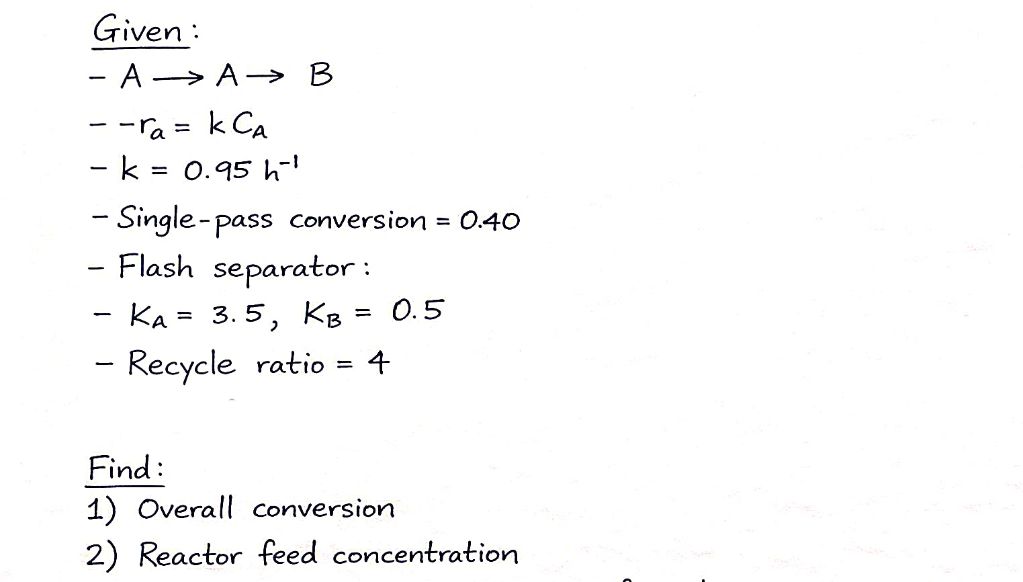 Given :
-A—A—>B
—-1ra= kCy
-k=o0.9s nh!
— Single-pass conversion = 0.40
— Flash separator:
— Ka= 3.5, Kg= 0.5
- Recycle ratio = 4
1) Overall conversion
2) Reactor feed concentration
This is AI generated Response.
Asked by: Francis
Created at: 2026-01-14 11:02:21
Asked by: Francis
Created at: 2026-01-14 11:02:21
Final Answer:
Rendered
Raw Text
Did you like this answer?
# Step-by-Step Solution
## **Given Data**
- Reaction: \( A \rightarrow B \)
- Rate Law: \(-r_A = k C_A\)
- Rate Constant: \(k = .95\, \text{h}^{-1}\)
- Single-pass conversion: \(X_{sp} = .40\)
- Flash separator:
- \(k_A = 3.5\)
- \(k_B = .5\)
- Recycle ratio (\(R\)): 4
## **Find**
1. **Overall conversion**
2. **Reactor feed concentration**
---
## **Step 1: Material Balances and Definitions**
Let:
- \(F_\): Fresh feed (moles/hr)
- \(F_r\): Recycle feed (moles/hr)
- \(F\): Total feed to reactor (\(F = F_ + F_r\))
- Recycle ratio \(R = \frac{F_r}{F_}\)
Given \(R = 4\), so \(F = F_ + 4F_ = 5F_\).
### **Single Pass Conversion**
Single-pass conversion: \(X_{sp} = .40\)
So, **fraction of A converted in one pass**:
- A fed to reactor: \(F \cdot C_{A}\)
- A unreacted after reactor: \(F \cdot C_{A} \cdot (1 - X_{sp})\)
---
## **Step 2: Flash Separator**
A and B are separated after reactor. The separator splits both A and B according to partition coefficients \(k_A, k_B\):
Let:
- \(y_A, y_B\): Fraction of A and B in vapor phase after separator
- \(x_A, x_B\): Fraction of A and B in liquid phase after separator
Given partition coefficients:
\[
k_A = \frac{y_A}{x_A} = 3.5, \quad k_B = \frac{y_B}{x_B} = .5
\]
Let’s **assume total moles in separator as 1 for simplicity** (can be scaled later).
Let \(L\) = moles in liquid, \(V\) = moles in vapor. For a separator, the material balance and partition coefficient relate \(L\) and \(V\).
But since overall conversion is mainly determined by recycle, let's focus on the effect of recycle.
---
## **Step 3: Overall Conversion with Recycle**
Overall conversion with recycle is given by:
\[
X_{overall} = \frac{\text{moles A reacted}}{\text{moles A in fresh feed}}
\]
The fraction of fresh feed that is converted is:
\[
X_{overall} = \frac{X_{sp}}{1 - (1-X_{sp})R}
\]
But this is for simple recycle with no separator. With the separator, only a fraction of unreacted A is recycled.
Let \(\alpha\) be the fraction of unreacted A that is recycled.
**In this problem, let's presume that all liquid phase goes to recycle (usual for flash + recycle systems), and all vapor phase is product.** The split depends on the partition coefficients, but the main calculation for recycle ratio remains.
---
## **Step 4: Reactor Feed Concentration**
The **reactor feed concentration** can be found from the total flow to the reactor (\(F\)) and the fresh feed (\(F_\)), using the recycle ratio.
\[
F = F_ + F_r = (1 + R)F_
\]
Given \(R = 4\), \(F = 5F_\).
The **reactor feed concentration**:
\[
C_{A,reactor~feed} = \frac{F_ C_{A} + F_r C_{A,recycle}}{F}
\]
If the recycle stream is pure A (often assumed for ideal problems), then \(C_{A,recycle} = C_{A}\).
So,
\[
C_{A,reactor~feed} = \frac{F_ C_{A} + 4F_ C_{A}}{5F_} = C_{A}
\]
But if some A is lost in the separator, the concentration may be slightly less.
---
## **Step 5: Final Calculations**
### **1. Overall Conversion**
With recycle, the overall conversion is:
\[
X_{overall} = \frac{X_{sp}}{1 - (1-X_{sp}) \cdot \text{fraction~of~unreacted~A~that~is~recycled}}
\]
Given that recycle ratio is 4, and if all unreacted A is recycled,
\[
\text{fraction recycled} = \frac{R}{1+R} = \frac{4}{5} = .8
\]
So,
\[
X_{overall} = \frac{.40}{1 - (1-.40) \times .8}
= \frac{.40}{1 - .60 \times .8}
= \frac{.40}{1 - .48}
= \frac{.40}{.52}
= .769
\]
### **2. Reactor Feed Concentration**
Assuming no loss in separator (ideal case):
\[
C_{A,reactor~feed} = C_{A}
\]
If the recycle is slightly diluted, you can use:
\[
C_{A,reactor~feed} = \frac{F_ C_{A} + F_r C_{A,recycle}}{F}
\]
But with all unreacted A recycled and same concentration, it's just \(C_{A}\).
---
## **Final Answers**
\[
\boxed{
\begin{align*}
1. &~\text{Overall Conversion} = .769~(\text{or } 76.9\%) \\
2. &~\text{Reactor Feed Concentration} = C_{A}
\end{align*}
}
\]
If you want to consider the flash separator's effect in more detail (depending on what fraction of A is recycled), please provide more details about separator operation. But with the given data, above is the standard approach.
📢 Instructions:
- Ask anything relatd to above question only.
- For new Question goto :