This is AI generated Response.
Asked by: Francis
Created at: 2026-01-13 19:44:49
Final Answer:
RenderedRaw Text
Did you like this answer?
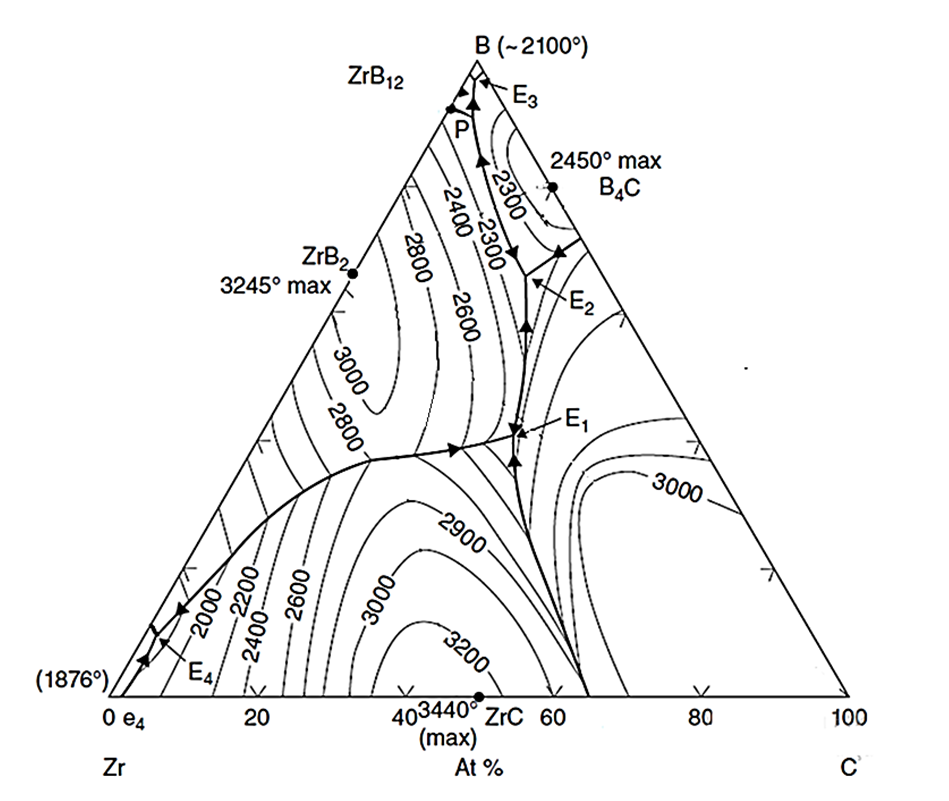
Let's solve each part step by step using the provided **Zr-C-B ternary phase diagram**.
---
## a) **Propose a Suitable Composition (Zr, ZrC, ZrB₂, ≤30 at.% Liquid)**
### **Step 1: Identify Phase Regions**
- You want a mixture of **Zr, ZrC, ZrB₂** with up to **30% liquid** during sintering.
- On the diagram:
- **Zr**: bottom-left corner
- **ZrC**: bottom-right (labeled 344°C)
- **ZrB₂**: upper left (labeled 3245°C)
### **Step 2: Locate Suitable Region**
- For all three solids to coexist, select a composition near the triangle connecting Zr, ZrC, and ZrB₂.
- Find where this triangle lies just inside (or near) the liquid phase field for up to 30% liquid.
### **Step 3: Choose a Composition**
- Example: A point near Zr (say 40 at.%), ZrC (30 at.%), ZrB₂ (30 at.%).
- Check the diagram: This point is near the lower center, inside the 260–280°C isotherms, close to the boundary where a liquid phase appears.
- At slightly above 260°C, a small amount of liquid can form.
### **Step 4: Justify**
- This composition (Zr 40, ZrC 30, ZrB₂ 30 at.%) will:
- Be in the three-phase solid region (Zr, ZrC, ZrB₂) just before melting.
- On heating, up to 30% liquid will form around 260–270°C.
---
## b) **30C-30B-40Zr (at.%) Sintering at 260°C: First Liquid Phase?**
### **Step 1: Locate Composition**
- Find point: 40% Zr, 30% C, 30% B.
- This is close to the center of the triangle.
### **Step 2: Find Liquidus Temperature**
- Find the **lowest temperature contour line** that passes through this point.
- The point is between the **260°C and 280°C** contours, but closer to 260°C.
**→ The first liquid appears at ~260°C.**
### **Step 3: Amount of First Liquid**
- At the temperature where liquid first appears (solidus), the amount of liquid is **just barely above zero**.
- To find the amount at a specific higher temperature (e.g., 260°C), use the lever rule between the solidus and liquidus lines.
- Since your point is almost exactly on the 260°C contour, the amount of liquid at 260°C is **almost zero** (incipient melting).
- As temperature increases above 260°C, the liquid fraction increases.
---
## c) **Can You Use 5C-80B-15Zr (at.%) at 240°C? (≤10 at.% Liquid Allowed)**
### **Step 1: Locate Composition**
- 5% C, 80% B, 15% Zr.
- This point is near the top of the triangle (near B).
### **Step 2: Check Isotherms**
- The **240°C isotherm** passes below this point.
- This means at 240°C, the composition is **above the solidus** and **inside the liquid phase region**.
### **Step 3: Estimate Liquid Fraction**
- Since the point is clearly above the solidus at 240°C, a significant amount of liquid will form.
- Likely, **much more than 10 at.% liquid** will be present at 240°C.
**→ It is **not possible** to use this UHTC at 240°C if you require ≤10 at.% liquid.**
---
## **Final Answers Summary**
### a) **Suitable composition:**
- **Zr 40 at.%, ZrC 30 at.%, ZrB₂ 30 at.%**
(Ensures coexistence of three solids with up to 30% liquid during sintering.)
### b) **30C-30B-40Zr at 260°C:**
- **First liquid forms at:** ~**260°C**
- **Amount of first liquid at 260°C:** **Almost zero** (incipient melting; increases above 260°C)
### c) **5C-80B-15Zr at 240°C:**
- **Not possible** to use this composition at 240°C if liquid phase must be ≤10 at.%, because a much larger liquid fraction will be present.
---
**If you need detailed lever rule calculations or further phase fraction estimates, let me know!**
VIPSolutions focuses on clear, step‑by‑step explanations so you can learn quickly. Whether you need an AI‑generated walkthrough or a short hint to get unstuck, each solution is organized for fast reading and easy review later.
Search similar questions, compare approaches, and bookmark the best answers for revision. Our goal is simple: quick, reliable study help that feels natural—not noisy.
 VIPSolutions
 B (~2100°)
ZB 0
B12 A Eq
P
2450° max
2 \3 B,C
ze, /\ B\ \§ 7
3245° max < \ V
fer}
\ 3
[22 .
\%
©,
SD. J
2) N
4 »
S/o
Heals §
aia
~ 2)
wor) Ef | [® 2
Oey 20 403440° 7c 60 80 100
(max)
zr At% c