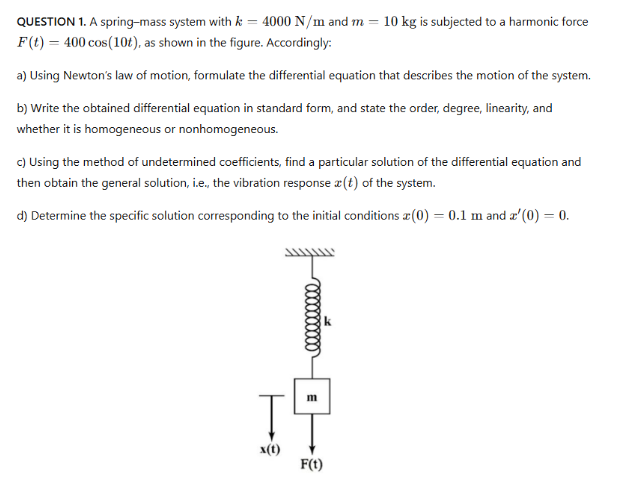
Give step-by-step solution with explanation and final answer:‘QUESTION 1. A sprng-mass system with k = 4000 N/m and mm = 10 ke is subjected to a hamoric force
F(t) = 400 cos(101). as shown in the figure. Accordingly:
2) Using Newton's law of motion, formulate the differential equation that describes the motion of the system.
b) Write the obtained differential equation in standard form, and state the order, degree, linearity, and
whether its homogeneous or nonhomogeneous.
©) Using the method of undetermined coefficients, find a particular solution of the differential equation and
then obtain the general solution, ie. the vibration response z(t) of the system.
@) Determine the specific solution corresponding to th inital conditions 2(0) = 0.1 m and #/(0) = 0.
| Kk
a)
F(t)
Question:
Give step-by-step solution with explanation and final answer:
This is AI generated Response. Asked by: Rahul Created at: 2026-01-13 15:40:41
Did you like this answer?
👍 0
👎 0
Let's address each part step by step:
---
## **a) Formulate the Differential Equation**
### **Using Newton's Law of Motion:**
Newton’s second law:
\[
F = m a = m \frac{d^2 x}{dt^2}
\]
For the spring-mass system:
- **Spring force:** \( F_s = -kx \) (restoring force)
- **External force:** \( F(t) = 400 \cos(10t) \)
Sum of forces:
\[
m \frac{d^2 x}{dt^2} = -kx + F(t)
\]
Substitute the given values:
- \( m = 10\, \text{kg} \)
- \( k = 400\, \text{N/m} \)
- \( F(t) = 400 \cos(10t) \)
\[
10 \frac{d^2 x}{dt^2} = -400x + 400 \cos(10t)
\]
---
## **b) Write in Standard Form and State Properties**
### **Standard Form:**
\[
\frac{d^2 x}{dt^2} + 400x = 40 \cos(10t)
\]
(Divide both sides by 10)
### **Properties:**
- **Order:** 2 (second-order)
- **Degree:** 1 (highest power of derivative is 1)
- **Linearity:** Linear (no products or powers of \( x \) or its derivatives)
- **Homogeneity:** Nonhomogeneous (right side is not zero)
---
## **c) Find the General Solution Using Undetermined Coefficients**
### **Homogeneous Solution:**
Solve:
\[
\frac{d^2 x}{dt^2} + 400x =
\]
The characteristic equation:
\[
r^2 + 400 = \implies r^2 = -400 \implies r = \pm 20i
\]
So, the complementary (homogeneous) solution:
\[
x_h(t) = C_1 \cos(20t) + C_2 \sin(20t)
\]
### **Particular Solution:**
Guess a particular solution of the form:
\[
x_p(t) = A \cos(10t) + B \sin(10t)
\]
Find its derivatives:
\[
x_p'(t) = -10A \sin(10t) + 10B \cos(10t)
\]
\[
x_p''(t) = -100A \cos(10t) - 100B \sin(10t)
\]
Substitute into the ODE:
\[
x_p'' + 400 x_p = 40 \cos(10t)
\]
\[
(-100A \cos(10t) - 100B \sin(10t)) + 400(A \cos(10t) + B \sin(10t)) = 40 \cos(10t)
\]
\[
(-100A + 400A)\cos(10t) + (-100B + 400B)\sin(10t) = 40\cos(10t)
\]
\[
(300A)\cos(10t) + (300B)\sin(10t) = 40\cos(10t)
\]
Matching coefficients:
- \( 300A = 40 \implies A = \frac{2}{15} \)
- \( 300B = \implies B = \)
So,
\[
x_p(t) = \frac{2}{15} \cos(10t)
\]
### **General Solution:**
\[
x(t) = C_1 \cos(20t) + C_2 \sin(20t) + \frac{2}{15} \cos(10t)
\]
---
## **d) Apply Initial Conditions**
Given:
- \( x() = .1 \)
- \( x'() = \)
First, calculate \( x'(t) \):
\[
x'(t) = -20C_1 \sin(20t) + 20C_2 \cos(20t) - \frac{2}{15} \cdot 10 \sin(10t)
\]
\[
x'(t) = -20C_1 \sin(20t) + 20C_2 \cos(20t) - \frac{4}{3} \sin(10t)
\]
At \( t = \):
- \( \cos() = 1, \sin() = \)
So,
\[
x() = C_1 \cdot 1 + C_2 \cdot + \frac{2}{15} \cdot 1 = C_1 + \frac{2}{15}
\]
\[
x'() = -20C_1 \cdot + 20C_2 \cdot 1 - \frac{4}{3} \cdot = 20C_2
\]
Set equal to initial conditions:
\[
x() = .1 \implies C_1 + \frac{2}{15} = .1 \implies C_1 = .1 - \frac{2}{15} = .1 - .1333 = -.0333
\]
\[
x'() = \implies 20C_2 = \implies C_2 =
\]
---
## **Final Solution**
\[
\boxed{
x(t) = -.0333 \cos(20t) + \frac{2}{15} \cos(10t)
}
\]
where \( \frac{2}{15} \approx .1333 \).
---
### **Summary of Steps**
1. **Formulate ODE:** \( 10x'' + 400x = 400\cos(10t) \)
2. **Standard Form:** \( x'' + 400x = 40\cos(10t) \); 2nd order, 1st degree, linear, nonhomogeneous.
3. **General Solution:** \( x(t) = C_1 \cos(20t) + C_2 \sin(20t) + \frac{2}{15}\cos(10t) \)
4. **With Initial Conditions:**
\( x(t) = -.0333 \cos(20t) + .1333 \cos(10t) \)
📢 Instructions:
Ask anything relatd to above question only.
For new Question goto :
🚀 Submit (-0.25 Credits🪙)
Study Help, Fast Answers
VIPSolutions focuses on clear, step‑by‑step explanations so you can learn quickly. Whether you need an AI‑generated walkthrough or a short hint to get unstuck, each solution is organized for fast reading and easy review later.
Search similar questions, compare approaches, and bookmark the best answers for revision. Our goal is simple: quick, reliable study help that feels natural—not noisy.
 VIPSolutions
 ‘QUESTION 1. A sprng-mass system with k = 4000 N/m and mm = 10 ke is subjected to a hamoric force
F(t) = 400 cos(101). as shown in the figure. Accordingly:
2) Using Newton's law of motion, formulate the differential equation that describes the motion of the system.
b) Write the obtained differential equation in standard form, and state the order, degree, linearity, and
whether its homogeneous or nonhomogeneous.
©) Using the method of undetermined coefficients, find a particular solution of the differential equation and
then obtain the general solution, ie. the vibration response z(t) of the system.
@) Determine the specific solution corresponding to th inital conditions 2(0) = 0.1 m and #/(0) = 0.
| Kk
a)
F(t)