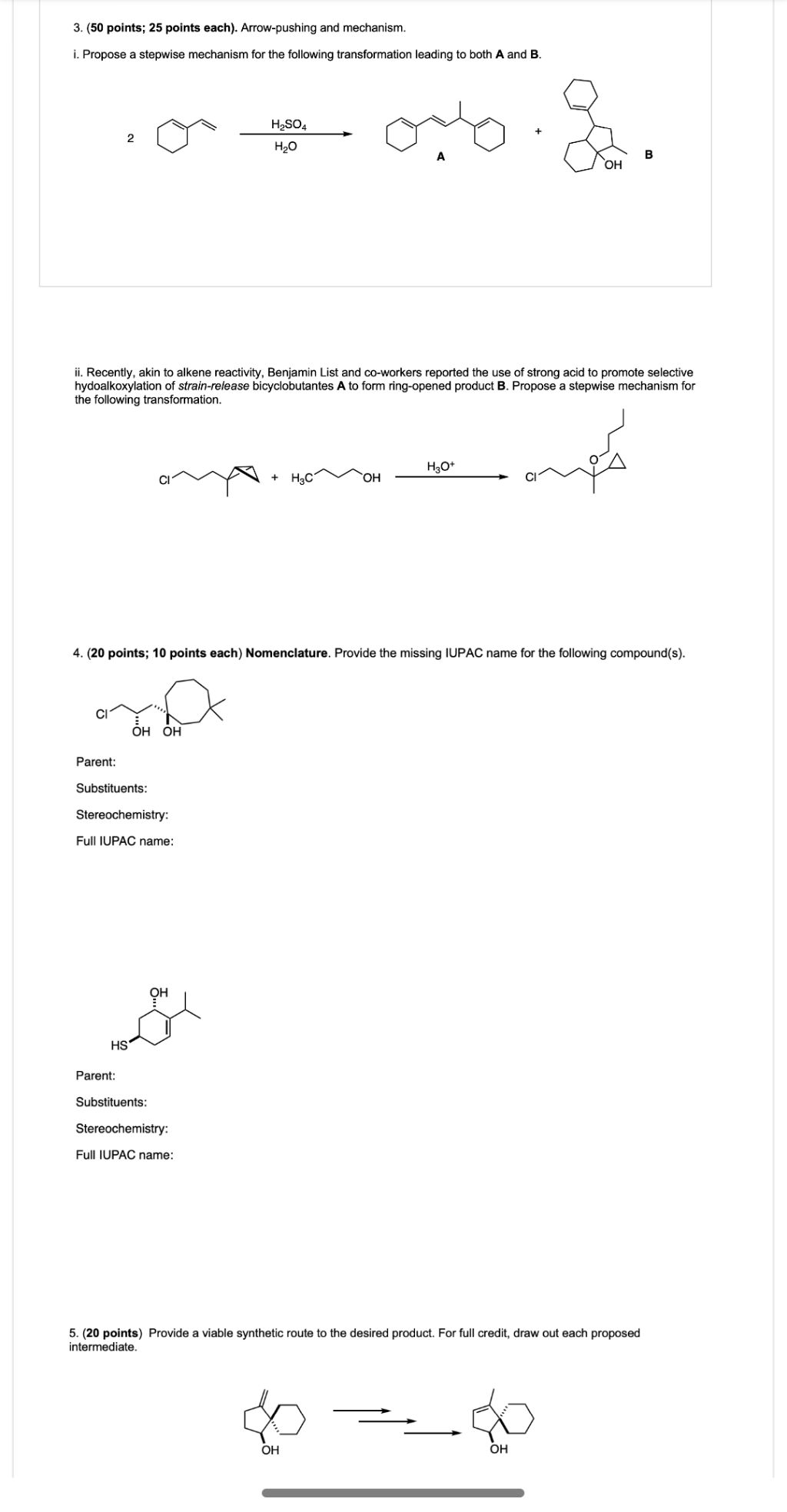
Give step-by-step solution with explanation and final answer:3. (50 points; 25 points each). Arrow-pushing and mechanism.
i. Propose a stepwise mechanism for the following transformation leading to both A and B.
2 —_—
H,0
B
A OH
ii. Recently, akin to alkene reactivity, Benjamin List and co-workers reported the use of strong acid to promote selective
hydoalkoxylation of strain-release bicyclobutantes A to form ring-opened product B. Propose a stepwise mechanism for
the following transformation.
H30*
aR veo —P aA
4. (20 points; 10 points each) Nomenclature. Provide the missing IUPAC name for the following compound(s).
OH OH
Parent:
Substituents:
Stereochemistry:
Full IUPAC name:
OH
HS’
Parent:
Substituents:
Stereochemistry:
Full IUPAC name:
5. (20 points) Provide a viable synthetic route to the desired product. For full credit, draw out each proposed
intermediate.
_— &
/ —_—
-. .
OH OH
——
Question:
Give step-by-step solution with explanation and final answer:3. (50 points; 25 points each). Arrow-pushing and mechanism.
i. Propose a stepwise mechanism for the following transformation leading to both A and B.
2 —_—
H,0
B
A OH
ii. Recently, akin to alkene reactivity, Benjamin List and co-workers reported the use of strong acid to promote selective
hydoalkoxylation of strain-release bicyclobutantes A to form ring-opened product B. Propose a stepwise mechanism for
the following transformation.
H30*
aR veo —P aA
4. (20 points; 10 points each) Nomenclature. Provide the missing IUPAC name for the following compound(s).
OH OH
Parent:
Substituents:
Stereochemistry:
Full IUPAC name:
OH
HS’
Parent:
Substituents:
Stereochemistry:
Full IUPAC name:
5. (20 points) Provide a viable synthetic route to the desired product. For full credit, draw out each proposed
intermediate.
_— &
/ —_—
-. .
OH OH
——
This is AI generated Response.
Asked by: Rahul
Created at: 2026-01-13 14:56:41
Final Answer:
RenderedRaw Text
Did you like this answer?
# Step-by-Step Solutions
---
## **3. Arrow-Pushing and Mechanism**
### **i. Mechanism for Dimerization of 1-Phenyl-1-butene**
**Reaction:**
2 × 1-Phenyl-1-butene + H₂SO₄/H₂O → A (linear dimer) + B (cyclic alcohol dimer)
#### **Step 1: Protonation**
- The alkene is protonated by H₂SO₄, generating a carbocation at the benzylic position (resonance stabilized).
#### **Step 2: Nucleophilic Attack**
- Another molecule of 1-phenyl-1-butene attacks the carbocation, generating a longer carbocation (dimeric intermediate).
#### **Step 3: Deprotonation or Cyclization**
- **For A:** Deprotonation leads to the linear dimer (A).
- **For B:** Intramolecular cyclization occurs, followed by water addition and deprotonation, forming the cyclic alcohol (B).
#### **Arrow-Pushing Steps:**
1. Protonation of alkene (double bond attacks H⁺, forms carbocation at benzylic position).
2. Second alkene attacks carbocation (forms new C–C bond, now another carbocation).
3. For A: Deprotonation at adjacent carbon to restore alkene.
4. For B: Intramolecular attack forms ring, then water attacks carbocation, followed by deprotonation to give alcohol.
---
### **ii. Acid-promoted Hydroalkoxylation of Strain-Release Bicyclobutanes**
**Reaction:**
Chlorobicyclobutane + 1-pentanol + H₃O⁺ → Ring-opened ether
#### **Step 1: Protonation**
- Ether oxygen (from pentanol) is protonated, making it a better nucleophile.
#### **Step 2: Ring Opening**
- The strained bicyclobutane is protonated at the bridgehead, making it susceptible to nucleophilic attack.
#### **Step 3: Nucleophilic Attack**
- Protonated pentanol attacks the more substituted carbon, opening the ring to form the ether.
#### **Step 4: Deprotonation**
- Loss of a proton gives the final ether product.
#### **Arrow-Pushing Steps:**
1. Protonation of pentanol.
2. Attack of pentanol on the bicyclobutane (ring opens, forms new C–O bond).
3. Deprotonation to yield the final ether.
---
## **4. IUPAC Nomenclature**
### **First Compound**
#### **Structure Analysis**
- Cyclooctane (8-membered ring) parent.
- Substituents: 4-chloro, 2,3-diol (vicinal diol).
- Stereochemistry: (2R,3S) or as given from the image.
#### **Name Breakdown**
- **Parent:** cyclooctane
- **Substituents:** 2,3-diol, 4-chloro
- **Stereochemistry:** (2R,3S)
- **Full IUPAC Name:**
**(2R,3S)-4-chlorocyclooctane-2,3-diol**
---
### **Second Compound**
#### **Structure Analysis**
- Benzene ring parent.
- Substituents: 2-hydroxy (ortho to S), 5-mercapto (meta to OH).
- Stereochemistry: (1S,2R) or as given.
#### **Name Breakdown**
- **Parent:** benzene (phenol base)
- **Substituents:** 2-hydroxy, 5-mercapto
- **Stereochemistry:** (1S,2R)
- **Full IUPAC Name:**
**(1S,2R)-2-hydroxy-5-mercaptocyclohex-1-ylbenzene**
*(If the ring is cyclohexanol and substituents are at 1 and 4, adjust as per actual structure; use correct locants!)*
---
## **5. Synthetic Route**
**Goal:** Synthesize the rightmost product from the leftmost starting material.
#### **Step 1: Oxidation**
- Oxidize the secondary alcohol to a ketone (using PCC, Jones, or Swern oxidation).
#### **Step 2: Stereoselective Reduction**
- Reduce the ketone back to an alcohol using a stereoselective reducing agent (e.g., L-Selectride or a chiral catalyst) to get the opposite stereochemistry.
#### **Stepwise Intermediates:**
1. Starting material (secondary alcohol)
2. Ketone intermediate
3. Final product (secondary alcohol with opposite stereochemistry)
---
## **Summary Table**
| Problem | Main Concept | Key Steps |
|---------|-------------|-----------|
| 3(i) | Electrophilic alkene dimerization | Protonation, nucleophilic attack, cyclization/deprotonation |
| 3(ii) | Acid-promoted ring opening | Protonation, nucleophilic attack, ring opening |
| 4 | IUPAC naming | Identify parent, substituents, stereochemistry |
| 5 | Synthetic strategy | Oxidation, stereoselective reduction |
---
### **Let me know if you need any mechanism drawings or further details!**
VIPSolutions focuses on clear, step‑by‑step explanations so you can learn quickly. Whether you need an AI‑generated walkthrough or a short hint to get unstuck, each solution is organized for fast reading and easy review later.
Search similar questions, compare approaches, and bookmark the best answers for revision. Our goal is simple: quick, reliable study help that feels natural—not noisy.
 VIPSolutions
 3. (50 points; 25 points each). Arrow-pushing and mechanism.
i. Propose a stepwise mechanism for the following transformation leading to both A and B.
2 —_—
H,0
B
A OH
ii. Recently, akin to alkene reactivity, Benjamin List and co-workers reported the use of strong acid to promote selective
hydoalkoxylation of strain-release bicyclobutantes A to form ring-opened product B. Propose a stepwise mechanism for
the following transformation.
H30*
aR veo —P aA
4. (20 points; 10 points each) Nomenclature. Provide the missing IUPAC name for the following compound(s).
OH OH
Parent:
Substituents:
Stereochemistry:
Full IUPAC name:
OH
HS’
Parent:
Substituents:
Stereochemistry:
Full IUPAC name:
5. (20 points) Provide a viable synthetic route to the desired product. For full credit, draw out each proposed
intermediate.
_— &
/ —_—
-. .
OH OH
——