Give step-by-step solution with explanation and final answer:Homework HLA
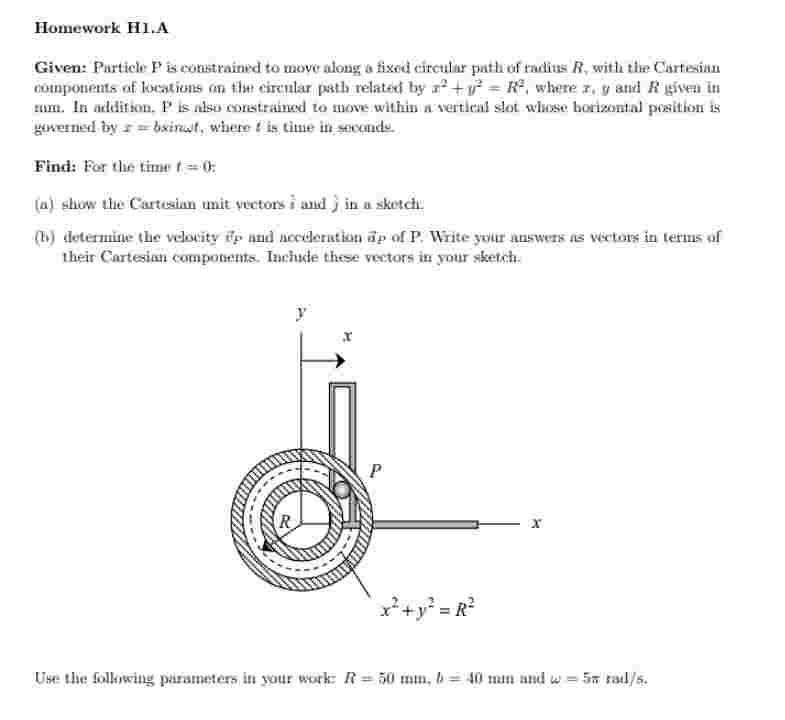
Given: Particle I is constrained to move along o fixed circular path of mdins RB, with the Cartesinn
components of locations an tl eirenlar path related by 22 +5? = RB, where x, y and R given in
sum, In addition. 17 is also constrained to move within vertical slot whose horizontal position i
governed by = byinut, where £ is time in seconds.
Find: For the time f= 0;
(a) show the Cartesian unit vectors § and J in a sketch.
(1) determise the velocity @ and acceleration dp of P. Write your answers 4s victors in terms of
their Cartesian components. Tnchide these vectors in your sketch.
y
x
pt| P
$B)
Ni § RUN
NN UN . x
NHN Spd
NR IN
ay IS
3
ms
Pay =r
Uses thie Sollowinig perametess in your work: R= 50 min. b= 40 mun and w = 55 rad/s.
Question:
Give step-by-step solution with explanation and final answer:Homework HLA
Given: Particle I is constrained to move along o fixed circular path of mdins RB, with the Cartesinn
components of locations an tl eirenlar path related by 22 +5? = RB, where x, y and R given in
sum, In addition. 17 is also constrained to move within vertical slot whose horizontal position i
governed by = byinut, where £ is time in seconds.
Find: For the time f= 0;
(a) show the Cartesian unit vectors § and J in a sketch.
(1) determise the velocity @ and acceleration dp of P. Write your answers 4s victors in terms of
their Cartesian components. Tnchide these vectors in your sketch.
y
x
pt| P
$B)
Ni § RUN
NN UN . x
NHN Spd
NR IN
ay IS
3
ms
Pay =r
Uses thie Sollowinig perametess in your work: R= 50 min. b= 40 mun and w = 55 rad/s.
This is AI generated Response.
Asked by: Rahul
Created at: 2026-01-13 14:39:15
Final Answer:
RenderedRaw Text
Did you like this answer?
Let's break down and solve the problem step by step.
---
## **Given**
- Particle \( P \) moves along a fixed circle of radius \( R \):
\( x^2 + y^2 = R^2 \)
- The slot guiding \( P \) moves horizontally:
\( x = b \sin(\omega t) \)
- Parameters:
\( R = 50 \) mm, \( b = 40 \) mm, \( \omega = 5\pi \) rad/s
---
## **Step 1: Show Unit Vectors \( \mathbf{i} \) and \( \mathbf{j} \) in a Sketch**
- \( \mathbf{i} \): Unit vector along \( x \)-axis (to the right).
- \( \mathbf{j} \): Unit vector along \( y \)-axis (upwards).
You can sketch these on the provided diagram as arrows from the origin:
- \( \mathbf{i} \) points to the right (horizontal).
- \( \mathbf{j} \) points up (vertical).
---
## **Step 2: Find Cartesian Components of Velocity and Acceleration**
### **A. Position of P**
Given:
- \( x = b \sin(\omega t) \)
- \( x^2 + y^2 = R^2 \Rightarrow y = \sqrt{R^2 - x^2} \)
So,
\[
\mathbf{r}_P = x\,\mathbf{i} + y\,\mathbf{j}
\]
\[
x = b \sin(\omega t)
\]
\[
y = \sqrt{R^2 - b^2 \sin^2(\omega t)}
\]
---
### **B. Velocity of P**
\[
\mathbf{v}_P = \frac{d\mathbf{r}_P}{dt} = \dot{x}\,\mathbf{i} + \dot{y}\,\mathbf{j}
\]
Where:
\[
\dot{x} = b\omega \cos(\omega t)
\]
\[
y = \sqrt{R^2 - x^2}
\]
So,
\[
\dot{y} = \frac{d}{dt}\left[\sqrt{R^2 - x^2}\right] = \frac{1}{2}\left(R^2 - x^2\right)^{-1/2} \cdot (-2x\dot{x}) = -\frac{x\dot{x}}{\sqrt{R^2 - x^2}}
\]
Substitute \(x = b\sin(\omega t)\), \(\dot{x} = b\omega\cos(\omega t)\):
\[
\dot{y} = -\frac{b\sin(\omega t) \cdot b\omega\cos(\omega t)}{\sqrt{R^2 - b^2\sin^2(\omega t)}}
= -\frac{b^2\omega\sin(\omega t)\cos(\omega t)}{\sqrt{R^2 - b^2\sin^2(\omega t)}}
\]
So,
\[
\boxed{
\mathbf{v}_P = b\omega\cos(\omega t)\,\mathbf{i} - \frac{b^2\omega\sin(\omega t)\cos(\omega t)}{\sqrt{R^2 - b^2\sin^2(\omega t)}}\,\mathbf{j}
}
\]
---
### **C. Acceleration of P**
\[
\mathbf{a}_P = \ddot{x}\,\mathbf{i} + \ddot{y}\,\mathbf{j}
\]
\[
\ddot{x} = -b\omega^2\sin(\omega t)
\]
For \(\ddot{y}\), differentiate \(\dot{y}\):
\[
\dot{y} = -\frac{x\dot{x}}{y}
\]
So,
\[
\ddot{y} = \frac{d}{dt} \left(-\frac{x\dot{x}}{y}\right)
= -\frac{\dot{x}\dot{x} + x\ddot{x}}{y} + \frac{x\dot{x}\dot{y}}{y^2}
\]
Plug in values:
- \(\dot{x} = b\omega\cos(\omega t)\)
- \(\ddot{x} = -b\omega^2\sin(\omega t)\)
- \(x = b\sin(\omega t)\)
- \(y = \sqrt{R^2 - b^2\sin^2(\omega t)}\)
- \(\dot{y}\) as above
Thus,
\[
\ddot{y} = -\frac{[\dot{x}^2 + x\ddot{x}]}{y} + \frac{x\dot{x}\dot{y}}{y^2}
\]
---
## **Step 3: Evaluate at \( t = \)**
- \( \sin() = \), \( \cos() = 1 \)
\[
x =
\]
\[
y = R = 50\,\text{mm}
\]
\[
\dot{x} = b\omega = 40 \times 5\pi = 200\pi\,\text{mm/s}
\]
\[
\dot{y} = \quad (\text{since } \sin() = )
\]
\[
\ddot{x} =
\]
\[
\dot{x}^2 = (200\pi)^2
\]
\[
x\ddot{x} =
\]
\[
\ddot{y} = -\frac{(200\pi)^2}{50}
\]
---
### **Final Answers at \( t = \):**
#### **Velocity:**
\[
\boxed{
\mathbf{v}_P = (200\pi)\,\mathbf{i} + \,\mathbf{j}\ \text{mm/s}
}
\]
#### **Acceleration:**
\[
\boxed{
\mathbf{a}_P = \,\mathbf{i} - \frac{(200\pi)^2}{50}\,\mathbf{j}\ \text{mm/s}^2
}
\]
Numeric value for \( \mathbf{a}_P \):
\[
(200\pi)^2 = 40000 \pi^2 \approx 40000 \times 9.87 = 394800
\]
\[
\frac{394800}{50} = 7896
\]
So:
\[
\boxed{
\mathbf{a}_P = \,\mathbf{i} - 7896\,\mathbf{j}\ \text{mm/s}^2
}
\]
---
## **Summary Table**
| Quantity | Expression | Value at \( t = \) |
|-----------------|-------------------|-------------------------------|
| \( \mathbf{v}_P \) | \( b\omega\,\mathbf{i} \) | \( 200\pi\,\mathbf{i} \) mm/s |
| \( \mathbf{a}_P \) | \( -\frac{\dot{x}^2}{R}\,\mathbf{j} \) | \( -7896\,\mathbf{j} \) mm/s\(^2\) |
---
## **Sketch**
Include:
- \( \mathbf{i} \): right along \( x \)
- \( \mathbf{j} \): up along \( y \)
- \( \mathbf{v}_P \) to the right at \( t = \)
- \( \mathbf{a}_P \) downward at \( t = \)
---
**Let me know if you need the sketch drawn out!**
VIPSolutions focuses on clear, step‑by‑step explanations so you can learn quickly. Whether you need an AI‑generated walkthrough or a short hint to get unstuck, each solution is organized for fast reading and easy review later.
Search similar questions, compare approaches, and bookmark the best answers for revision. Our goal is simple: quick, reliable study help that feels natural—not noisy.
 VIPSolutions
 Homework HLA
Given: Particle I is constrained to move along o fixed circular path of mdins RB, with the Cartesinn
components of locations an tl eirenlar path related by 22 +5? = RB, where x, y and R given in
sum, In addition. 17 is also constrained to move within vertical slot whose horizontal position i
governed by = byinut, where £ is time in seconds.
Find: For the time f= 0;
(a) show the Cartesian unit vectors § and J in a sketch.
(1) determise the velocity @ and acceleration dp of P. Write your answers 4s victors in terms of
their Cartesian components. Tnchide these vectors in your sketch.
y
x
pt| P
$B)
Ni § RUN
NN UN . x
NHN Spd
NR IN
ay IS
3
ms
Pay =r
Uses thie Sollowinig perametess in your work: R= 50 min. b= 40 mun and w = 55 rad/s.