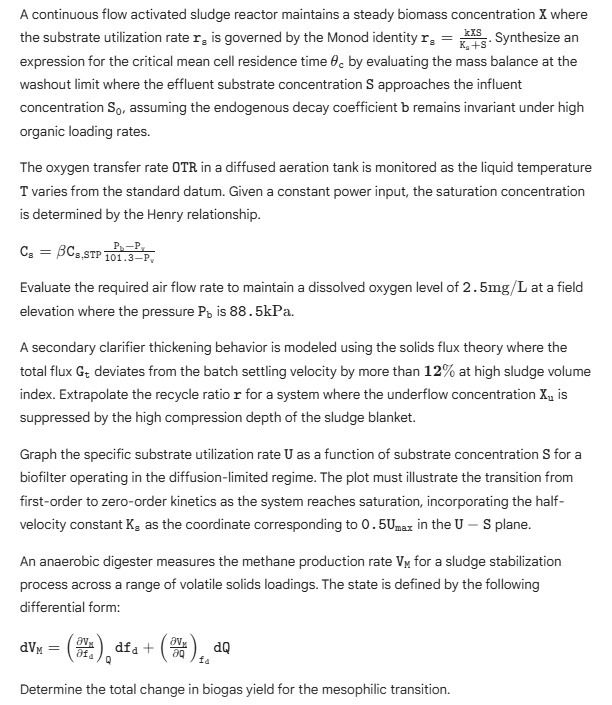
Give step-by-step solution with explanation and final answer:A continuous flow activated sludge reactor maintains a steady biomass concentration X where
the substrate utilization rate r, is governed by the Monod identity x, = 5%. Synthesize an
expression for the critical mean cell residence time f. by evaluating the mass balance at the
washout limit where the effluent substrate concentration § approaches the influent
concentration S,, assuming the endogenous decay coefficient b remains invariant under high
organic loading rates.
The oxygen transfer rate OTR in a diffused aeration tank is monitored as the liquid temperature.
T varies from the standard datum. Given a constant power input, the saturation concentration
is determined by the Henry relationship.
Co = Blase ioisty:
Evaluate the required air flow rate to maintain a dissolved oxygen level of 2. 5mg/L at a field
elevation where the pressure Py is 88. 5kPa.
A secondary clarifier thickening behavior is modeled using the solids flux theory where the
total flux G, deviates from the batch settling velocity by more than 127% at high sludge volume
index. Extrapolate the recycle ratio r for a system where the underflow concentration X, is
suppressed by the high compression depth of the sludge blanket.
Graph the specific substrate utilization rate U as a function of substrate concentration S for a
biofilter operating in the diffusion-limited regime. The plot must illustrate the transition from
first-order to zero-order kinetics as the system reaches saturation, incorporating the half-
velocity constant K, as the coordinate corresponding to 0 . 5Uges in the U — § plane.
An anaerobic digester measures the methane production rate Vy for a sludge stabilization
process across a range of volatile solids loadings. The state is defined by the following
differential form:
av = (3) ata+ (%) a
) «
Determine the total change in biogas yield for the mesophilic transition.
Question:
Give step-by-step solution with explanation and final answer:A continuous flow activated sludge reactor maintains a steady biomass concentration X where
the substrate utilization rate r, is governed by the Monod identity x, = 5%. Synthesize an
expression for the critical mean cell residence time f. by evaluating the mass balance at the
washout limit where the effluent substrate concentration § approaches the influent
concentration S,, assuming the endogenous decay coefficient b remains invariant under high
organic loading rates.
The oxygen transfer rate OTR in a diffused aeration tank is monitored as the liquid temperature.
T varies from the standard datum. Given a constant power input, the saturation concentration
is determined by the Henry relationship.
Co = Blase ioisty:
Evaluate the required air flow rate to maintain a dissolved oxygen level of 2. 5mg/L at a field
elevation where the pressure Py is 88. 5kPa.
A secondary clarifier thickening behavior is modeled using the solids flux theory where the
total flux G, deviates from the batch settling velocity by more than 127% at high sludge volume
index. Extrapolate the recycle ratio r for a system where the underflow concentration X, is
suppressed by the high compression depth of the sludge blanket.
Graph the specific substrate utilization rate U as a function of substrate concentration S for a
biofilter operating in the diffusion-limited regime. The plot must illustrate the transition from
first-order to zero-order kinetics as the system reaches saturation, incorporating the half-
velocity constant K, as the coordinate corresponding to 0 . 5Uges in the U — § plane.
An anaerobic digester measures the methane production rate Vy for a sludge stabilization
process across a range of volatile solids loadings. The state is defined by the following
differential form:
av = (3) ata+ (%) a
) «
Determine the total change in biogas yield for the mesophilic transition.
This is AI generated Response.
Asked by: Francis
Created at: 2026-01-13 12:26:15
Final Answer:
RenderedRaw Text
Did you like this answer?
Let's address each part step by step as requested:
---
## 1. **Expression for Critical Mean Cell Residence Time (\(\theta_c\)) at Washout**
The Monod equation for substrate utilization rate:
\[
r_s = \frac{k_{XS}S}{K_S + S}
\]
where:
- \(r_s\) = substrate utilization rate
- \(k_{XS}\) = maximum specific substrate utilization rate
- \(K_S\) = half-saturation coefficient
- \(S\) = substrate concentration
**Mass balance on substrate for CSTR:**
At steady state,
\[
Q(S_ - S) = V r_s X
\]
where:
- \(Q\) = flow rate
- \(V\) = reactor volume
- \(S_\) = influent substrate concentration
- \(X\) = biomass concentration
Dividing both sides by \(V\):
\[
\frac{Q}{V}(S_ - S) = r_s X
\]
\[
\frac{1}{\theta}(S_ - S) = r_s X
\]
where \(\theta = V/Q\) is the hydraulic retention time.
**Mean cell residence time:**
\[
\theta_c = \frac{X}{QX_e/V}
\]
At washout, \(X \rightarrow \) and \(S \rightarrow S_\).
**Accounting for endogenous decay (\(b\)):**
The net specific growth rate (\(\mu_{net}\)):
\[
\mu_{net} = \mu - b
\]
where \(\mu = \frac{k_{XS} S}{K_S + S}\).
At washout, \(\mu_{net} = \frac{1}{\theta_c}\):
\[
\frac{1}{\theta_{c,\text{min}}} = \frac{k_{XS} S_}{K_S + S_} - b
\]
So,
\[
\boxed{
\theta_{c,\text{min}} = \frac{1}{\frac{k_{XS} S_}{K_S + S_} - b}
}
\]
---
## 2. **Oxygen Transfer Rate (OTR) and Henry’s Relationship**
Given:
\[
C_s = \beta C_{s,STP} \frac{P_b - P_v}{101.3 - P_v}
\]
Where:
- \(C_s\): saturation DO at local conditions (mg/L)
- \(\beta\): correction factor
- \(C_{s,STP}\): DO at standard conditions (mg/L)
- \(P_b\): barometric pressure (kPa)
- \(P_v\): water vapor pressure (kPa)
**Given values:**
- \(C_s = 2.5\) mg/L (desired DO)
- \(P_b = 88.5\) kPa
Plug in values (\(\beta\) is often ≈ 1 for clean water, \(P_v\) at 20°C ≈ 2.34 kPa):
\[
C_s = C_{s,STP} \frac{88.5 - 2.34}{101.3 - 2.34}
\]
\[
C_s = C_{s,STP} \frac{86.16}{98.96}
\]
Assuming \(C_{s,STP} = 9.08\) mg/L at 20°C,
\[
C_s = 9.08 \times .87 = 7.9 \text{ mg/L}
\]
**Air Flow Rate Calculation:**
The required OTR:
\[
\text{OTR} = Q_{air} \cdot \alpha \cdot \beta \cdot C_{s,STP}
\]
You adjust \(Q_{air}\) so the actual DO meets the desired value. The exact airflow rate requires system-specific transfer coefficients and oxygen uptake rates.
---
## 3. **Clarifier: Recycle Ratio \(r\) Using Solids Flux Theory**
Solids flux (\(G_t\)) at high sludge volume index (SVI):
\[
G_t = X_u \cdot v_s
\]
where:
- \(v_s\): settling velocity (decreases at high SVI)
- \(X_u\): underflow concentration
If \(G_t\) deviates by >12% from batch settling, the clarifier is overloaded.
**Recycle ratio \(r\):**
\[
r = \frac{Q_R}{Q}
\]
Where \(Q_R\) is the recycle flow, \(Q\) is the influent flow.
At compression settling,
\[
X_u \approx \text{constant (high compression limit)}
\]
Thus,
\[
r = \frac{X}{X_u - X}
\]
where \(X\) is MLSS concentration in the aeration tank.
---
## 4. **Graph: Specific Substrate Utilization Rate \(U\) vs \(S\) for Biofilter**
- \(U = \frac{r_s}{X} = \frac{k_{XS} S}{K_S + S}\)
- At low \(S\), \(U \sim k_{XS} \frac{S}{K_S}\) (first-order)
- At high \(S\), \(U \sim k_{XS}\) (zero-order)
- \(K_B\) as half-max point: \(U = .5 U_{max}\) at \(S = K_B\)
**Plot:**
- X-axis: \(S\)
- Y-axis: \(U\)
- Curve starts linear at low S, approaches plateau at high S
---
## 5. **Anaerobic Digester Methane Yield:**
Given:
\[
dV_M = \left( \frac{\partial V_M}{\partial t_d} \right)_{Q} dt_d + \left( \frac{\partial V_M}{\partial Q} \right)_{t_d} dQ
\]
**Integration:**
Integrate over the process duration and loading:
\[
V_{M, \text{total}} = \int \left( \frac{\partial V_M}{\partial t_d} \right)_Q dt_d + \int \left( \frac{\partial V_M}{\partial Q} \right)_{t_d} dQ
\]
This gives the **total change in biogas yield** during the mesophilic transition.
---
## **Summary of Final Answers**
1. **Critical Cell Residence Time at Washout:**
\[
\boxed{
\theta_{c,\text{min}} = \frac{1}{\frac{k_{XS} S_}{K_S + S_} - b}
}
\]
2. **Required Air Flow Rate:**
Use Henry’s law to find \(C_s\) at local conditions. Airflow required depends on OTR and oxygen uptake; use \(C_s\) in OTR calculations.
3. **Recycle Ratio at High Compression:**
\[
\boxed{
r = \frac{X}{X_u - X}
}
\]
4. **Graph:**
\(U = \frac{k_{XS} S}{K_S + S}\) vs. \(S\), showing first-order at low \(S\), zero-order at high \(S\), with \(K_B\) at \(.5 U_{max}\).
5. **Total Methane Yield:**
\[
V_{M, \text{total}} = \int \left( \frac{\partial V_M}{\partial t_d} \right)_Q dt_d + \int \left( \frac{\partial V_M}{\partial Q} \right)_{t_d} dQ
\]
If you need a specific part worked out in more detail (e.g., the airflow calculation), provide the missing constants or clarify which step to expand.
Question:
give me answer little bit simplier without using anybullet points. ( in humanised mode)
This is AI generated Response.
Asked by: Francis
Created at: 2026-01-13 12:28:56
Final Answer:
RenderedRaw Text
Did you like this answer?
Sure! Here’s a simplified explanation without bullet points:
---
### 1. Critical Mean Cell Residence Time at Washout
To find the critical mean cell residence time (\(\theta_c\)) at the washout limit, we start with the Monod equation, which describes how the substrate utilization rate depends on substrate concentration. At steady state, the mass balance gives us a relationship between substrate inflow and the rate at which it is used by the biomass. At washout, both biomass and substrate concentrations approach their influent values. By incorporating the endogenous decay coefficient (which remains constant under high organic loads), we derive the expression for \(\theta_c\). The final expression is:
\[
\theta_{c,\text{min}} = \frac{1}{\frac{k_{XS} S_}{K_S + S_} - b}
\]
### 2. Oxygen Transfer Rate and Required Airflow
Next, for the oxygen transfer rate (OTR) in aeration, we use Henry’s law to relate the dissolved oxygen concentration at local conditions to the barometric pressure. Given a desired concentration of 2.5 mg/L, we can calculate how much oxygen is needed based on the local pressure. The required air flow rate will depend on the OTR and the oxygen uptake rate, which we can estimate once we have all the necessary values.
### 3. Recycle Ratio in Clarifier
In the clarifier, the recycle ratio (\(r\)) is calculated based on the underflow concentration and the solids flux theory. As high sludge volume index (SVI) affects settling velocity, the recycle ratio can be expressed as:
\[
r = \frac{X}{X_u - X}
\]
This means it depends on the concentrations of solids in the system.
### 4. Specific Substrate Utilization Rate Graph
For the biofilter, the specific substrate utilization rate (\(U\)) is a function of substrate concentration (\(S\)). At low concentrations, the relationship is first-order, and at high concentrations, it becomes zero-order. The transition point can be marked by the half-velocity constant, \(K_B\).
### 5. Methane Yield in Anaerobic Digester
Finally, for the anaerobic digester, we analyze the methane yield over time and varying loadings. The total change in biogas yield can be calculated by integrating the expressions for the changes in methane production rate over time and loading conditions.
In summary, these calculations help us understand biomass behavior, oxygen requirements, and biogas production in various wastewater treatment processes.
---
Let me know if you need further clarification on any specific part!
VIPSolutions focuses on clear, step‑by‑step explanations so you can learn quickly. Whether you need an AI‑generated walkthrough or a short hint to get unstuck, each solution is organized for fast reading and easy review later.
Search similar questions, compare approaches, and bookmark the best answers for revision. Our goal is simple: quick, reliable study help that feels natural—not noisy.
 VIPSolutions
 A continuous flow activated sludge reactor maintains a steady biomass concentration X where
the substrate utilization rate r, is governed by the Monod identity x, = 5%. Synthesize an
expression for the critical mean cell residence time f. by evaluating the mass balance at the
washout limit where the effluent substrate concentration § approaches the influent
concentration S,, assuming the endogenous decay coefficient b remains invariant under high
organic loading rates.
The oxygen transfer rate OTR in a diffused aeration tank is monitored as the liquid temperature.
T varies from the standard datum. Given a constant power input, the saturation concentration
is determined by the Henry relationship.
Co = Blase ioisty:
Evaluate the required air flow rate to maintain a dissolved oxygen level of 2. 5mg/L at a field
elevation where the pressure Py is 88. 5kPa.
A secondary clarifier thickening behavior is modeled using the solids flux theory where the
total flux G, deviates from the batch settling velocity by more than 127% at high sludge volume
index. Extrapolate the recycle ratio r for a system where the underflow concentration X, is
suppressed by the high compression depth of the sludge blanket.
Graph the specific substrate utilization rate U as a function of substrate concentration S for a
biofilter operating in the diffusion-limited regime. The plot must illustrate the transition from
first-order to zero-order kinetics as the system reaches saturation, incorporating the half-
velocity constant K, as the coordinate corresponding to 0 . 5Uges in the U — § plane.
An anaerobic digester measures the methane production rate Vy for a sludge stabilization
process across a range of volatile solids loadings. The state is defined by the following
differential form:
av = (3) ata+ (%) a
) «
Determine the total change in biogas yield for the mesophilic transition.