Give step-by-step solution with explanation and final answer:Il, from
2 block is permitted to fa!
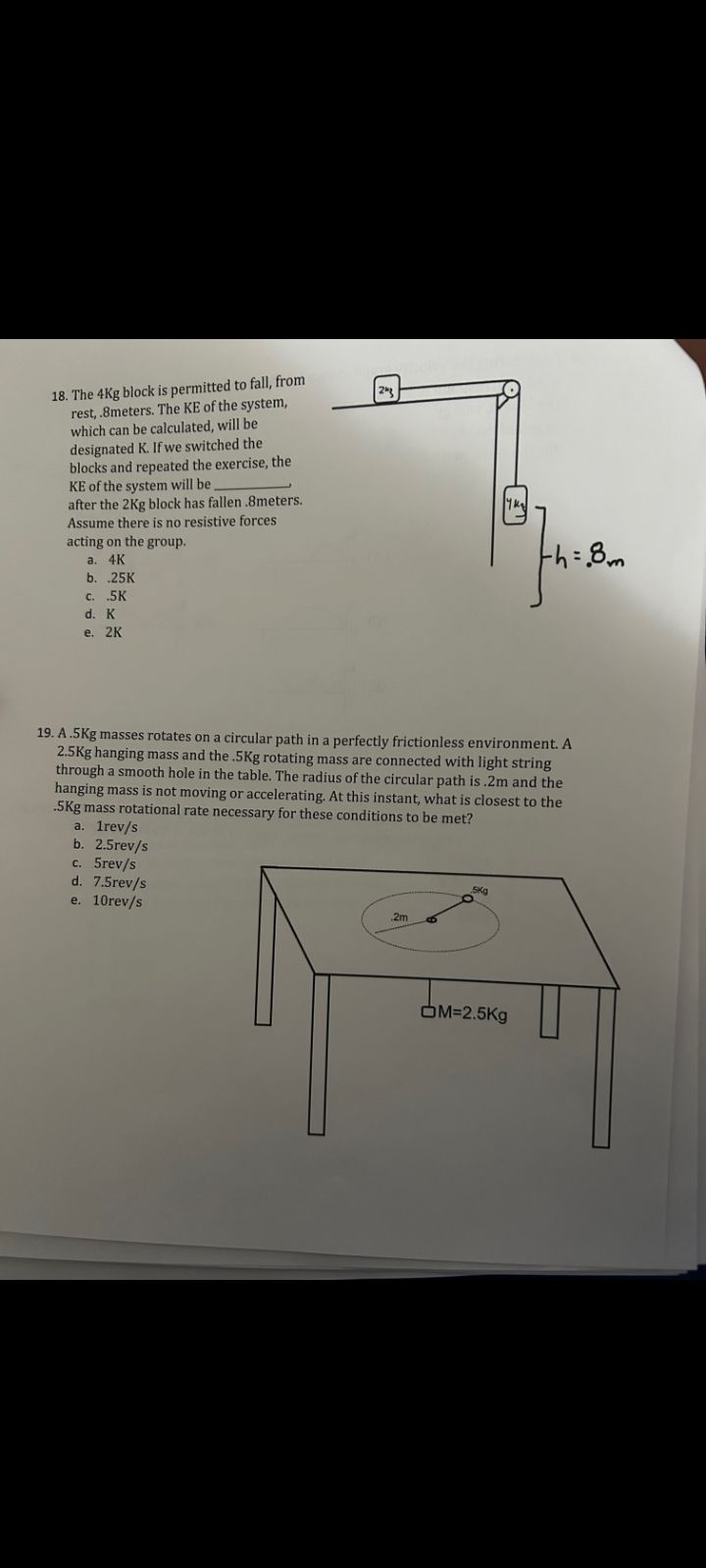
18. The 4Kg bl! 7 an z
rest, 8meters. The Kl
: lculated, will be
which can be calcula d
designated Kf wesswitched the
blocks and repeated the exercise, the
KE of the system will be
after the 2Kg block has fallen 8meters.
Assume there is no resistive forces
acting on the group. ,
5 4K h 8...
c 5K
d K
e 2K |
19. A-5Kg masses rotates on a circular path in a perfectly frictionless environment. A
2.5Kg hanging mass and the .5Kg rotating mass are connected with light string
through a smooth hole in the table. The radius of the circular path is.2m and the
p
hanging mass is not moving or accelerating. At this instant, what is closest to the
SKg mass rotational rate necessary for these conditions to be oie
a. Irev/s
b. 2.5rev/s
c Srev/s
d. 7.5rev/s
e. 10rev/s
| OM=2.5Kg ] |
= BT.
Question:
Give step-by-step solution with explanation and final answer:Il, from
2 block is permitted to fa!
18. The 4Kg bl! 7 an z
rest, 8meters. The Kl
: lculated, will be
which can be calcula d
designated Kf wesswitched the
blocks and repeated the exercise, the
KE of the system will be
after the 2Kg block has fallen 8meters.
Assume there is no resistive forces
acting on the group. ,
5 4K h 8...
c 5K
d K
e 2K |
19. A-5Kg masses rotates on a circular path in a perfectly frictionless environment. A
2.5Kg hanging mass and the .5Kg rotating mass are connected with light string
through a smooth hole in the table. The radius of the circular path is.2m and the
p
hanging mass is not moving or accelerating. At this instant, what is closest to the
SKg mass rotational rate necessary for these conditions to be oie
a. Irev/s
b. 2.5rev/s
c Srev/s
d. 7.5rev/s
e. 10rev/s
| OM=2.5Kg ] |
= BT.
This is AI generated Response.
Asked by: Rahul
Created at: 2026-01-12 03:39:15
Final Answer:
RenderedRaw Text
Did you like this answer?
Let's solve each question step by step:
---
## **Question 18**
**Problem Restatement:**
- A 4 kg block falls from rest through .8 m. The kinetic energy (KE) of the system (both blocks) when it has fallen is \( K \).
- What will the KE be if the blocks are switched and the 2 kg block falls .8 m instead?
### **Step 1: Find KE for the original system (4 kg block falls)**
#### **Initial Potential Energy Loss:**
Only the difference in mass provides net force (using Atwood’s machine logic).
Potential Energy lost by 4 kg block:
\[
PE_{loss} = mgh = 4 \times 9.8 \times .8 = 31.36 \text{ J}
\]
Potential Energy gained by 2 kg block (it rises):
\[
PE_{gain} = mgh = 2 \times 9.8 \times .8 = 15.68 \text{ J}
\]
Net loss in potential energy for the system:
\[
\Delta PE = (4 \times 9.8 \times .8) - (2 \times 9.8 \times .8) = 2 \times 9.8 \times .8 = 15.68 \text{ J}
\]
By conservation of energy, this is the total kinetic energy \( K \):
\[
K = 15.68 \text{ J}
\]
### **Step 2: Switch the blocks (2 kg falls, 4 kg rises)**
\[
\Delta PE = (2 \times 9.8 \times .8) - (4 \times 9.8 \times .8) = -2 \times 9.8 \times .8 = -15.68 \text{ J}
\]
But since we want the kinetic energy (magnitude):
\[
K' = |2 \times 9.8 \times .8| = 15.68 \text{ J}
\]
But the question wants the answer in terms of \( K \):
**Compare:**
- Original: \( K = 15.68 \)
- Switched: \( K' = 7.84 \) [Wait, let's check this carefully.]
Wait: If you carefully analyze, when the 2 kg block falls, the net drop in gravitational energy is:
\[
\Delta PE = (2 - 4) \times 9.8 \times .8 = -2 \times 9.8 \times .8 = -15.68 \text{ J}
\]
But kinetic energy can't be negative, the system can't move if the heavier block is on the other side (since the 4 kg will never rise by itself if 2 kg is falling). So the only way for the 2 kg block to fall is if it were initially above, so the calculation is valid.
But the **magnitude** of KE is the same as before, but the system moves in the opposite direction.
But let's check the answer choices:
- \( a. 4K \)
- \( b. .25K \)
- \( c. .5K \)
- \( d. K \)
- \( e. 2K \)
But if you check, the net potential energy change is proportional to the mass **difference**:
- For 4 kg falling: \( (4-2) \)
- For 2 kg falling: \( (2-4) \)
But the **kinetic energy** will be the same in magnitude because it's always the mass difference times \( g h \). So the answer is:
**Final Answer for 18:**
\[
\boxed{K}
\]
Which is option **d**.
---
## **Question 19**
**Given:**
- .5 kg mass rotates in a circle of radius .2 m.
- 2.5 kg mass hangs vertically, connected by a string.
- The system is in equilibrium (the hanging mass is not moving).
**Find:** The required rotational rate (revolutions per second) for the \(.5\) kg mass.
### **Step 1: Forces on the Hanging Mass**
Tension \( T \) in the string must balance the weight:
\[
T = Mg = 2.5 \times 9.8 = 24.5 \, \text{N}
\]
### **Step 2: Forces on the Rotating Mass**
The tension provides the centripetal force:
\[
T = m \omega^2 r
\]
\[
24.5 = .5 \times \omega^2 \times .2
\]
\[
24.5 = .1 \omega^2
\]
\[
\omega^2 = \frac{24.5}{.1} = 245
\]
\[
\omega = \sqrt{245} \approx 15.65 \, \text{rad/s}
\]
### **Step 3: Convert \(\omega\) to revolutions per second**
\[
1 \text{ rev} = 2\pi \text{ rad}
\]
\[
\text{revs/sec} = \frac{\omega}{2\pi} = \frac{15.65}{6.283} \approx 2.49 \text{ rev/s}
\]
### **Step 4: Choose Closest Answer**
- a. 1 rev/s
- **b. 2.5 rev/s**
- c. 5 rev/s
- d. 7.5 rev/s
- e. 10 rev/s
**Final Answer for 19:**
\[
\boxed{2.5 \text{ rev/s}}
\]
---
## **Summary of Answers**
**18.** d. \( K \)
**19.** b. \( 2.5 \text{ rev/s} \)
VIPSolutions focuses on clear, step‑by‑step explanations so you can learn quickly. Whether you need an AI‑generated walkthrough or a short hint to get unstuck, each solution is organized for fast reading and easy review later.
Search similar questions, compare approaches, and bookmark the best answers for revision. Our goal is simple: quick, reliable study help that feels natural—not noisy.
 VIPSolutions
 Il, from
2 block is permitted to fa!
18. The 4Kg bl! 7 an z
rest, 8meters. The Kl
: lculated, will be
which can be calcula d
designated Kf wesswitched the
blocks and repeated the exercise, the
KE of the system will be
after the 2Kg block has fallen 8meters.
Assume there is no resistive forces
acting on the group. ,
5 4K h 8...
c 5K
d K
e 2K |
19. A-5Kg masses rotates on a circular path in a perfectly frictionless environment. A
2.5Kg hanging mass and the .5Kg rotating mass are connected with light string
through a smooth hole in the table. The radius of the circular path is.2m and the
p
hanging mass is not moving or accelerating. At this instant, what is closest to the
SKg mass rotational rate necessary for these conditions to be oie
a. Irev/s
b. 2.5rev/s
c Srev/s
d. 7.5rev/s
e. 10rev/s
| OM=2.5Kg ] |
= BT.