 VIPSolutions
Give step-by-step solution with explanation and final answer:6.58 A subsonic diffuser has an inlet Mach number of M, = 0.4. The inlet pressure and temperature are p;, = 100 kPa and T', = 15°C, respectively. The diffuser static pressure recovery is Cp = 0.75 and the exit Mach number is M, = 0.1. For y = 1.4, and R = 287 J/kg.K, calculate (a) inlet dynamic pressure, g,, in kPa (b) exit static pressure, p,, in kPa (c) exit total pressure, p,,, in kPa (d) diffuser area ratio A, /A, o FY | M, M, Be ewmweswssooomesss ss x I mn FIGURE P6.58
Question:
Give step-by-step solution with explanation and final answer: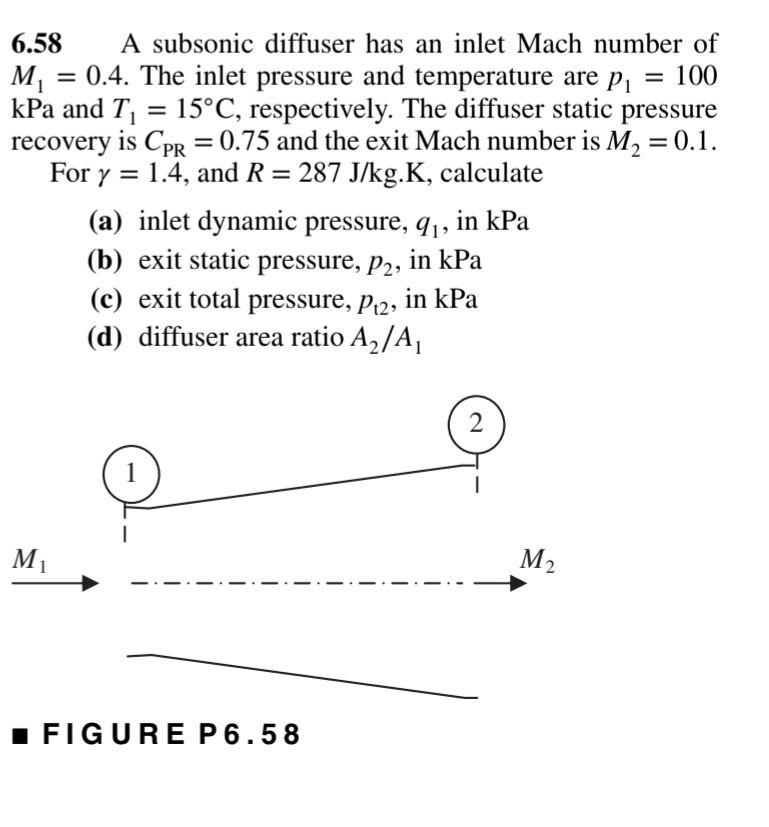 6.58 A subsonic diffuser has an inlet Mach number of
M, = 0.4. The inlet pressure and temperature are p;, = 100
kPa and T', = 15°C, respectively. The diffuser static pressure
recovery is Cp = 0.75 and the exit Mach number is M, = 0.1.
For y = 1.4, and R = 287 J/kg.K, calculate
(a) inlet dynamic pressure, g,, in kPa
(b) exit static pressure, p,, in kPa
(c) exit total pressure, p,,, in kPa
(d) diffuser area ratio A, /A,
o FY
|
M, M,
Be ewmweswssooomesss ss x I
mn FIGURE P6.58
This is AI generated Response.
Asked by: Rahul
Created at: 2026-01-12 03:09:38
Asked by: Rahul
Created at: 2026-01-12 03:09:38
Final Answer:
Rendered
Raw Text
Did you like this answer?
Let's solve the problem step by step:
Given Data:
- \( M_1 = .4 \)
- \( M_2 = .1 \)
- \( p_1 = 100 \) kPa
- \( T_1 = 15^\circ \text{C} = 288.15 \) K
- \( C_{PR} = .75 \)
- \( \gamma = 1.4 \)
- \( R = 287 \) J/kg·K
---
## (a) Inlet Dynamic Pressure, \( q_1 \)
Dynamic pressure:
\[
q_1 = \frac{1}{2} \rho_1 V_1^2
\]
But,
\[
V_1 = M_1 \cdot a_1
\]
\[
a_1 = \sqrt{\gamma R T_1}
\]
Calculate \( a_1 \):
\[
a_1 = \sqrt{1.4 \times 287 \times 288.15} = \sqrt{1.4 \times 287 \times 288.15} \approx 340.3 \text{ m/s}
\]
So,
\[
V_1 = .4 \times 340.3 = 136.12 \text{ m/s}
\]
Now, calculate \( \rho_1 \):
\[
\rho_1 = \frac{p_1}{RT_1} = \frac{100,000}{287 \times 288.15} \approx 1.21 \text{ kg/m}^3
\]
Calculate \( q_1 \):
\[
q_1 = \frac{1}{2} \times 1.21 \times (136.12)^2 \approx 11,210 \text{ Pa} = 11.2 \text{ kPa}
\]
---
## (b) Exit Static Pressure, \( p_2 \)
Diffuser static pressure recovery:
\[
C_{PR} = \frac{p_2 - p_1}{p_{t1} - p_1}
\]
\[
p_2 = p_1 + C_{PR}(p_{t1} - p_1)
\]
First, find inlet total (stagnation) pressure \( p_{t1} \):
\[
\frac{p_{t1}}{p_1} = \left[1 + \frac{\gamma-1}{2}M_1^2 \right]^{\frac{\gamma}{\gamma-1}}
\]
\[
= [1 + .2 \times .16]^{3.5} = [1 + .032]^{3.5} = 1.032^{3.5}
\]
\[
= e^{3.5 \ln(1.032)} \approx e^{3.5 \times .03147} = e^{.1101} \approx 1.116
\]
\[
p_{t1} = 1.116 \times 100 = 111.6 \text{ kPa}
\]
Now, solve for \( p_2 \):
\[
p_2 = 100 + .75 \times (111.6 - 100) = 100 + .75 \times 11.6 = 100 + 8.7 = 108.7 \text{ kPa}
\]
---
## (c) Exit Total Pressure, \( p_{t2} \)
\[
\frac{p_{t2}}{p_2} = \left[1 + \frac{\gamma-1}{2}M_2^2 \right]^{\frac{\gamma}{\gamma-1}}
\]
\[
[1 + .2 \times .01]^{3.5} = [1 + .002]^{3.5} = 1.002^{3.5}
\]
\[
= e^{3.5 \times .001998} = e^{.00699} \approx 1.007
\]
\[
p_{t2} = 1.007 \times 108.7 = 109.46 \text{ kPa}
\]
---
## (d) Diffuser Area Ratio \( \frac{A_2}{A_1} \)
\[
\frac{A_2}{A_1} = \frac{M_1}{M_2} \left( \frac{1 + \frac{\gamma-1}{2}M_2^2}{1 + \frac{\gamma-1}{2}M_1^2} \right)^{\frac{\gamma+1}{2(\gamma-1)}}
\]
First, compute the ratio inside the exponent:
- \( 1 + .2 \cdot .01 = 1.002 \)
- \( 1 + .2 \cdot .16 = 1.032 \)
- Exponent: \( \frac{1.4+1}{2 \times .4} = \frac{2.4}{.8} = 3 \)
So,
\[
\frac{A_2}{A_1} = \frac{.4}{.1} \left( \frac{1.002}{1.032} \right)^3 = 4 \times (.970)^3 \approx 4 \times .913 = 3.65
\]
---
## **Final Answers**
**(a)** Inlet dynamic pressure, \( q_1 = \boxed{11.2 \text{ kPa}} \)
**(b)** Exit static pressure, \( p_2 = \boxed{108.7 \text{ kPa}} \)
**(c)** Exit total pressure, \( p_{t2} = \boxed{109.5 \text{ kPa}} \)
**(d)** Diffuser area ratio, \( \frac{A_2}{A_1} = \boxed{3.65} \)
📢 Instructions:
- Ask anything relatd to above question only.
- For new Question goto :