 VIPSolutions
Give step-by-step solution with explanation and final answer:Use Lagrange's equations to derive the differential equations governing the motion of the system of Fig. 5-9 using x and 8 as generalized coordinates. pr i < J—¢ @D A Slender bar of = mass 2m, length L 3—= 2% Fig. 59
Question:
Give step-by-step solution with explanation and final answer: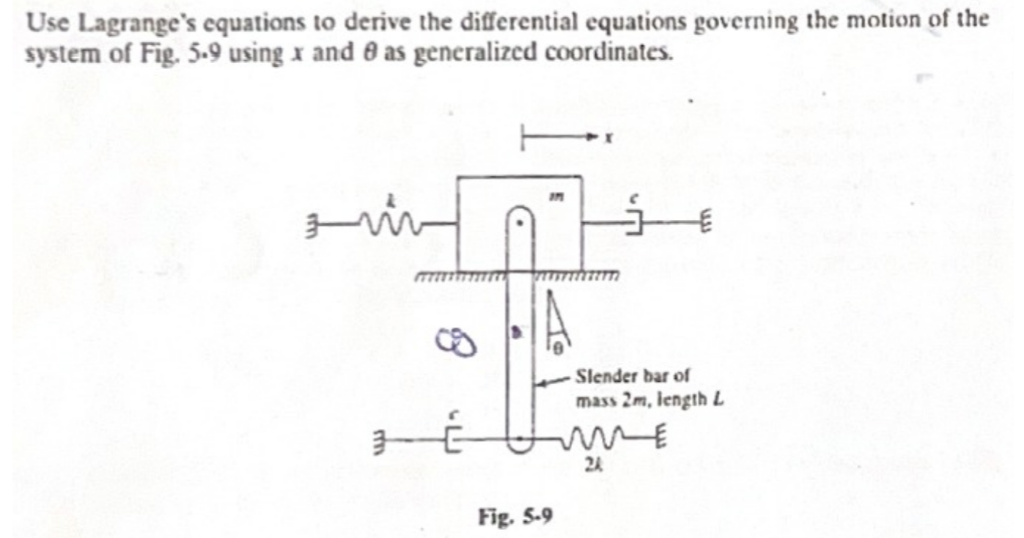 Use Lagrange's equations to derive the differential equations governing the motion of the
system of Fig. 5-9 using x and 8 as generalized coordinates.
pr
i <
J—¢
@D A
Slender bar of
= mass 2m, length L
3—=
2%
Fig. 59
This is AI generated Response.
Asked by: Rahul
Created at: 2026-01-11 22:01:46
Asked by: Rahul
Created at: 2026-01-11 22:01:46
Final Answer:
Rendered
Raw Text
Did you like this answer?
# Step-by-Step Solution Using Lagrange's Equations
We are to derive the equations of motion for the given system using **Lagrange's equations** with generalized coordinates \( x \) (horizontal displacement of the mass \( m \)) and \( \theta \) (angle of the slender bar).
---
## **1. Identify Generalized Coordinates**
- \( x \): Displacement of mass \( m \)
- \( \theta \): Angular displacement of the slender bar
---
## **2. Kinetic Energy (\( T \))**
### **A. Mass \( m \) (Slider)**
- Moves horizontally: velocity \( \dot{x} \)
- Kinetic energy:
\[
T_1 = \frac{1}{2} m \dot{x}^2
\]
### **B. Slender Bar (mass \( 2m \), length \( L \))**
- The bar's center of mass has both translational and rotational motion.
#### **i. Position of Center of Mass (COM)**
- Relative to the slot: \( (x, ) \)
- COM position:
\[
x_{com} = x + \frac{L}{2} \sin\theta
\]
\[
y_{com} = -\frac{L}{2} \cos\theta
\]
#### **ii. Velocity of COM**
\[
\dot{x}_{com} = \dot{x} + \frac{L}{2} \dot{\theta} \cos\theta
\]
\[
\dot{y}_{com} = \frac{L}{2} \dot{\theta} \sin\theta
\]
\[
v_{com}^2 = (\dot{x}_{com})^2 + (\dot{y}_{com})^2
= \left(\dot{x} + \frac{L}{2} \dot{\theta} \cos\theta\right)^2 + \left(\frac{L}{2} \dot{\theta} \sin\theta\right)^2
\]
\[
= \dot{x}^2 + L \dot{x} \dot{\theta} \cos\theta + \frac{L^2}{4} \dot{\theta}^2 (\cos^2\theta + \sin^2\theta)
\]
But \( \cos^2\theta + \sin^2\theta = 1 \):
\[
v_{com}^2 = \dot{x}^2 + L \dot{x} \dot{\theta} \cos\theta + \frac{L^2}{4} \dot{\theta}^2
\]
#### **iii. Rotational Kinetic Energy about COM**
\[
I_{com} = \frac{1}{12} (2m) L^2 = \frac{1}{6} m L^2
\]
\[
T_{rot} = \frac{1}{2} I_{com} \dot{\theta}^2 = \frac{1}{12} m L^2 \dot{\theta}^2
\]
#### **iv. Total Kinetic Energy of Bar**
\[
T_2 = \frac{1}{2} (2m) v_{com}^2 + \frac{1}{2} I_{com} \dot{\theta}^2
\]
\[
= m v_{com}^2 + \frac{1}{12} m L^2 \dot{\theta}^2
\]
\[
= m \left(\dot{x}^2 + L \dot{x} \dot{\theta} \cos\theta + \frac{L^2}{4} \dot{\theta}^2 \right) + \frac{1}{12} m L^2 \dot{\theta}^2
\]
\[
= m \dot{x}^2 + m L \dot{x} \dot{\theta} \cos\theta + m \frac{L^2}{4} \dot{\theta}^2 + \frac{1}{12} m L^2 \dot{\theta}^2
\]
\[
= m \dot{x}^2 + m L \dot{x} \dot{\theta} \cos\theta + m \left(\frac{1}{4} + \frac{1}{12}\right) L^2 \dot{\theta}^2
\]
\[
= m \dot{x}^2 + m L \dot{x} \dot{\theta} \cos\theta + m \frac{1}{3} L^2 \dot{\theta}^2
\]
### **C. Total Kinetic Energy**
\[
T = T_1 + T_2 = \frac{1}{2} m \dot{x}^2 + m \dot{x}^2 + m L \dot{x} \dot{\theta} \cos\theta + m \frac{1}{3} L^2 \dot{\theta}^2
\]
\[
= \frac{3}{2} m \dot{x}^2 + m L \dot{x} \dot{\theta} \cos\theta + \frac{2}{3} m L^2 \dot{\theta}^2
\]
---
## **3. Potential Energy (\( V \))**
### **A. Springs**
- Left and right springs (each \( k \)), attached to mass \( m \):
\[
V_1 = \frac{1}{2}k x^2 + \frac{1}{2}k x^2 = kx^2
\]
- Spring attached to the bar (2\( k \)), extension is \( y_{end} = x + L \sin\theta \):
\[
V_2 = \frac{1}{2} (2k) (x + L \sin\theta)^2 = k(x + L \sin\theta)^2
\]
\[
V = kx^2 + k(x + L \sin\theta)^2
\]
---
## **4. Lagrangian (\( L \))**
\[
L = T - V
\]
\[
= \left[\frac{3}{2} m \dot{x}^2 + m L \dot{x} \dot{\theta} \cos\theta + \frac{2}{3} m L^2 \dot{\theta}^2 \right] - [kx^2 + k(x + L \sin\theta)^2]
\]
---
## **5. Lagrange’s Equations**
For each coordinate \( q_i \):
\[
\frac{d}{dt} \left( \frac{\partial L}{\partial \dot{q}_i}\right) - \frac{\partial L}{\partial q_i} =
\]
Let’s compute for \( x \) and \( \theta \):
---
### **A. For \( x \):**
#### **i. Compute \( \frac{\partial L}{\partial \dot{x}} \):**
\[
\frac{\partial L}{\partial \dot{x}} = 3m \dot{x} + m L \dot{\theta} \cos\theta
\]
#### **ii. Compute \( \frac{d}{dt} \left(\frac{\partial L}{\partial \dot{x}}\right) \):**
\[
\frac{d}{dt} \left(\frac{\partial L}{\partial \dot{x}}\right) = 3m \ddot{x} + m L \ddot{\theta} \cos\theta - m L \dot{\theta}^2 \sin\theta
\]
(using product rule on \( m L \dot{\theta} \cos\theta \))
#### **iii. Compute \( \frac{\partial L}{\partial x} \):**
\[
\frac{\partial L}{\partial x} = -2k x - 2k(x + L \sin\theta)
= -2k x - 2k x - 2k L \sin\theta
= -2k x - 2k L \sin\theta
\]
#### **iv. Lagrange’s equation for \( x \):**
\[
3m \ddot{x} + m L \ddot{\theta} \cos\theta - m L \dot{\theta}^2 \sin\theta + 2k x + 2k (x + L \sin\theta) =
\]
\[
3m \ddot{x} + m L \ddot{\theta} \cos\theta - m L \dot{\theta}^2 \sin\theta + 2k x + 2k x + 2k L \sin\theta =
\]
\[
3m \ddot{x} + m L \ddot{\theta} \cos\theta - m L \dot{\theta}^2 \sin\theta + 4k x + 2k L \sin\theta =
\]
---
### **B. For \( \theta \):**
#### **i. Compute \( \frac{\partial L}{\partial \dot{\theta}} \):**
\[
\frac{\partial L}{\partial \dot{\theta}} = m L \dot{x} \cos\theta + \frac{4}{3} m L^2 \dot{\theta}
\]
#### **ii. Compute \( \frac{d}{dt} \left(\frac{\partial L}{\partial \dot{\theta}}\right) \):**
\[
\frac{d}{dt} \left(\frac{\partial L}{\partial \dot{\theta}}\right)
= m L \ddot{x} \cos\theta - m L \dot{x} \dot{\theta} \sin\theta + \frac{4}{3} m L^2 \ddot{\theta}
\]
#### **iii. Compute \( \frac{\partial L}{\partial \theta} \):**
\[
\frac{\partial L}{\partial \theta} = - m L \dot{x} \dot{\theta} \sin\theta - 2k L (x + L \sin\theta) \cos\theta
\]
#### **iv. Lagrange’s equation for \( \theta \):**
\[
m L \ddot{x} \cos\theta - m L \dot{x} \dot{\theta} \sin\theta + \frac{4}{3} m L^2 \ddot{\theta} + m L \dot{x} \dot{\theta} \sin\theta + 2k L (x + L \sin\theta) \cos\theta =
\]
\[
m L \ddot{x} \cos\theta + \frac{4}{3} m L^2 \ddot{\theta} + 2k L (x + L \sin\theta) \cos\theta =
\]
---
## **6. Final Equations of Motion**
\[
\boxed{
\begin{aligned}
&3m \ddot{x} + m L \ddot{\theta} \cos\theta - m L \dot{\theta}^2 \sin\theta + 4k x + 2k L \sin\theta = \\
& m L \ddot{x} \cos\theta + \frac{4}{3} m L^2 \ddot{\theta} + 2k L (x + L \sin\theta) \cos\theta =
\end{aligned}
}
\]
---
### **Summary**
- These are the coupled nonlinear differential equations (in \( x \) and \( \theta \)) describing the dynamics of the system using Lagrange's equations, as required.
Question:
Then solved
This is AI generated Response.
Asked by: Rahul
Created at: 2026-01-11 22:21:08
Asked by: Rahul
Created at: 2026-01-11 22:21:08
Final Answer:
Rendered
Raw Text
Did you like this answer?
# Step-by-Step Solution Using Lagrange's Equations
We will derive the equations of motion for the given system using **Lagrange's equations** with generalized coordinates \( x \) (horizontal displacement of the mass \( m \)) and \( \theta \) (angle of the slender bar).
---
## 1. Identify Generalized Coordinates
- **\( x \)**: Displacement of mass \( m \)
- **\( \theta \)**: Angular displacement of the slender bar
---
## 2. Kinetic Energy (\( T \))
### A. Mass \( m \) (Slider)
- Moves horizontally: velocity \( \dot{x} \)
- Kinetic energy:
\[
T_1 = \frac{1}{2} m \dot{x}^2
\]
### B. Slender Bar (mass \( 2m \), length \( L \))
- The bar's center of mass has both translational and rotational motion.
#### i. Position of Center of Mass (COM)
- Relative to the slot: \( (x, 0) \)
- COM position:
\[
x_{com} = x + \frac{L}{2} \sin\theta
\]
\[
y_{com} = -\frac{L}{2} \cos\theta
\]
#### ii. Velocity of COM
\[
\dot{x}_{com} = \dot{x} + \frac{L}{2} \dot{\theta} \cos\theta
\]
\[
\dot{y}_{com} = \frac{L}{2} \dot{\theta} \sin\theta
\]
\[
v_{com}^2 = \left(\dot{x} + \frac{L}{2} \dot{\theta} \cos\theta\right)^2 + \left(\frac{L}{2} \dot{\theta} \sin\theta\right)^2
\]
\[
= \dot{x}^2 + L \dot{x} \dot{\theta} \cos\theta + \frac{L^2}{4} \dot{\theta}^2
\]
#### iii. Rotational Kinetic Energy about COM
\[
I_{com} = \frac{1}{12} (2m) L^2 = \frac{1}{6} m L^2
\]
\[
T_{rot} = \frac{1}{2} I_{com} \dot{\theta}^2 = \frac{1}{12} m L^2 \dot{\theta}^2
\]
#### iv. Total Kinetic Energy of Bar
\[
T_2 = m v_{com}^2 + \frac{1}{12} m L^2 \dot{\theta}^2
\]
\[
= m \left(\dot{x}^2 + L \dot{x} \dot{\theta} \cos\theta + \frac{L^2}{4} \dot{\theta}^2 \right) + \frac{1}{12} m L^2 \dot{\theta}^2
\]
Combining terms:
\[
T_2 = m \dot{x}^2 + m L \dot{x} \dot{\theta} \cos\theta + m \left(\frac{1}{4} + \frac{1}{12}\right) L^2 \dot{\theta}^2
\]
\[
= m \dot{x}^2 + m L \dot{x} \dot{\theta} \cos\theta + m \frac{1}{3} L^2 \dot{\theta}^2
\]
### C. Total Kinetic Energy
\[
T = T_1 + T_2 = \frac{1}{2} m \dot{x}^2 + m \dot{x}^2 + m L \dot{x} \dot{\theta} \cos\theta + m \frac{1}{3} L^2 \dot{\theta}^2
\]
\[
= \frac{3}{2} m \dot{x}^2 + m L \dot{x} \dot{\theta} \cos\theta + \frac{2}{3} m L^2 \dot{\theta}^2
\]
---
## 3. Potential Energy (\( V \))
### A. Springs
- Left and right springs (each \( k \)), attached to mass \( m \):
\[
V_1 = kx^2
\]
- Spring attached to the bar (2\( k \)), extension is \( y_{end} = x + L \sin\theta \):
\[
V_2 = (k)(x + L \sin\theta)^2
\]
Total potential energy:
\[
V = kx^2 + k(x + L \sin\theta)^2
\]
---
## 4. Lagrangian (\( L \))
\[
L = T - V
\]
\[
= \left[\frac{3}{2} m \dot{x}^2 + m L \dot{x} \dot{\theta} \cos\theta + \frac{2}{3} m L^2 \dot{\theta}^2 \right] - [kx^2 + k(x + L \sin\theta)^2]
\]
---
## 5. Lagrange’s Equations
For each coordinate \( q_i \):
\[
\frac{d}{dt} \left( \frac{\partial L}{\partial \dot{q}_i}\right) - \frac{\partial L}{\partial q_i} = 0
\]
Let’s compute for \( x \) and \( \theta \):
### A. For \( x \):
#### i. Compute \( \frac{\partial L}{\partial \dot{x}} \):
\[
\frac{\partial L}{\partial \dot{x}} = 3m \dot{x} + m L \dot{\theta} \cos\theta
\]
#### ii. Compute \( \frac{d}{dt} \left(\frac{\partial L}{\partial \dot{x}}\right) \):
\[
\frac{d}{dt} \left(\frac{\partial L}{\partial \dot{x}}\right) = 3m \ddot{x} + m L \ddot{\theta} \cos\theta - m L \dot{\theta}^2 \sin\theta
\]
#### iii. Compute \( \frac{\partial L}{\partial x} \):
\[
\frac{\partial L}{\partial x} = -2kx - 2k(x + L \sin\theta) = -4kx - 2kL \sin\theta
\]
#### iv. Lagrange’s equation for \( x \):
\[
3m \ddot{x} + m L \ddot{\theta} \cos\theta - m L \dot{\theta}^2 \sin\theta + 4k x + 2kL \sin\theta = 0
\]
---
### B. For \( \theta \):
#### i. Compute \( \frac{\partial L}{\partial \dot{\theta}} \):
\[
\frac{\partial L}{\partial \dot{\theta}} = m L \dot{x} \cos\theta + \frac{4}{3} m L^2 \dot{\theta}
\]
#### ii. Compute \( \frac{d}{dt} \left(\frac{\partial L}{\partial \dot{\theta}}\right) \):
\[
\frac{d}{dt} \left(\frac{\partial L}{\partial \dot{\theta}}\right) = m L \ddot{x} \cos\theta - m L \dot{x} \dot{\theta} \sin\theta + \frac{4}{3} m L^2 \ddot{\theta}
\]
#### iii. Compute \( \frac{\partial L}{\partial \theta} \):
\[
\frac{\partial L}{\partial \theta} = -m L \dot{x} \dot{\theta} \sin\theta - 2kL (x + L \sin\theta) \cos\theta
\]
#### iv. Lagrange’s equation for \( \theta \):
\[
m L \ddot{x} \cos\theta - m L \dot{x} \dot{\theta} \sin\theta + \frac{4}{3} m L^2 \ddot{\theta} + 2kL (x + L \sin\theta) \cos\theta = 0
\]
---
## 6. Final Equations of Motion
The final equations of motion are:
\[
\boxed{
\begin{aligned}
&3m \ddot{x} + m L \ddot{\theta} \cos\theta - m L \dot{\theta}^2 \sin\theta + 4k x + 2k L \sin\theta = 0 \\
&\quad \\
&m L \ddot{x} \cos\theta + \frac{4}{3} m L^2 \ddot{\theta} + 2k L (x + L \sin\theta) \cos\theta = 0
\end{aligned}
}
\]
---
### Summary
These are the coupled nonlinear differential equations (in \( x \) and \( \theta \)) describing the dynamics of the system using Lagrange's equations, as required.
📢 Instructions:
- Ask anything relatd to above question only.
- For new Question goto :