 VIPSolutions
Give step-by-step solution with explanation and final answer:2. (15 Points) Assume that the attribute x takes on positive values, U;(x) =1— exp(—x), U,(x) = x2, and Us(x) = Vx. Sketch the above utility functions. Is the decision maker whose preferences are represented by the above functions risk averse, risk neutral or risk seeking? Why?
Question:
Give step-by-step solution with explanation and final answer: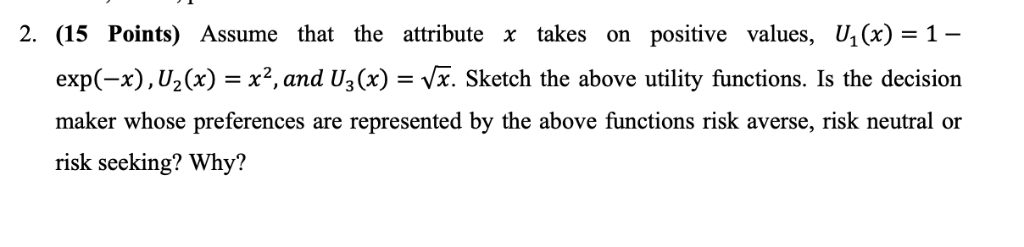 2. (15 Points) Assume that the attribute x takes on positive values, U;(x) =1—
exp(—x), U,(x) = x2, and Us(x) = Vx. Sketch the above utility functions. Is the decision
maker whose preferences are represented by the above functions risk averse, risk neutral or
risk seeking? Why?
This is AI generated Response.
Asked by: Rahul
Created at: 2026-01-11 06:13:58
Asked by: Rahul
Created at: 2026-01-11 06:13:58
Final Answer:
Rendered
Raw Text
Did you like this answer?
Let's solve the problem step by step.
---
## **Given Utility Functions**
- \( U_1(x) = 1 - \exp(-x) \)
- \( U_2(x) = x^2 \)
- \( U_3(x) = \sqrt{x} \)
Where \( x > \).
---
## **1. Sketching the Utility Functions**
Let's describe the shape of each function:
### **(a) \( U_1(x) = 1 - \exp(-x) \)**
- **Shape:** Increasing, concave.
- **Behavior:**
- At \( x = \): \( U_1() = \)
- As \( x \to \infty \): \( U_1(x) \to 1 \)
- **Second derivative:** \( U_1''(x) = -\exp(-x) < \) (always negative, so concave).
### **(b) \( U_2(x) = x^2 \)**
- **Shape:** Increasing, convex.
- **Behavior:**
- At \( x = \): \( U_2() = \)
- As \( x \) increases, \( U_2(x) \) grows rapidly.
- **Second derivative:** \( U_2''(x) = 2 > \) (always positive, so convex).
### **(c) \( U_3(x) = \sqrt{x} \)**
- **Shape:** Increasing, concave.
- **Behavior:**
- At \( x = \): \( U_3() = \)
- As \( x \) increases, \( U_3(x) \) increases but at a decreasing rate.
- **Second derivative:** \( U_3''(x) = -\frac{1}{4}x^{-3/2} < \) for \( x > \) (concave).
---
## **2. Risk Attitude Analysis**
Risk attitude is determined by the **concavity/convexity** of the utility functions:
- **Concave utility (\( U''(x) < \)) → Risk averse**
- **Linear utility (\( U''(x) = \)) → Risk neutral**
- **Convex utility (\( U''(x) > \)) → Risk seeking**
Let's analyze each:
### **(a) \( U_1(x) \):**
- **Second derivative:** \( U_1''(x) = -\exp(-x) < \)
- **Type:** **Concave**
- **Risk attitude:** **Risk averse**
### **(b) \( U_2(x) \):**
- **Second derivative:** \( U_2''(x) = 2 > \)
- **Type:** **Convex**
- **Risk attitude:** **Risk seeking**
### **(c) \( U_3(x) \):**
- **Second derivative:** \( U_3''(x) = -\frac{1}{4} x^{-3/2} < \) for \( x > \)
- **Type:** **Concave**
- **Risk attitude:** **Risk averse**
---
## **3. Summary Table**
| Utility Function | Second Derivative | Shape | Risk Attitude |
|------------------|-------------------|----------|---------------|
| \( U_1(x) \) | \( < \) | Concave | Risk averse |
| \( U_2(x) \) | \( > \) | Convex | Risk seeking |
| \( U_3(x) \) | \( < \) | Concave | Risk averse |
---
## **4. Why? (Explanation)**
- **Risk averse** individuals prefer certain outcomes over gambles with the same expected value. Their utility functions are concave, reflecting diminishing marginal utility.
- **Risk seeking** individuals prefer gambles, reflected by convex utility functions (increasing marginal utility).
- **Risk neutral** individuals have linear utility, but none of the given functions are linear.
---
## **5. Sketch (Description)**
You can sketch these functions for \( x > \):
- \( U_1(x) \): Starts at , rises quickly, then flattens toward 1.
- \( U_2(x) \): Starts at , rises slowly at first, then increases rapidly.
- \( U_3(x) \): Starts at , rises quickly at first, then increases slowly.
---
## **Final Answers**
### **Risk Attitudes:**
- \( U_1(x) \): **Risk averse** (concave)
- \( U_2(x) \): **Risk seeking** (convex)
- \( U_3(x) \): **Risk averse** (concave)
**Explanation:**
The concavity or convexity of the utility function determines risk preference. Concave means risk averse (diminishing returns), convex means risk seeking (increasing returns). This is confirmed by the sign of the second derivative.
📢 Instructions:
- Ask anything relatd to above question only.
- For new Question goto :