 VIPSolutions
Give step-by-step solution with explanation and final answer:ait Conitog outer fll | flow) fn
Question:
Give step-by-step solution with explanation and final answer: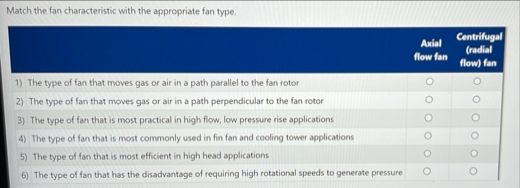 ait Conitog
outer fll
| flow) fn
This is AI generated Response.
Asked by: Rahul
Created at: 2026-01-11 04:06:25
Asked by: Rahul
Created at: 2026-01-11 04:06:25
Final Answer:
Rendered
Raw Text
Did you like this answer?
Let's solve each statement step-by-step and match it with either **Axial flow fan** or **Centrifugal (radial flow) fan**.
---
### 1) The type of fan that moves gas or air in a path parallel to the fan rotor
- **Axial flow fans** move air along the axis of the fan (parallel to the rotor).
- **Answer:** Axial flow fan
---
### 2) The type of fan that moves gas or air in a path perpendicular to the fan rotor
- **Centrifugal fans** move air at a right angle (perpendicular) to the axis of rotation.
- **Answer:** Centrifugal (radial flow) fan
---
### 3) The type of fan that is most practical in high flow, low pressure rise applications
- **Axial flow fans** are best for high flow, low pressure.
- **Answer:** Axial flow fan
---
### 4) The type of fan that is most commonly used in fin fan and cooling tower applications
- **Axial flow fans** are widely used in cooling towers and fin fans.
- **Answer:** Axial flow fan
---
### 5) The type of fan that is most efficient in high head applications
- **Centrifugal fans** are more efficient when high pressure (head) is needed.
- **Answer:** Centrifugal (radial flow) fan
---
### 6) The type of fan that has the disadvantage of requiring high rotational speeds to generate pressure
- **Axial flow fans** generally need higher speeds to generate significant pressure.
- **Answer:** Axial flow fan
---
## **Final Answers Table**
| Statement | Axial flow fan | Centrifugal (radial flow) fan |
|---------------------------------------------------------------------------|:--------------:|:-----------------------------:|
| 1) Moves air parallel to the fan rotor | ● | |
| 2) Moves air perpendicular to the fan rotor | | ● |
| 3) Most practical in high flow, low pressure rise applications | ● | |
| 4) Most commonly used in fin fan and cooling tower applications | ● | |
| 5) Most efficient in high head applications | | ● |
| 6) Disadvantage: requires high rotational speeds to generate pressure | ● | |
Let me know if you need further clarification!
📢 Instructions:
- Ask anything relatd to above question only.
- For new Question goto :