 VIPSolutions
Give step-by-step solution with explanation and final answer:A A homogeneous rod AB with length = 1 m and mass A m = 1 Kg is supported by pin C. At the instant shown, Juss the rod is at rest and a 2 = 1 kN force is applied at B. a 5 Determine a. angular acceleration of the rod, tpg. b. components of the reaction at C. 2L/3 ¢. acceleration of the centre of gravity of the rod. ag and point A, aa. P B 6 marks SOLUTIONS
Question:
Give step-by-step solution with explanation and final answer: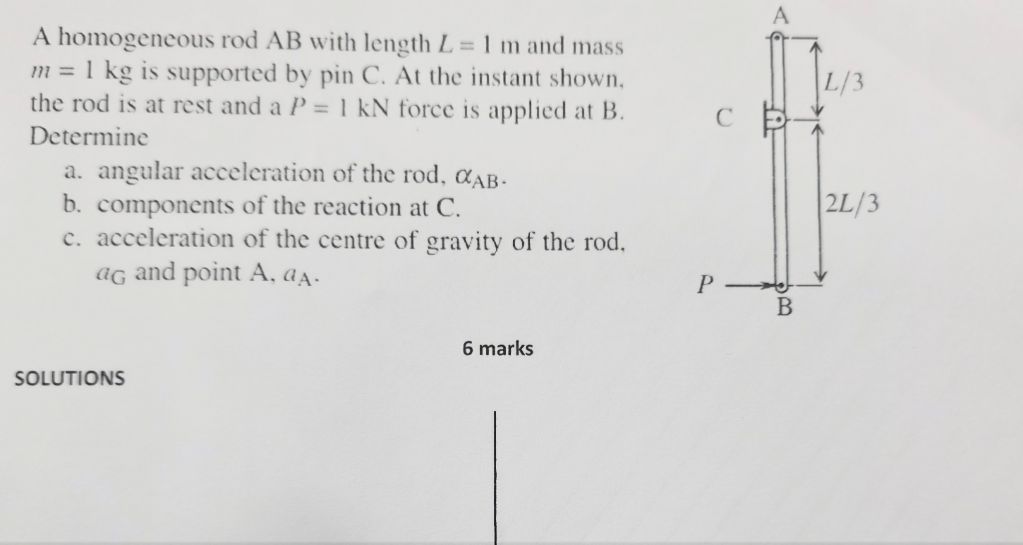 A
A homogeneous rod AB with length = 1 m and mass A
m = 1 Kg is supported by pin C. At the instant shown, Juss
the rod is at rest and a 2 = 1 kN force is applied at B. a 5
Determine
a. angular acceleration of the rod, tpg.
b. components of the reaction at C. 2L/3
¢. acceleration of the centre of gravity of the rod.
ag and point A, aa. P
B
6 marks
SOLUTIONS
This is AI generated Response.
Asked by: Rahul
Created at: 2026-01-10 15:40:50
Asked by: Rahul
Created at: 2026-01-10 15:40:50
Final Answer:
Rendered
Raw Text
Did you like this answer?
Let's solve the problem step by step.
---
## **Given Data**
- Length of rod, \( L = 1 \) m
- Mass of rod, \( m = 1 \) kg
- Force applied at \( B \), \( P = 1 \) kN \( = 100 \) N
- Rod is supported by pin at \( C \), located \( \frac{L}{3} \) from \( A \)
- Rod is at rest at the instant shown.
---
## **Step 1: Free Body Diagram & Moments**
Let's define:
- \( A \): Top of rod
- \( B \): Bottom of rod (where force is applied)
- \( C \): Pin support (\( \frac{L}{3} \) from \( A \), \( \frac{2L}{3} \) from \( B \))
**Forces acting:**
- Weight \( mg \) acting at the center (midpoint, \( \frac{L}{2} \) from \( A \))
- Applied force \( P \) at \( B \) (horizontal)
- Reactions at \( C \): \( C_x \), \( C_y \)
---
## **(a) Angular Acceleration of the Rod (\( \alpha_{AB} \))**
### **Moment of Inertia about C**
For a rod of length \( L \) and mass \( m \), the moment of inertia about a point \( d \) from the center is:
\[
I = I_{\text{center}} + m d^2 = \frac{1}{12} mL^2 + m d^2
\]
Here, \( d = | \text{distance from center to C} | = \left| \frac{L}{2} - \frac{L}{3} \right| = \frac{L}{6} \)
So,
\[
I_C = \frac{1}{12} mL^2 + m \left( \frac{L}{6} \right)^2 = \frac{1}{12} mL^2 + \frac{1}{36} mL^2 = \frac{1}{9} mL^2
\]
### **Moment Equation about C**
Sum of moments about \( C \):
\[
\sum M_C = I_C \alpha
\]
Moments due to:
- \( P \) at \( B \): Perpendicular distance from \( C \) to \( B \) is \( \frac{2L}{3} \)
- Weight passes through the center, which is at a distance \( \frac{L}{6} \) from \( C \)
\[
P \cdot \frac{2L}{3} - mg \cdot \frac{L}{6} = I_C \alpha
\]
Plug in values:
- \( P = 100 \) N
- \( m = 1 \) kg
- \( g = 9.81 \) m/s²
- \( L = 1 \) m
- \( I_C = \frac{1}{9} \) kg·m²
\[
100 \cdot \frac{2 \times 1}{3} - 1 \cdot 9.81 \cdot \frac{1}{6} = \frac{1}{9} \alpha
\]
\[
= 100 \cdot \frac{2}{3} - 9.81 \cdot \frac{1}{6} = \frac{1}{9} \alpha
\]
\[
= 666.67 - 1.635 = \frac{1}{9} \alpha
\]
\[
= 665.035 = \frac{1}{9} \alpha
\]
\[
\alpha = 9 \times 665.035 = 5985.32 \ \text{rad/s}^2
\]
**Final Answer:**
\[
\boxed{\alpha_{AB} = 5985 \ \text{rad/s}^2}
\]
---
## **(b) Components of the Reaction at \( C \) (\( C_x \), \( C_y \))**
### **Equations of Motion**
1. **Sum of Forces in \( x \):**
\[
C_x - P = m a_{Gx}
\]
2. **Sum of Forces in \( y \):**
\[
C_y - mg = m a_{Gy}
\]
3. **Acceleration of Center of Mass \( G \):**
- \( a_{Gx} = \alpha \cdot r_{G/C} \) (horizontal because rotation is about \( C \))
- \( r_{G/C} = \frac{L}{2} - \frac{L}{3} = \frac{L}{6} \)
- Acceleration is perpendicular to rod, so horizontal at this instant.
\[
a_{Gx} = \alpha \cdot \frac{L}{6}
\]
\[
a_{Gx} = 5985 \cdot \frac{1}{6} = 997.5 \ \text{m/s}^2
\]
So,
\[
C_x - 100 = 1 \times 997.5
\]
\[
C_x = 1997.5 \ \text{N}
\]
- \( a_{Gy} = \) (since angular acceleration is horizontal at instant shown)
\[
C_y - 9.81 = 1 \times
\]
\[
C_y = 9.81 \ \text{N}
\]
**Final Answers:**
\[
\boxed{C_x = 1997.5 \ \text{N}} \\
\boxed{C_y = 9.81 \ \text{N}}
\]
---
## **(c) Acceleration of Centre of Gravity (\( a_G \)) and Point \( A \) (\( a_A \))**
### **Centre of Gravity (\( a_G \))**
- \( a_{Gx} = \alpha \cdot r_{G/C} = 5985 \cdot \frac{1}{6} = 997.5 \) m/s² (right)
- \( a_{Gy} = \)
\[
\boxed{a_G = 997.5 \ \text{m/s}^2 \text{ (right)}}
\]
---
### **Point \( A \) (\( a_A \))**
- Distance from \( C \) to \( A \) is \( -\frac{L}{3} \) (upwards from \( C \))
- Acceleration of \( A \) relative to \( C \) is \( a_{A/C} = \alpha \cdot r_{A/C} \) (perpendicular to rod, i.e., horizontal at this instant)
So,
\[
a_{A, x} = \alpha \cdot \left( -\frac{L}{3} \right) = 5985 \cdot \left( -\frac{1}{3} \right) = -1995 \ \text{m/s}^2
\]
- (Negative means to the left)
\[
\boxed{a_A = 1995 \ \text{m/s}^2 \text{ (left)}}
\]
---
## **Summary Table**
| Quantity | Value | Direction |
|------------------------|-------------|--------------|
| Angular acceleration (\( \alpha_{AB} \)) | 5985 rad/s² | - |
| Reaction at C, \( C_x \) | 1997.5 N | Right |
| Reaction at C, \( C_y \) | 9.81 N | Up |
| Acceleration of G, \( a_G \) | 997.5 m/s² | Right |
| Acceleration of A, \( a_A \) | 1995 m/s² | Left |
---
### **Let me know if you need further clarification or a diagram!**
📢 Instructions:
- Ask anything relatd to above question only.
- For new Question goto :