Give step-by-step solution with explanation and final answer:1. The system shown in Figure 1 consists of a massless Me
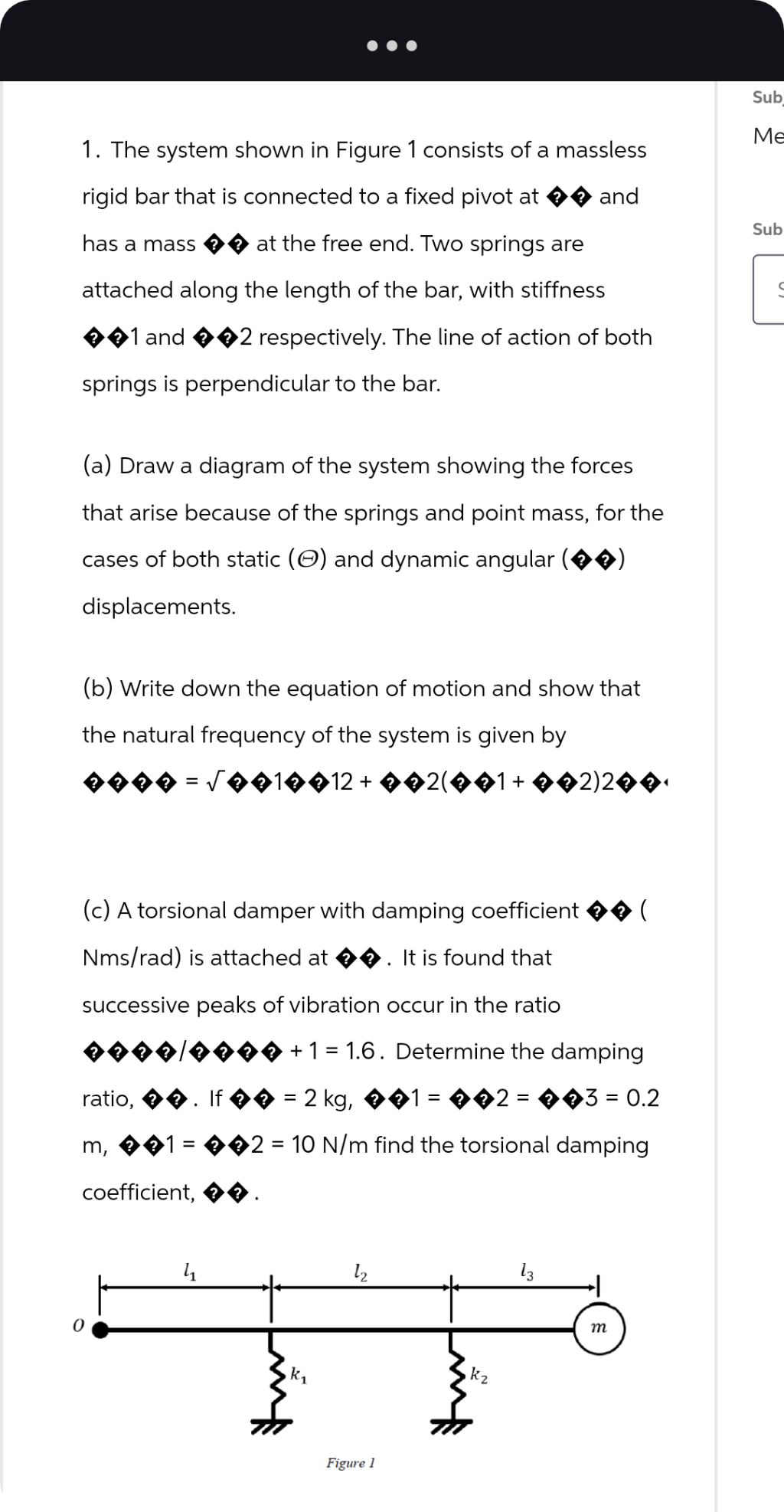
rigid bar that is connected to a fixed pivot at © € and
has a mass © € at the free end. Two springs are sub
attached along the length of the bar, with stiffness I
© Q1and @Q2 respectively. The line of action of both
springs is perpendicular to the bar.
(a) Draw a diagram of the system showing the forces
that arise because of the springs and point mass, for the
cases of both static (®) and dynamic angular (©)
displacements.
(b) Write down the equation of motion and show that
the natural frequency of the system is given by
0009 =/90010012+9002(001+ 9002)206
(c) A torsional damper with damping coefficient @€ (
Nms/rad) is attached at @€ . It is found that
successive peaks of vibration occur in the ratio
QOO0O/0009 +1=16. Determine the damping
ratio, Q€@. If QQ =2kg, ©Q1=- 9Q2=093=02
m, @©1=€©€2=10 N/m find the torsional damping
coefficient, @€ .
IA L, I; |
0 Ty 3 : )
ky k,
Figure 1
Question:
Give step-by-step solution with explanation and final answer:
This is AI generated Response. Asked by: Rahul Created at: 2026-01-10 15:27:41
Did you like this answer?
👍 0
👎 0
Let's solve each part step by step.
---
## (a) **Diagram and Forces**
**Diagram Description:**
- The bar is pivoted at \( O \).
- At distances \( l_1 \) and \( l_2 \) from the pivot, springs with stiffness \( k_1 \) and \( k_2 \) are attached perpendicular to the bar.
- At the end of the bar (distance \( l_3 \)), a mass \( m \) is attached.
**Forces:**
- **Static (\(\Theta\)):** Springs exert restoring forces perpendicular to the bar, proportional to their extensions (which depend on the static angular displacement \(\Theta\)).
- **Dynamic (\(\theta\)):** For small angular displacement \(\theta\) from equilibrium, restoring torques are generated by both springs.
**Restoring forces for small angular displacement \(\theta\):**
- Extension at \( k_1 \): \( l_1 \theta \)
- Extension at \( k_2 \): \( l_2 \theta \)
- Forces: \( F_1 = -k_1 l_1 \theta \), \( F_2 = -k_2 l_2 \theta \)
- Torques: \( \tau_1 = -k_1 l_1^2 \theta \), \( \tau_2 = -k_2 l_2^2 \theta \)
---
## (b) **Equation of Motion and Natural Frequency**
### **Step 1: Moment of Inertia**
The mass is at a distance \( l_3 \):
\[
I = m l_3^2
\]
### **Step 2: Equation of Motion (Summing Torques)**
\[
I \ddot{\theta} + (k_1 l_1^2 + k_2 l_2^2) \theta =
\]
### **Step 3: Natural Frequency**
This is a standard SHM equation:
\[
\ddot{\theta} + \frac{k_1 l_1^2 + k_2 l_2^2}{m l_3^2} \theta =
\]
So,
\[
\omega_n = \sqrt{\frac{k_1 l_1^2 + k_2 l_2^2}{m l_3^2}}
\]
---
## (c) **Damping Ratio and Torsional Damping Coefficient**
### **Step 1: Logarithmic Decrement**
Given:
\[
\frac{\theta_n}{\theta_{n+1}} = 1.6 \implies \delta = \ln(1.6) = .470
\]
### **Step 2: Damping Ratio (\(\zeta\))**
\[
\delta = 2\pi\zeta / \sqrt{1 - \zeta^2}
\]
Let \( x = \zeta \):
\[
.470 = \frac{2\pi x}{\sqrt{1-x^2}}
\]
\[
.470 \sqrt{1-x^2} = 2\pi x
\]
\[
.2209 (1-x^2) = 4\pi^2 x^2
\]
\[
.2209 - .2209 x^2 = 39.4784 x^2
\]
\[
.2209 = (39.4784 + .2209) x^2
\]
\[
x^2 = \frac{.2209}{39.6993}
\]
\[
x = \sqrt{.00557} \approx .0747
\]
So, **damping ratio** \( \zeta \approx .075 \)
---
### **Step 3: Find Torsional Damping Coefficient \( c \)**
\[
\zeta = \frac{c}{2 I \omega_n}
\]
- \( m = 2 \) kg
- \( l_1 = l_2 = l_3 = .2 \) m
- \( k_1 = k_2 = 10 \) N/m
#### Calculate \( I \):
\[
I = m l_3^2 = 2 \times (.2)^2 = 2 \times .04 = .08 \text{ kg m}^2
\]
#### Calculate \( \omega_n \):
\[
k_1 l_1^2 + k_2 l_2^2 = 10 \times (.2)^2 + 10 \times (.2)^2 = 2 \times 10 \times .04 = .8
\]
\[
\omega_n = \sqrt{ \frac{.8}{.08} } = \sqrt{10} = 3.162 \text{ rad/s}
\]
#### Solve for \( c \):
\[
c = 2 \zeta I \omega_n = 2 \times .075 \times .08 \times 3.162
\]
\[
= .15 \times .08 \times 3.162 = .012 \times 3.162 = .0379 \text{ Nms/rad}
\]
---
## **Final Answers**
### (a) **Diagram provided above; forces explained.**
### (b) **Equation of motion:**
\[
I \ddot{\theta} + (k_1 l_1^2 + k_2 l_2^2)\theta =
\]
**Natural frequency:**
\[
\omega_n = \sqrt{ \frac{k_1 l_1^2 + k_2 l_2^2}{m l_3^2} }
\]
### (c) **Damping ratio:** \( \zeta \approx .075 \)
**Torsional damping coefficient:**
\[
\boxed{c = .038 \ \text{Nms/rad}}
\]
---
Let me know if you need a sketch or further clarification!
📢 Instructions:
Ask anything relatd to above question only.
For new Question goto :
🚀 Submit (-0.25 Credits🪙)
Study Help, Fast Answers
VIPSolutions focuses on clear, step‑by‑step explanations so you can learn quickly. Whether you need an AI‑generated walkthrough or a short hint to get unstuck, each solution is organized for fast reading and easy review later.
Search similar questions, compare approaches, and bookmark the best answers for revision. Our goal is simple: quick, reliable study help that feels natural—not noisy.
 VIPSolutions
 1. The system shown in Figure 1 consists of a massless Me
rigid bar that is connected to a fixed pivot at © € and
has a mass © € at the free end. Two springs are sub
attached along the length of the bar, with stiffness I
© Q1and @Q2 respectively. The line of action of both
springs is perpendicular to the bar.
(a) Draw a diagram of the system showing the forces
that arise because of the springs and point mass, for the
cases of both static (®) and dynamic angular (©)
displacements.
(b) Write down the equation of motion and show that
the natural frequency of the system is given by
0009 =/90010012+9002(001+ 9002)206
(c) A torsional damper with damping coefficient @€ (
Nms/rad) is attached at @€ . It is found that
successive peaks of vibration occur in the ratio
QOO0O/0009 +1=16. Determine the damping
ratio, Q€@. If QQ =2kg, ©Q1=- 9Q2=093=02
m, @©1=€©€2=10 N/m find the torsional damping
coefficient, @€ .
IA L, I; |
0 Ty 3 : )
ky k,
Figure 1