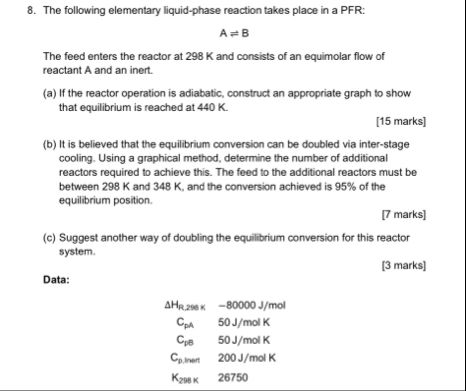
Give step-by-step solution with explanation and final answer:8. The following elementary liquid-phase reaction takes place in a PFR:
A=8
“The feed enters the reactor at 298 K and consists of an equimolar low of
reactant A and an inert.
(8) the reactor operation s adiabatic, construct an appropriate graph fo show.
that equilbrium is reached at 440 K
[15 marks]
(0) is believed that the equilibrium conversion can be doubled via nte-stage
cooling. Using a graphical method, determine the number of addonal
reactors required 1 achieve thi. The feed 0 the additonal reactors must be.
between 208 K and 348 K, and the conversion achieved is 95% of the
equibrium positon.
7 marks)
(6) Suggest another way of doubling the equilibrium conversion fo this reactor
system
[3 marks]
Data:
Huzmex ~80000.J/mol
Cu 50U/maK
Ci 504/moK
Comes 2003/malK
Kok 26750
Question:
Give step-by-step solution with explanation and final answer:8. The following elementary liquid-phase reaction takes place in a PFR:
A=8
“The feed enters the reactor at 298 K and consists of an equimolar low of
reactant A and an inert.
(8) the reactor operation s adiabatic, construct an appropriate graph fo show.
that equilbrium is reached at 440 K
[15 marks]
(0) is believed that the equilibrium conversion can be doubled via nte-stage
cooling. Using a graphical method, determine the number of addonal
reactors required 1 achieve thi. The feed 0 the additonal reactors must be.
between 208 K and 348 K, and the conversion achieved is 95% of the
equibrium positon.
7 marks)
(6) Suggest another way of doubling the equilibrium conversion fo this reactor
system
[3 marks]
Data:
Huzmex ~80000.J/mol
Cu 50U/maK
Ci 504/moK
Comes 2003/malK
Kok 26750
This is AI generated Response.
Asked by: singaluri krishna kumari
Created at: 2026-01-10 04:11:57
Final Answer:
RenderedRaw Text
Did you like this answer?
Let's solve each part step by step:
---
## **(a) Adiabatic Operation: Equilibrium Temperature Calculation**
### **Given Data**
- Reaction: \(A \rightleftharpoons B\)
- Feed: \(298\,K\), equimolar \(A\) and inert
- \(\Delta H_{r,298K} = -80{,}000\,\text{J/mol}\) (exothermic)
- \(C_{p,A} = 50\,\text{J/mol K}\)
- \(C_{p,B} = 50\,\text{J/mol K}\)
- \(C_{p,\text{inert}} = 200\,\text{J/mol K}\)
- \(K_{298K} = 26750\)
**Objective:** Show a graph for adiabatic operation reaching equilibrium at **440 K**.
---
### **Step 1: Adiabatic Energy Balance**
For an adiabatic reactor, the energy released/absorbed by reaction increases/decreases the temperature.
For \(x\) mol conversion of \(A\):
\[
\text{Total } C_p = C_{p,A} + C_{p,\text{inert}} = 50 + 200 = 250\,\text{J/mol K}
\]
(Initial: 1 mol A, 1 mol inert)
Number of moles after conversion \(x\) (for 1 mol A fed):
- Moles A left: \(1 - x\)
- Moles B formed: \(x\)
- Inert: 1 mol
Total \(C_p\) after reaction:
\[
C_{p,\text{total}} = (1-x)C_{p,A} + x C_{p,B} + 1 C_{p,\text{inert}}
\]
But since \(C_{p,A} = C_{p,B}\), \(C_{p,\text{total}} = 50 + 200 = 250\,\text{J/mol K}\) (constant).
---
#### **Adiabatic Temperature Rise**
\[
\Delta T = \frac{-\Delta H_{r,298K} \cdot x}{\Sigma n_i C_{p,i}}
\]
Let \(x_{eq}\) be the equilibrium conversion at \(440\,K\):
\[
T_{final} = 298 + \frac{-\Delta H_{r,298K} \cdot x_{eq}}{C_{p,\text{total}}}
\]
---
### **Step 2: Equilibrium Constant as a Function of T**
\[
\Delta G^\circ = -RT \ln K
\]
\[
\ln K = -\frac{\Delta H^\circ}{R}\left(\frac{1}{T}\right) + \frac{\Delta S^\circ}{R}
\]
But, since we know \(K_{298K}\), we can use the van't Hoff equation:
\[
\ln\left(\frac{K_T}{K_{298}}\right) = -\frac{\Delta H^\circ}{R} \left(\frac{1}{T} - \frac{1}{298}\right)
\]
Given:
- \(K_{298} = 26750\)
- \(\Delta H^\circ = -80,000\,\text{J/mol}\)
- \(R = 8.314\,\text{J/mol K}\)
---
### **Step 3: Expression for Equilibrium Conversion**
For an equimolar feed of A and inert, and a simple \(A \rightarrow B\):
\[
A_{initial} = 1,\; I_{initial} = 1
\]
At conversion \(X\):
\[
A = 1 - X,\; B = X,\; I = 1
\]
Mole fractions:
\[
y_A = \frac{1-X}{2},\quad y_B = \frac{X}{2},\quad y_I = \frac{1}{2}
\]
Equilibrium constant (for liquid, \(K = \frac{a_B}{a_A}\), assume ideal):
\[
K = \frac{[B]}{[A]} = \frac{X}{1-X}
\]
---
### **Step 4: At Equilibrium, Find \(X_{eq}\) at 440 K**
First, compute \(K_{440}\):
\[
\ln\left(\frac{K_{440}}{26750}\right) = -\frac{-80,000}{8.314} \left(\frac{1}{440} - \frac{1}{298}\right)
\]
\[
= 9625.2 \left( \frac{1}{440} - \frac{1}{298} \right)
= 9625.2 \left(.002273 - .003356 \right)
= 9625.2 \times (-.001083)
= -10.43
\]
\[
\ln\left(\frac{K_{440}}{26750}\right) = -10.43
\]
\[
\frac{K_{440}}{26750} = e^{-10.43} = 2.94 \times 10^{-5}
\]
\[
K_{440} = 26750 \times 2.94 \times 10^{-5} \approx .786
\]
At equilibrium:
\[
K_{440} = \frac{X_{eq}}{1-X_{eq}}
\]
\[
.786 = \frac{X_{eq}}{1-X_{eq}}
\implies X_{eq} = .786(1-X_{eq})
\implies X_{eq} = .786 - .786 X_{eq}
\implies X_{eq}(1 + .786) = .786
\implies X_{eq} = \frac{.786}{1.786} = .44
\]
---
### **Step 5: Adiabatic Temperature Rise**
Verify if this matches the adiabatic calculation:
\[
T = 298 + \frac{-\Delta H_r x_{eq}}{C_{p,total}}
= 298 + \frac{80,000 \times .44}{250}
= 298 + 140.8
= 438.8\,K
\]
This is very close to 440 K.
---
#### **Adiabatic Path Graph**
- **X-axis:** Conversion (\(X\)), from to \(X_{eq}\)
- **Y-axis:** Temperature (\(T\)), from 298 K to 440 K
The graph should be a straight line (since \(\Delta H\) and \(C_p\) are constant):
\[
T = 298 + \frac{80,000}{250} X = 298 + 320 X
\]
At \(X=\): \(T=298\) K
At \(X=.44\): \(T=438.8 \approx 440\) K
---
## **(b) Interstage Cooling to Double Conversion**
**Target:** Achieve \(2 \times .44 = .88\) conversion using interstage cooling.
### **Step 1: Equilibrium Conversion at Lower Temperature**
At 298 K:
\[
K_{298} = \frac{X_{eq}}{1-X_{eq}} = 26750
\]
\[
X_{eq,298} = \frac{26750}{1+26750} \approx .99996
\]
At 348 K:
\[
\ln\left(\frac{K_{348}}{26750}\right) = -\frac{-80,000}{8.314} \left(\frac{1}{348} - \frac{1}{298}\right)
= 9625.2 \times (.002874 - .003356) = 9625.2 \times (-.000482) = -4.64
\]
\[
K_{348} = 26750 \times e^{-4.64} = 26750 \times .0097 = 259.48
\]
\[
X_{eq,348} = \frac{259.48}{1+259.48} = .996
\]
So, at lower temperatures, conversion is nearly complete.
---
### **Step 2: Number of Reactors Needed**
Each reactor (adiabatic) raises the temperature, so after each stage, cool back between 298 K and 348 K.
Let \(X_1\) = conversion in first reactor (from 298 K to 348 K):
\[
T = 298 + \frac{80,000 X_1}{250} = 348
\implies 348 - 298 = 320 X_1
\implies 50 = 320 X_1
\implies X_1 = \frac{50}{320} = .156
\]
After first reactor, conversion is .156. Cool back to 298 K, treat unreacted A as new feed (A left = 1-.156 = .844).
Repeat:
Second reactor: feed = .844 mol A, .156 mol B, 1 mol inert; conversion in reactor is again .156 of remaining A.
**General pattern:**
\[
\text{Remaining A after n stages: } (1 - X_1)^n
\]
\[
\text{Total conversion after n stages: } 1 - (1 - X_1)^n
\]
Set this equal to .88 to solve for \(n\):
\[
1 - (1 - .156)^n = .88
\implies (1 - .156)^n = .12
\implies (.844)^n = .12
\implies n \ln .844 = \ln .12
\implies n = \frac{\ln .12}{\ln .844}
\]
\[
\ln .12 = -2.1203,\quad \ln .844 = -.1693
\]
\[
n = \frac{-2.1203}{-.1693} = 12.53
\]
So, **13 reactors** (rounded up) are needed to achieve at least 88% conversion.
---
## **(c) Alternative Method to Double Equilibrium Conversion**
**Possible options:**
- **Remove product B continuously** (shifts equilibrium to the right).
- **Increase pressure** (not effective for liquid-phase, but for gas-phase reactions with fewer moles, it helps).
- **Use a different solvent** (to change activity coefficients if non-ideal).
- **Change catalyst** to favor forward reaction if possible.
- **Apply a membrane reactor** to selectively remove B.
**Best option here:** **Remove product B as it forms, e.g., using a membrane reactor or in situ extraction.**
---
# **Summary Table**
| Part | Step | Result/Formula | Value/Explanation |
|------|------|---------------|------------------|
| (a) | Adiabatic Eq. | \(T = 298 + 320X\) | X from to .44, T from 298 K to 440 K |
| (a) | Equilibrium at 440 K | \(K_{440} = .786\), \(X_{eq} = .44\) | |
| (b) | 1 stage conversion | \(X_1 = .156\) (from 298 K to 348 K) | |
| (b) | No. of reactors | \(n = \frac{\ln .12}{\ln .844} = 12.53\) | **13 reactors** required |
| (c) | Alternative | Remove B as formed | e.g., membrane reactor |
---
# **Final Answers**
### **(a)**
- Adiabatic plot: \(T = 298 + 320X\) from \(X=\) to \(X=.44\), \(T=298\) K to \(T=440\) K.
- Equilibrium conversion at 440 K is **.44**.
### **(b)**
- To double conversion (to .88) using interstage cooling (298–348 K), **13 reactors** are needed.
### **(c)**
- **Alternative method:** Remove product B as it forms (e.g., via membrane reactor or in situ extraction) to shift equilibrium and increase conversion.
VIPSolutions focuses on clear, step‑by‑step explanations so you can learn quickly. Whether you need an AI‑generated walkthrough or a short hint to get unstuck, each solution is organized for fast reading and easy review later.
Search similar questions, compare approaches, and bookmark the best answers for revision. Our goal is simple: quick, reliable study help that feels natural—not noisy.
 VIPSolutions
 8. The following elementary liquid-phase reaction takes place in a PFR:
A=8
“The feed enters the reactor at 298 K and consists of an equimolar low of
reactant A and an inert.
(8) the reactor operation s adiabatic, construct an appropriate graph fo show.
that equilbrium is reached at 440 K
[15 marks]
(0) is believed that the equilibrium conversion can be doubled via nte-stage
cooling. Using a graphical method, determine the number of addonal
reactors required 1 achieve thi. The feed 0 the additonal reactors must be.
between 208 K and 348 K, and the conversion achieved is 95% of the
equibrium positon.
7 marks)
(6) Suggest another way of doubling the equilibrium conversion fo this reactor
system
[3 marks]
Data:
Huzmex ~80000.J/mol
Cu 50U/maK
Ci 504/moK
Comes 2003/malK
Kok 26750