 VIPSolutions
Give step-by-step solution with explanation and final answer:7.35 Consider the combustion of butane and air according to C,H,, + 8(0, + 3.76N,) — 4CO, + 5H,0 +1.50, + 8B3.76)N, Calculate the (a) fuel-to-air ratio, (b) equivalence ratio, @, for this reaction
Question:
Give step-by-step solution with explanation and final answer: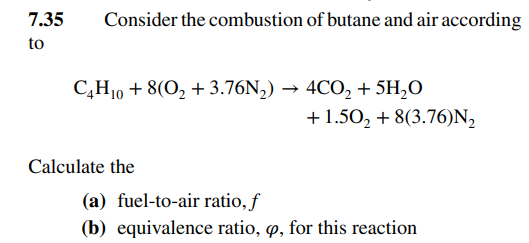 7.35 Consider the combustion of butane and air according
to
C,H,, + 8(0, + 3.76N,) — 4CO, + 5H,0
+1.50, + 8B3.76)N,
Calculate the
(a) fuel-to-air ratio,
(b) equivalence ratio, @, for this reaction
This is AI generated Response.
Asked by: Francis
Created at: 2026-01-10 03:51:33
Asked by: Francis
Created at: 2026-01-10 03:51:33
Final Answer:
Rendered
Raw Text
Did you like this answer?
Let's solve the problem step by step:
---
## Given Reaction:
\[
\mathrm{C_4H_{10}} + 8(\mathrm{O_2} + 3.76\mathrm{N_2}) \rightarrow 4\mathrm{CO_2} + 5\mathrm{H_2O} + 1.5\mathrm{O_2} + 8(3.76)\mathrm{N_2}
\]
### (a) **Fuel-to-air ratio,** \( f \)
#### **Step 1: Find moles of fuel and air**
- 1 mole of butane (\(\mathrm{C_4H_{10}}\))
- Air: \(8(\mathrm{O_2} + 3.76\mathrm{N_2})\)
#### **Step 2: Calculate moles of air**
- 1 mole of \(\mathrm{O_2}\) is accompanied by 3.76 moles of \(\mathrm{N_2}\) in air.
- Moles of air \(= 8 \times (1 + 3.76) = 8 \times 4.76 = 38.08\) moles of air
#### **Step 3: Find the mass of fuel and air**
**Molar mass of butane (\(\mathrm{C_4H_{10}}\)):**
\[
\mathrm{C_4H_{10}}: (4 \times 12.01) + (10 \times 1.008) = 48.04 + 10.08 = 58.12~\mathrm{g/mol}
\]
**Molar mass of air:**
\[
\text{Average molar mass of dry air} \approx 28.97~\mathrm{g/mol}
\]
#### **Step 4: Calculate fuel-to-air ratio (\( f \))**
\[
f = \frac{\text{mass of fuel}}{\text{mass of air}}
\]
\[
\text{Mass of fuel} = 1~\mathrm{mol} \times 58.12~\mathrm{g/mol} = 58.12~\mathrm{g}
\]
\[
\text{Mass of air} = 38.08~\mathrm{mol} \times 28.97~\mathrm{g/mol} = 1103~\mathrm{g}
\]
\[
f = \frac{58.12}{1103} = .0527
\]
---
### (b) **Equivalence ratio, \( \phi \)**
\[
\phi = \frac{(\text{fuel/air})_\text{actual}}{(\text{fuel/air})_\text{stoichiometric}}
\]
#### **Step 1: Find stoichiometric fuel-to-air ratio**
Stoichiometric combustion of butane:
\[
\mathrm{C_4H_{10}} + x (\mathrm{O_2} + 3.76 \mathrm{N_2}) \rightarrow
\]
Complete combustion:
\[
\mathrm{C_4H_{10}} + \frac{13}{2}\mathrm{O_2} + \frac{13}{2} \cdot 3.76 \mathrm{N_2} \rightarrow 4\mathrm{CO_2} + 5\mathrm{H_2O} + (\text{N}_2)
\]
So, stoichiometric air required:
\[
\frac{13}{2}(\mathrm{O_2} + 3.76\mathrm{N_2}) = 6.5 \times 4.76 = 30.94~\text{mol air}
\]
\[
\text{Mass of air (stoich)} = 30.94 \times 28.97 = 897~\mathrm{g}
\]
\[
f_{stoich} = \frac{58.12}{897} = .0648
\]
#### **Step 2: Calculate equivalence ratio \( \phi \)**
\[
\phi = \frac{f_{actual}}{f_{stoich}} = \frac{.0527}{.0648} = .813
\]
---
## **Final Answers**
**(a) Fuel-to-air ratio, \( f \):**
\[
\boxed{.0527}
\]
**(b) Equivalence ratio, \( \phi \):**
\[
\boxed{.813}
\]
---
Let me know if you'd like any clarifications!
📢 Instructions:
- Ask anything relatd to above question only.
- For new Question goto :