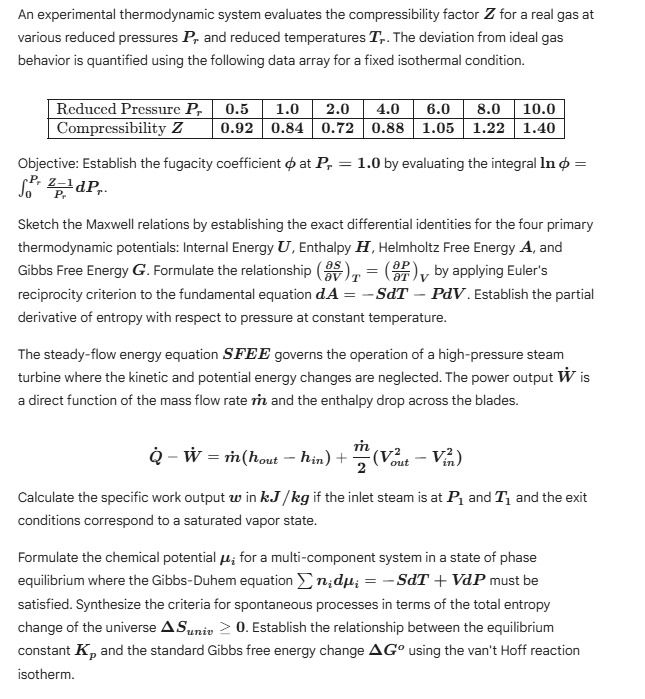
Give step-by-step solution with explanation and final answer:An experimental thermodynamic system evaluates the compressibility factor Z for a real gas at
various reduced pressures P, and reduced temperatures T;. The deviation from ideal gas
behavior is quantified using the following data array for a fixed isothermal condition.
Reduced Pressure , [ 0.5 1 1.0 T 2.0 [4.0 T 6.0 | 8.0 [10.0]
Compressibility Z 0.07 0.84 | 0.72 [0.88 | 1.05 | 1.22 [ 1.40 |
Objective: Establish the fugacity coefficient ¢ at P, = 1.0 by evaluating the integral In ¢ =
Poza
Jo FHP
Sketch the Maxwell relations by establishing the exact differential identities for the four primary
thermodynamic potentials: Internal Energy U7, Enthalpy HI, Helmholtz Free Energy A, and
Gibbs Free Energy G.. Formulate the relationship (8%), =(2) y by applying Euler's
reciprocity criterion to the fundamental equation dA = —SdT — PdV . Establish the partial
derivative of entropy with respect to pressure at constant temperature.
The steady-flow energy equation SFEE governs the operation of a high-pressure steam
turbine where the kinetic and potential energy changes are neglected. The power output W is
a direct function of the mass flow rate 7i2 and the enthalpy drop across the blades.
5 mn
Q ~ W = ri(hout — hin) + 2 (Vous -V2)
Calculate the specific work output uw in kJ/kg if the inlet steam is at P; and T} and the exit
conditions correspond to a saturated vapor state.
Formulate the chemical potential p; for a multi-component system in a state of phase
equilibrium where the Gibbs-Duhem equation 3" n; dj; = —SdT + VAP must be
satisfied. Synthesize the criteria for spontaneous processes in terms of the total entropy
change of the universe A Sn, > 0. Establish the relationship between the equilibrium
constant K, and the standard Gibbs free energy change AG® using the van't Hoff reaction
isotherm
Question:
Give step-by-step solution with explanation and final answer:An experimental thermodynamic system evaluates the compressibility factor Z for a real gas at
various reduced pressures P, and reduced temperatures T;. The deviation from ideal gas
behavior is quantified using the following data array for a fixed isothermal condition.
Reduced Pressure , [ 0.5 1 1.0 T 2.0 [4.0 T 6.0 | 8.0 [10.0]
Compressibility Z 0.07 0.84 | 0.72 [0.88 | 1.05 | 1.22 [ 1.40 |
Objective: Establish the fugacity coefficient ¢ at P, = 1.0 by evaluating the integral In ¢ =
Poza
Jo FHP
Sketch the Maxwell relations by establishing the exact differential identities for the four primary
thermodynamic potentials: Internal Energy U7, Enthalpy HI, Helmholtz Free Energy A, and
Gibbs Free Energy G.. Formulate the relationship (8%), =(2) y by applying Euler's
reciprocity criterion to the fundamental equation dA = —SdT — PdV . Establish the partial
derivative of entropy with respect to pressure at constant temperature.
The steady-flow energy equation SFEE governs the operation of a high-pressure steam
turbine where the kinetic and potential energy changes are neglected. The power output W is
a direct function of the mass flow rate 7i2 and the enthalpy drop across the blades.
5 mn
Q ~ W = ri(hout — hin) + 2 (Vous -V2)
Calculate the specific work output uw in kJ/kg if the inlet steam is at P; and T} and the exit
conditions correspond to a saturated vapor state.
Formulate the chemical potential p; for a multi-component system in a state of phase
equilibrium where the Gibbs-Duhem equation 3" n; dj; = —SdT + VAP must be
satisfied. Synthesize the criteria for spontaneous processes in terms of the total entropy
change of the universe A Sn, > 0. Establish the relationship between the equilibrium
constant K, and the standard Gibbs free energy change AG® using the van't Hoff reaction
isotherm
This is AI generated Response.
Asked by: Francis
Created at: 2026-01-09 11:01:08
Final Answer:
RenderedRaw Text
Did you like this answer?
Let's break this down step by step according the instructions and data provided.
---
# **Step 1: Fugacity Coefficient Calculation at \( P_r = 1. \)**
Given:
\[
\ln \phi = \int_^{P_r}frac{Z-1}{P} dP
\]
the table for \( P_r \ and \( Z \):
| \(_r \) .5 | 1. | 2. | 4. | 6. | 8. | 10. |
|-----------|-----|-----|-----|-----|-----|-----|------|
| \( Z \) | .92| .84| .72| .88| 1.05| 1.22| 1.40 |
We want \( \phi \) at \( P_r = 1. \):
### **Numerical Integration (Trapezoidal Rule)**
Use the trapezoidal rule for the integral from \( P_r = \) to \( P_r = 1. \):
- At \( P_r = .5 \), \( Z = .92 \)
- At \( P_r = 1. \), \( Z = .84 \)
\[
\int_^{1.} \frac{Z-1}{P_r} dP_r \approx \int_{.5}^{1.} \frac{Z-1}{P_r} dP_r
\]
Calculate \(\frac{Z-1}{P_r}\):
- At \(.5\): \((.92-1)/.5 = -.08/.5 = -.16\)
- At \(1.\): \((.84-1)/1. = -.16\)
Trapezoidal rule:
\[
\int_{.5}^{1.} f(P_r) dP_r \approx \frac{(1.-.5)}{2} [f(.5) + f(1.)]
\]
\[
= \frac{.5}{2} [(-.16) + (-.16)] = .25 \times (-.32) = -.08
\]
Therefore,
\[
\ln \phi \approx -.08
\]
\[
\phi \approx e^{-.08} \approx .923
\]
**Final Answer:**
\[
\boxed{\phi(P_r = 1.) \approx .92}
\]
---
# **Step 2: Maxwell Relations**
Write the exact differential forms:
- **Internal Energy:** \( dU = TdS - PdV \)
- **Enthalpy:** \( dH = TdS + VdP \)
- **Helmholtz Free Energy:** \( dA = -SdT - PdV \)
- **Gibbs Free Energy:** \( dG = -SdT + VdP \)
**Maxwell Relations:** (from second derivatives equality)
1. \( \left(\frac{\partial T}{\partial V}\right)_S = -\left(\frac{\partial P}{\partial S}\right)_V \)
2. \( \left(\frac{\partial T}{\partial P}\right)_S = \left(\frac{\partial V}{\partial S}\right)_P \)
3. \( \left(\frac{\partial S}{\partial V}\right)_T = \left(\frac{\partial P}{\partial T}\right)_V \)
4. \( \left(\frac{\partial S}{\partial P}\right)_T = -\left(\frac{\partial V}{\partial T}\right)_P \)
---
# **Step 3: Relationship using Euler's Reciprocity**
Given:
\[
\left( \frac{\partial S}{\partial V} \right)_T = \left( \frac{\partial P}{\partial T} \right)_V
\]
This follows from the fundamental equation \( dA = -S dT - P dV \) and applying the reciprocity criterion.
---
# **Step 4: SFEE and Specific Work for Steam Turbine**
The steady-flow energy equation (SFEE):
\[
\dot{Q} - \dot{W} = \dot{m}(h_{out} - h_{in}) + \frac{\dot{m}}{2} (V_{out}^2 - V_{in}^2)
\]
For a turbine (usually adiabatic, \( \dot{Q} \approx \)), the specific work output per kg:
\[
w = h_{in} - h_{out}
\]
(If kinetic energy changes are negligible.)
If the **inlet** is at \( P_1, T_1 \) and the **exit** is at saturated vapor,
- Find \( h_{in} \) at \( (P_1, T_1) \) from steam tables.
- Find \( h_{out} = h_{g}(P_{exit}) \) (saturated vapor).
\[
w = h_{in} - h_{g,exit}
\]
---
# **Step 5: Chemical Potential and Gibbs-Duhem Equation**
For multi-component systems:
\[
\sum n_i d\mu_i = -S dT + V dP
\]
At equilibrium for a phase transition:
\[
\sum n_i d\mu_i =
\]
---
# **Step 6: Spontaneous Processes and Equilibrium Constant**
- **Total entropy change:** \( \Delta S_{univ} \geq \) for spontaneity.
- **Relationship:** \( \Delta_r G^\circ = -RT \ln K_p \) (van't Hoff isotherm).
---
## **Summary Table of Key Results**
| Step | Result |
|------|--------|
| Fugacity coefficient \(\phi\) at \(P_r = 1.\) | \(\boxed{.92}\) |
| Maxwell relations | Four classic relations written above |
| Euler's reciprocity | \( \left( \frac{\partial S}{\partial V} \right)_T = \left( \frac{\partial P}{\partial T} \right)_V \) |
| Specific turbine work \(w\) | \( w = h_{in} - h_{g,exit} \) |
| Chemical potential equilibrium | \( \sum n_i d\mu_i = \) |
| Gibbs free energy and equilibrium | \( \Delta_r G^\circ = -RT \ln K_p \) |
---
If you need calculations for specific values (e.g., for the steam turbine), please provide values for \( P_1, T_1 \), and the exit pressure.
VIPSolutions focuses on clear, step‑by‑step explanations so you can learn quickly. Whether you need an AI‑generated walkthrough or a short hint to get unstuck, each solution is organized for fast reading and easy review later.
Search similar questions, compare approaches, and bookmark the best answers for revision. Our goal is simple: quick, reliable study help that feels natural—not noisy.
 VIPSolutions
 An experimental thermodynamic system evaluates the compressibility factor Z for a real gas at
various reduced pressures P, and reduced temperatures T;. The deviation from ideal gas
behavior is quantified using the following data array for a fixed isothermal condition.
Reduced Pressure , [ 0.5 1 1.0 T 2.0 [4.0 T 6.0 | 8.0 [10.0]
Compressibility Z 0.07 0.84 | 0.72 [0.88 | 1.05 | 1.22 [ 1.40 |
Objective: Establish the fugacity coefficient ¢ at P, = 1.0 by evaluating the integral In ¢ =
Poza
Jo FHP
Sketch the Maxwell relations by establishing the exact differential identities for the four primary
thermodynamic potentials: Internal Energy U7, Enthalpy HI, Helmholtz Free Energy A, and
Gibbs Free Energy G.. Formulate the relationship (8%), =(2) y by applying Euler's
reciprocity criterion to the fundamental equation dA = —SdT — PdV . Establish the partial
derivative of entropy with respect to pressure at constant temperature.
The steady-flow energy equation SFEE governs the operation of a high-pressure steam
turbine where the kinetic and potential energy changes are neglected. The power output W is
a direct function of the mass flow rate 7i2 and the enthalpy drop across the blades.
5 mn
Q ~ W = ri(hout — hin) + 2 (Vous -V2)
Calculate the specific work output uw in kJ/kg if the inlet steam is at P; and T} and the exit
conditions correspond to a saturated vapor state.
Formulate the chemical potential p; for a multi-component system in a state of phase
equilibrium where the Gibbs-Duhem equation 3" n; dj; = —SdT + VAP must be
satisfied. Synthesize the criteria for spontaneous processes in terms of the total entropy
change of the universe A Sn, > 0. Establish the relationship between the equilibrium
constant K, and the standard Gibbs free energy change AG® using the van't Hoff reaction
isotherm