 VIPSolutions
Give step-by-step solution with explanation and final answer:= == ee — =. = ng y — [=] Sm CERES | ER Een oF et 5s 15] ot te = Sg 2g og 5 § © EGRESS oo © £ Clos £3 F oe EE 5 a 5 Boa 2 Qa £ 0 o ° a 0 laptta=) irs) [23 - = fos) TT) Sl © 2 = = ZL Ee Ee Di re S| 5 gd 2 5 Che sl Toe ot Ci Epa = Boo = 5 ® = == SF Sue JOR © = === SUR ORE oc ° a = sel 8 vo a = [=P] a OS 0 — = 4 g 2 ie el &© 5 az =e YR on 9 a a! — [7] Er To = IZ = = 3 S p= = Gi” 2 a g = == a SE ce 2 EO © === 2 gE gE Se i =r a 35 et a g 3g 2 == = = © = & Te 5 Se a g 8 a re = Sc = = TE eS £1 gE 8 2 Se = 2% =< = = g a a = = gd ee = See ~ = a B® = = ee z oo = i Sheed == & 2 = @ — = [ey BE dd g a = Fa = l=] E =] ~ ge Ee Le =
Question:
Give step-by-step solution with explanation and final answer: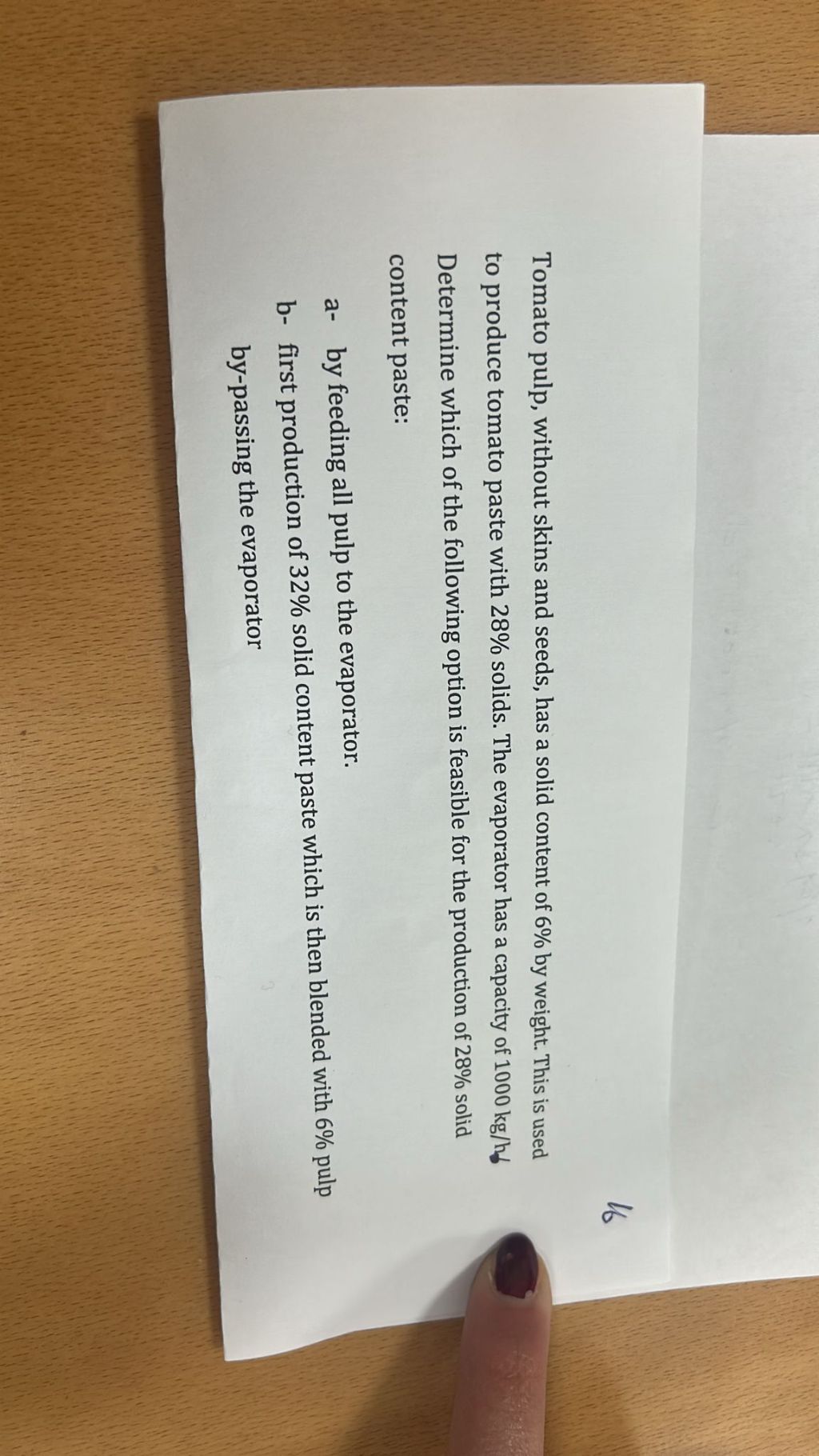 =
==
ee —
=. =
ng
y —
[=] Sm
CERES
| ER Een oF
et 5s
15]
ot te =
Sg 2g og 5 § ©
EGRESS oo © £
Clos £3 F
oe EE
5 a 5 Boa 2
Qa £ 0 o °
a 0 laptta=) irs)
[23 - = fos) TT) Sl
© 2 = = ZL
Ee Ee Di re
S| 5 gd 2 5
Che sl Toe
ot
Ci Epa
= Boo = 5 ® =
== SF Sue JOR ©
= === SUR ORE oc ° a
= sel 8 vo a
= [=P] a OS 0
— = 4 g 2
ie el &© 5 az
=e YR on 9
a a! — [7]
Er To = IZ
= = 3 S p=
= Gi” 2 a g
= == a SE
ce 2 EO ©
=== 2 gE gE
Se i =r a 35
et a g 3g 2
== = = © = &
Te 5
Se a g 8 a
re = Sc
= = TE
eS £1 gE 8 2
Se = 2% =<
= = g a a
= = gd
ee =
See ~
= a B® = =
ee z oo
= i Sheed
== & 2 = @
— = [ey BE dd g
a = Fa
= l=]
E
=] ~
ge
Ee
Le =
This is AI generated Response.
Asked by: francis
Created at: 2026-01-08 21:36:17
Asked by: francis
Created at: 2026-01-08 21:36:17
Final Answer:
Rendered
Raw Text
Did you like this answer?
Let's break down and solve the problem step by step:
---
## **Problem Restatement**
- **Tomato pulp** has 6% solids by weight.
- **Evaporator** produces **tomato paste with 28% solids**.
- **Evaporator's capacity**: **100 kg/h (feed rate- **Question**: Can we make 28% solid paste by either:
- (a) Feeding all pulp to the evaporator?
- (b) First producing 33% solid paste and blending it with 6% pulp to get 28% solid paste?
---
## **Step 1: Mass Balance for Option (a)**
### **a. Feeding all pulp to the evaporator**
Let:
- Feed rate to evaporator = \( F \) (kg/h) = **100 kg/h**
- Feed solids = \( S_f = 6\% \)
- Product solids = \( S_p = 28\% \)
- Product mass = \( P \) (kg/h)
**Solids in feed:**
\( \text{Solids in feed} = F \times .06 = 100 \times .06 = 60 \) kg solids/h
**All solids leave in product:**
\( \text{Product solids} = P \times .28 \)
So,
\( 60 = P \times .28 \implies P = \frac{60}{.28} = 214.29 \) kg/h
---
### **Evaporator Output**
- Feed (100 kg/h) → Product (214.29 kg/h of 28% solids paste)
---
## **Step 2: Mass Balance for Option (b)**
### **b. First produce 33% paste, then blend with 6% pulp to get 28% paste**
Let:
- **Evaporator** makes **33% solids paste** from 6% pulp.
- **Blending** some of this paste with additional 6% pulp to get 28% solids paste.
Let:
- Amount of 33% paste = \( x \) kg
- Amount of 6% pulp = \( y \) kg
- Final blend = \( x + y \) kg at 28% solids
**Solids in blend:**
\( .33x + .06y = .28(x+y) \)
Expand:
\( .33x + .06y = .28x + .28y \)
\( .33x + .06y - .28x - .28y = \)
\( .05x - .22y = \)
\( .05x = .22y \)
\( \frac{x}{y} = \frac{.22}{.05} = 4.4 \)
So, for every 4.4 kg of 33% paste, blend 1 kg of 6% pulp.
---
#### **Evaporator Capacity**
Evaporator must process **6% pulp** to make **33% paste**.
Let the fresh 6% pulp fed to evaporator = \( F \) (kg/h)
Let evaporator product (33% paste) = \( x \) (kg/h)
**Solids in feed:** \( .06F \)
**Solids in product:** \( .33x \)
Set equal:
\( .06F = .33x \implies F = 5.5x \)
Since the evaporator can process **100 kg/h** of **6% pulp**:
- \( F \leq 100 \)
- \( x = F/5.5 \leq 100/5.5 = 181.82 \) kg/h (33% paste produced)
**Corresponding amount of 6% pulp to blend:**
\( y = x/4.4 = 181.82/4.4 = 41.32 \) kg/h
**Total final blend:**
\( x + y = 181.82 + 41.32 = 223.14 \) kg/h of 28% paste.
---
## **Step 3: Compare Both Options**
### **Option (a):**
- 214.29 kg/h of 28% paste
### **Option (b):**
- 223.14 kg/h of 28% paste
---
## **Step 4: Feasibility**
Both options are feasible, but **Option (b) produces slightly more 28% paste** because blending allows for more efficient use of the evaporator's capacity.
---
## **Final Answers**
### **a. By feeding all pulp to the evaporator:**
**Feasible.** You can produce **214.29 kg/h** of 28% paste.
### **b. By first producing 33% paste and blending with 6% pulp:**
**Feasible.** You can produce **223.14 kg/h** of 28% paste.
---
## **Summary Table**
| Option | Process | 28% Paste Produced (kg/h) | Feasible? |
|--------|--------------------------------------|---------------------------|-----------|
| (a) | All pulp to evaporator | 214.29 | Yes |
| (b) | 33% paste then blend with 6% pulp | 223.14 | Yes |
**Option (b) is more productive.**
📢 Instructions:
- Ask anything relatd to above question only.
- For new Question goto :