Give step-by-step solution with explanation and final answer:= (90/100): A Winter Dawn an,
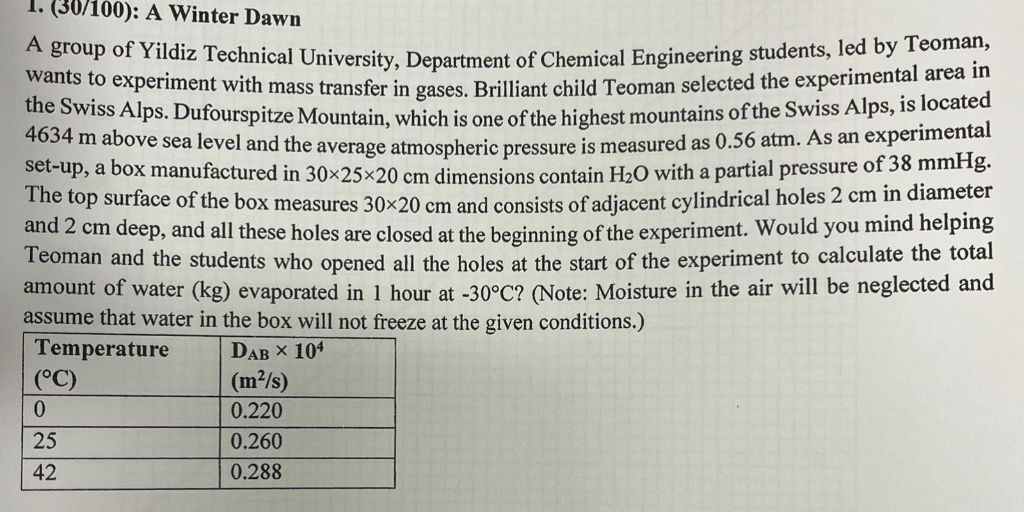
A group of Yildiz Technical University, Department of Chemical Engineering students, a he in
wants to experiment with mass transfer in gases. Brilliant child Teoman selected the capeen is located
the Swiss Alps. Dufourspitze Mountain, which is one of the highest mountains pases los Sy
4634 m above sea level and the average atmospheric pressure is measured as 0.56 atm. As an one mH
Set-up, a box manufactured in 30x25x20 em dimensions contain HzO with a partial pressure ud = t 5
The top surface of the box measures 30x20 cm and consists of adjacent cylindrical holes 2 cm = 2
and 2 cm deep, and all these holes are closed at the beginning of the experiment. Would you filo i i
Teoman and the students who opened all the holes at the start of the experiment © calculate tl pe >
amount of water (kg) evaporated in 1 hour at -30°C? (Note: Moisture in the air will be neglected an
assume that water in the box will not freeze at the given conditions.)
Temperature Das x 10%
wo
[0 OD
[le
Question:
Give step-by-step solution with explanation and final answer:
This is AI generated Response. Asked by: Francis Created at: 2026-01-08 21:31:59
Did you like this answer?
👍 0
👎 0
Let's solve the problem step by step.
---
## **Step 1: Gather Given Data**
- **Box dimensions:**30 \times25 \times20 \ \text{cm}\)
- **Top surface area:** \(30 \times 20 \ \text{cm} = 600 \ \text{cm}^2\)
- **Number of holes:** Not specified, but each hole is 2 cm in diameter, drilled into the top surface with 2 cm depth (height).
- **Partial pressure of water (\(P_{H_2O}\)):** 38 mmHg
- **Atmospheric pressure (\(P_{atm}\)):** .56 atm
- **Temperature:** -30°C
- **Diffusivity (\(D_{AB}\)) at °C:** \(2.20 \times 10^{-5} \ \text{m}^2/\text{s}\) (since -30°C is not in the table, use the value at °C)
- **Time:** 1 hour = 360 s
---
## **Step 2: Convert Units**
- **Partial pressure of water:**
\(38 \ \text{mmHg} \times \frac{1 \ \text{atm}}{760 \ \text{mmHg}} = .05 \ \text{atm}\)
- **Box top surface area:** \(600 \ \text{cm}^2 = .06 \ \text{m}^2\)
- **Each hole area:** \(A_{hole} = \pi (r^2) = \pi (.01)^2 = 3.14 \times 10^{-4} \ \text{m}^2\)
- **Number of holes:** \(N = \frac{.06}{3.14 \times 10^{-4}} \approx 191\)
- **Depth of holes (L):** 2 cm = .02 m
---
## **Step 3: Find the Rate of Water Vapor Diffusion**
Using **Fick’s Law for steady-state diffusion** through a cylindrical hole:
\[
N_A = \frac{D_{AB} \cdot A \cdot (P_{A1} - P_{A2})}{R T \cdot L / P_{total}}
\]
But for mass transfer in a dilute system through a stagnant air film:
\[
N_A = \frac{D_{AB} \cdot A \cdot (P_{A1} - P_{A2})}{R T \cdot L}
\]
Where:
- \(N_A\): molar flux (\(\text{mol/s}\))
- \(D_{AB}\): diffusivity (\(\text{m}^2/\text{s}\))
- \(A\): total area of all holes (\(\text{m}^2\))
- \(L\): length of diffusion path (\(\text{m}\))
- \(P_{A1}\): partial pressure of water vapor inside (\(\text{Pa}\))
- \(P_{A2}\): partial pressure of water vapor outside (\(\text{Pa}\)), here zero.
- \(R\): gas constant = .0821 L·atm/(mol·K) or 8.205 × 10⁻² L·atm/(mol·K), or 8.314 J/(mol·K)
- \(T\): temperature in K
### **Convert Pressures to Pascals**
- \(P_{A1} = .05 \ \text{atm} = .05 \times 101325 = 5066 \ \text{Pa}\)
- \(P_{A2} = \) (neglect outside moisture)
### **Convert Diffusivity**
- \(D_{AB} = 2.20 \times 10^{-5} \ \text{m}^2/\text{s}\)
### **Total Area of Holes**
- \(A_{hole} = 3.14 \times 10^{-4} \ \text{m}^2\)
- \(N = 191\)
- \(A_{total} = N \cdot A_{hole} = 191 \times 3.14 \times 10^{-4} = .06 \ \text{m}^2\) (matches top area, as expected)
### **Temperature in Kelvin**
\[
T = -30 + 273.15 = 243.15 \ \text{K}
\]
---
## **Step 4: Calculate Moles of H₂O Evaporated in 1 Hour**
Plug into Fick's Law:
\[
N_A = \frac{D_{AB} \cdot A_{total} \cdot (P_{A1} - P_{A2})}{R T \cdot L}
\]
- \(D_{AB} = 2.20 \times 10^{-5}\)
- \(A_{total} = .06\)
- \(P_{A1} - P_{A2} = 5066 \ \text{Pa}\)
- \(R = 8.314 \ \text{J/mol·K}\)
- \(T = 243.15 \ \text{K}\)
- \(L = .02 \ \text{m}\)
\[
N_A = \frac{2.20 \times 10^{-5} \cdot .06 \cdot 5066}{8.314 \cdot 243.15 \cdot .02}
\]
Calculate numerator:
\[
2.20 \times 10^{-5} \cdot .06 = 1.32 \times 10^{-6}
\]
\[
1.32 \times 10^{-6} \cdot 5066 = .006686
\]
Calculate denominator:
\[
8.314 \cdot 243.15 = 2022.2
\]
\[
2022.2 \cdot .02 = 40.444
\]
Now,
\[
N_A = \frac{.006686}{40.444} = 1.653 \times 10^{-4} \ \text{mol/s}
\]
---
## **Step 5: Total Amount in 1 Hour**
- \(1 \ \text{hour} = 360 \ \text{s}\)
\[
n_{total} = N_A \times 360 = 1.653 \times 10^{-4} \times 360 = .595 \ \text{mol}
\]
---
## **Step 6: Convert Moles to Mass**
- Molar mass of water: 18 g/mol = .018 kg/mol
\[
\text{Mass} = n_{total} \cdot M = .595 \cdot .018 = .0107 \ \text{kg}
\]
---
## **Step 7: Final Answer**
### **Total water evaporated in 1 hour:**
\[
\boxed{.0107~\text{kg}}
\]
---
### **Summary Table**
| Step | Value |
|------|-------|
| Diffusivity (\(D_{AB}\)) | \(2.20 \times 10^{-5}~\text{m}^2/\text{s}\) |
| Total area of holes (\(A\)) | \(.06~\text{m}^2\) |
| Partial pressure difference (\(P_{A1} - P_{A2}\)) | \(5066~\text{Pa}\) |
| Gas constant (\(R\)) | \(8.314~\text{J/(mol·K)}\) |
| Temperature (\(T\)) | \(243.15~\text{K}\) |
| Path length (\(L\)) | \(.02~\text{m}\) |
| Time | \(360~\text{s}\) |
| Moles evaporated | \(.595~\text{mol}\) |
| Mass evaporated | \(.0107~\text{kg}\) |
---
## **Final Answer**
\[
\boxed{.0107~\text{kg}~\text{of water will evaporate from the box in 1 hour at -30^\circ\text{C}.}}
\]
If you need any clarification or more explanation, let me know!
📢 Instructions:
Ask anything relatd to above question only.
For new Question goto :
🚀 Submit (-0.25 Credits🪙)
Study Help, Fast Answers
VIPSolutions focuses on clear, step‑by‑step explanations so you can learn quickly. Whether you need an AI‑generated walkthrough or a short hint to get unstuck, each solution is organized for fast reading and easy review later.
Search similar questions, compare approaches, and bookmark the best answers for revision. Our goal is simple: quick, reliable study help that feels natural—not noisy.
 VIPSolutions
 = (90/100): A Winter Dawn an,
A group of Yildiz Technical University, Department of Chemical Engineering students, a he in
wants to experiment with mass transfer in gases. Brilliant child Teoman selected the capeen is located
the Swiss Alps. Dufourspitze Mountain, which is one of the highest mountains pases los Sy
4634 m above sea level and the average atmospheric pressure is measured as 0.56 atm. As an one mH
Set-up, a box manufactured in 30x25x20 em dimensions contain HzO with a partial pressure ud = t 5
The top surface of the box measures 30x20 cm and consists of adjacent cylindrical holes 2 cm = 2
and 2 cm deep, and all these holes are closed at the beginning of the experiment. Would you filo i i
Teoman and the students who opened all the holes at the start of the experiment © calculate tl pe >
amount of water (kg) evaporated in 1 hour at -30°C? (Note: Moisture in the air will be neglected an
assume that water in the box will not freeze at the given conditions.)
Temperature Das x 10%
wo
[0 OD
[le