 VIPSolutions
Give step-by-step solution with explanation and final answer:1. Sistentio mache Suksiyony gekilde ghaterilasly ola Mok diyagramends verilmigtic. Sisteme KONIG (Grr) lenis. Sistemi geribesleme Kasminda sensor rans foksiyonuherkesin obrenct numamunn son 3 haps olscakte. Buna goee Routh-Hurwitz Karablk ts Gzrinden ssemin Karr beleyine R(s) [C— i GCriem 10 Cs) T Ng || SCHOEN
Question:
Give step-by-step solution with explanation and final answer: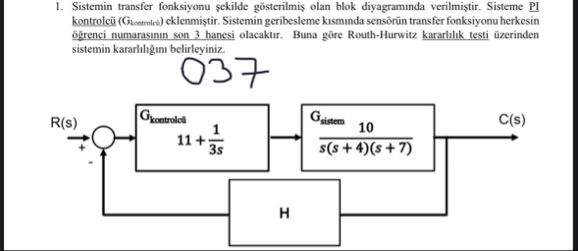 1. Sistentio mache Suksiyony gekilde ghaterilasly ola Mok diyagramends verilmigtic. Sisteme
KONIG (Grr) lenis. Sistemi geribesleme Kasminda sensor rans foksiyonuherkesin
obrenct numamunn son 3 haps olscakte. Buna goee Routh-Hurwitz Karablk ts Gzrinden
ssemin Karr beleyine
R(s) [C— i GCriem 10 Cs)
T Ng || SCHOEN
This is AI generated Response.
Asked by: Mk
Created at: 2026-01-08 20:02:57
Asked by: Mk
Created at: 2026-01-08 20:02:57
Final Answer:
Rendered
Raw Text
Did you like this answer?
Let's solve the problem step by step using the **Routh-Hurwitz criterion** to determine the stability of the system.
---
## **Step 1: Write the given transfer functions**
- **Controller:** \( G_{\text{kontrolcü}} = 11 + \frac{1}{3s} \)
- **System:** \( G_{\text{sistem}} = \frac{10}{s(s+4)(s+7)} \)
- **Sensor Transfer Function:** Last 3 digits of student number = **037**, so \( H(s) = .037 \)
---
## **Step 2: Find the open-loop transfer function**
\[
G_{\text{open-loop}}(s) = G_{\text{kontrolcü}} \cdot G_{\text{sistem}}
= \left(11 + \frac{1}{3s}\right) \cdot \frac{10}{s(s+4)(s+7)}
\]
Rewrite the controller:
\[
11 + \frac{1}{3s} = \frac{33s + 1}{3s}
\]
So,
\[
G_{\text{open-loop}}(s) = \frac{33s + 1}{3s} \cdot \frac{10}{s(s+4)(s+7)} = \frac{10(33s + 1)}{3s^2(s+4)(s+7)}
\]
---
## **Step 3: Find the closed-loop transfer function**
The closed-loop transfer function is:
\[
T(s) = \frac{G_{\text{open-loop}}(s)}{1 + G_{\text{open-loop}}(s)H(s)}
\]
The denominator (characteristic equation) is:
\[
1 + G_{\text{open-loop}}(s)H(s) =
\]
Plug in \( H(s) = .037 \):
\[
1 + \frac{10(33s + 1)}{3s^2(s+4)(s+7)} \cdot .037 =
\]
\[
1 + \frac{.37(33s + 1)}{s^2(s+4)(s+7)} =
\]
\[
s^2(s+4)(s+7) + .37(33s+1) =
\]
Expand \( s^2(s+4)(s+7) \):
\[
(s+4)(s+7) = s^2 + 11s + 28
\]
\[
s^2(s^2 + 11s + 28) = s^4 + 11s^3 + 28s^2
\]
So the equation becomes:
\[
s^4 + 11s^3 + 28s^2 + .37 \times 33s + .37 \times 1 =
\]
\[
s^4 + 11s^3 + 28s^2 + 12.21s + .37 =
\]
---
## **Step 4: Apply the Routh-Hurwitz Criterion**
Write the coefficients:
| \( s^4 \) | \( s^3 \) | \( s^2 \) | \( s^1 \) | \( s^ \) |
|-----------|-----------|-----------|-----------|-----------|
| 1 | 11 | 28 | 12.21 | .37 |
Set up the Routh array:
\[
\begin{array}{c|cc}
s^4 & 1 & 28 \\
s^3 & 11 & 12.21 \\
s^2 & A & .37 \\
s^1 & B & \\
s^ & .37 & \\
\end{array}
\]
Calculate \( A \) and \( B \):
### Calculate \( A \):
\[
A = \frac{11 \times 28 - 1 \times 12.21}{11} = \frac{308 - 12.21}{11} = \frac{295.79}{11} \approx 26.89
\]
### Calculate \( B \):
\[
B = \frac{26.89 \times 12.21 - 11 \times .37}{26.89} = \frac{328.333 - 4.07}{26.89} = \frac{324.263}{26.89} \approx 12.06
\]
---
## **Step 5: Check the first column sign**
First column is:
- \( 1 \)
- \( 11 \)
- \( 26.89 \)
- \( 12.06 \)
- \( .37 \)
**All positive!**
---
## **Final Answer**
### **The system is stable** according to the Routh-Hurwitz criterion.
---
### **Summary Table**
| Row | Coefficient | Value |
|-----|-------------|------------|
| s⁴ | 1 | |
| s³ | 11 | |
| s² | 26.89 | |
| s¹ | 12.06 | |
| s⁰ | .37 | |
**All coefficients are positive, so the system is stable.**
📢 Instructions:
- Ask anything relatd to above question only.
- For new Question goto :