Give step-by-step solution with explanation and final answer:
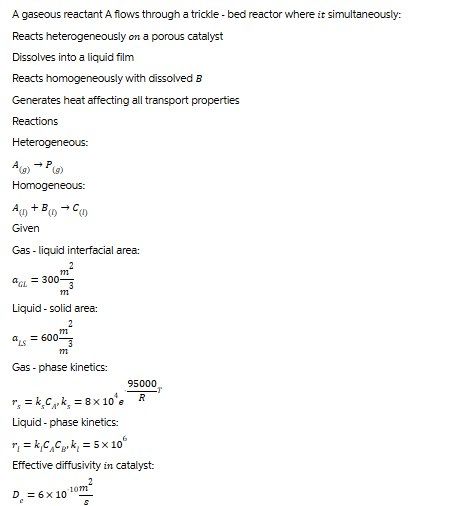
Give step-by-step solution with explanation and final answer:A gaseous reactant A flows through a trickle - bed reactor where i simultaneously:
Reacts nterogeneousy on 8 porous cast
Disoles no uid im
Reacts hemogeneousy wih disoled 3
J Py —
Reactions
Heterogensos
402 Py
Homogeneous:
Ag +Bp Cy
Given
Gos. ld rfc ace:
ozs
qian
wy Coe
opr netic:
5000,
r=kCyk =8xi0's R
[ERE———
ry =kC Cp = 5X10"
recive asnty in cays:
Hearys constant
HT) = 1400ex0(0.02(T - 300)]
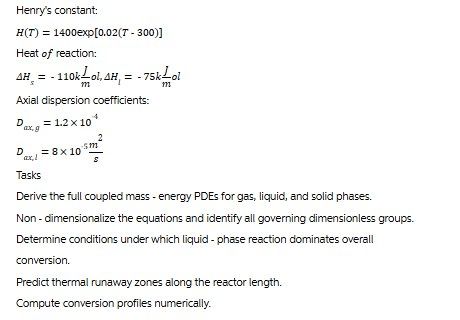
esto rect:
an, = -saokLo an = -rskLa
it dperion costes
5, = 12x10"
i)
Tas
Dr the lcs energy PEs or gat. vic, and st es
Non-imendnsiz th uations and ef govern iendones rue.
tein conor cer ic gs rescind orl
[SR ———
Camute comer res mercy.
Question:
Give step-by-step solution with explanation and final answer:
Give step-by-step solution with explanation and final answer:A gaseous reactant A flows through a trickle - bed reactor where i simultaneously:
Reacts nterogeneousy on 8 porous cast
Disoles no uid im
Reacts hemogeneousy wih disoled 3
J Py —
Reactions
Heterogensos
402 Py
Homogeneous:
Ag +Bp Cy
Given
Gos. ld rfc ace:
ozs
qian
wy Coe
opr netic:
5000,
r=kCyk =8xi0's R
[ERE———
ry =kC Cp = 5X10"
recive asnty in cays:
Hearys constant
HT) = 1400ex0(0.02(T - 300)]
esto rect:
an, = -saokLo an = -rskLa
it dperion costes
5, = 12x10"
i)
Tas
Dr the lcs energy PEs or gat. vic, and st es
Non-imendnsiz th uations and ef govern iendones rue.
tein conor cer ic gs rescind orl
[SR ———
Camute comer res mercy.
This is AI generated Response.
Asked by: francis
Created at: 2026-01-08 13:34:16
Final Answer:
RenderedRaw Text
Did you like this answer?
Let's break this advanced chemical reactor problem into clear, step-by-step tasks, as requested. We'll focus on **formulating the full mass-energy PDEs**, **non-dimensionalizing**, **identifying key dimensionless groups**, and outlining steps for **analysis** and **numerical computation**.
---
# 1. **Formulate the Full Coupled Mass-Energy PDEs**
Let:
- \( C_{A,g}(z,t) \): Concentration of A in gas phase
- \( C_{A,l}(z,t) \): Concentration of A in liquid phase
- \( C_{A,s}(z,t) \): Concentration of A in solid catalyst
- \( T(z,t) \): Temperature
- \( u_g, u_l \): Superficial velocities (gas, liquid)
- \( \varepsilon_g, \varepsilon_l, \varepsilon_s \): Volume fractions (gas, liquid, solid)
- \( a_{GL}, a_{LS} \): Interfacial areas (gas-liquid, liquid-solid)
- \( k_L \): Liquid-side mass transfer coefficient
- \( r_s, r_l \): Solid-phase and liquid-phase reaction rates
### **Mass Balances**
#### **Gas Phase (A):**
\[
\varepsilon_g \frac{\partial C_{A,g}}{\partial t} + u_g \frac{\partial C_{A,g}}{\partial z} = D_{ax,g} \frac{\partial^2 C_{A,g}}{\partial z^2} - a_{GL} k_L (C_{A,g} - C_{A,l}^*)
\]
where \( C_{A,l}^* = \frac{C_{A,g}}{H(T)} \) (from Henry’s law).
---
#### **Liquid Phase (A):**
\[
\varepsilon_l \frac{\partial C_{A,l}}{\partial t} + u_l \frac{\partial C_{A,l}}{\partial z} = D_{ax,l} \frac{\partial^2 C_{A,l}}{\partial z^2} + a_{GL}k_L (C_{A,g} - C_{A,l}^*) - a_{LS} k_{LS} (C_{A,l} - C_{A,s}) - r_{l,\text{hom}}
\]
- \( k_{LS} \): Mass transfer coefficient (liquid-solid)
- \( r_{l,\text{hom}} \): Homogeneous reaction in liquid
---
#### **Solid Phase (A):**
\[
\varepsilon_s \frac{\partial C_{A,s}}{\partial t} = D_e \frac{\partial^2 C_{A,s}}{\partial r^2} + a_{LS}k_{LS} (C_{A,l} - C_{A,s}) - r_{s,\text{het}}
\]
- \( D_e \): Effective diffusivity in solid
- \( r_{s,\text{het}} \): Heterogeneous reaction rate
---
### **Energy Balance (All Phases):**
\[
\rho C_p \frac{\partial T}{\partial t} + u_g \rho_g C_{p,g} \frac{\partial T}{\partial z} + u_l \rho_l C_{p,l} \frac{\partial T}{\partial z} = \lambda \frac{\partial^2 T}{\partial z^2} + (-\Delta H_s) r_{s,\text{het}} + (-\Delta H_l) r_{l,\text{hom}}
\]
- \( \lambda \): Effective thermal conductivity
---
# 2. **Non-Dimensionalize the Equations**
Define dimensionless variables:
- \( \hat{z} = \frac{z}{L} \)
- \( \hat{t} = \frac{t u_g}{L} \)
- \( \hat{C}_{A,g} = \frac{C_{A,g}}{C_{A,g,}} \), etc.
- \( \hat{T} = \frac{T - T_}{T_} \)
Key dimensionless groups:
- **Peclet number**: \( \mathrm{Pe}_g = \frac{u_g L}{D_{ax,g}} \), \( \mathrm{Pe}_l = \frac{u_l L}{D_{ax,l}} \)
- **Damköhler numbers** (solid, liquid): \( \mathrm{Da}_s = \frac{r_{s,\text{het}} L}{u_g C_{A,g,}} \), \( \mathrm{Da}_l = \frac{r_{l,\text{hom}} L}{u_l C_{A,l,}} \)
- **Biot numbers** for mass transfer: \( \mathrm{Bi}_{GL} = \frac{a_{GL} k_L L}{u_g} \), \( \mathrm{Bi}_{LS} = \frac{a_{LS} k_{LS} L}{u_l} \)
- **Thiele modulus** for effectiveness in catalyst: \( \phi = L \sqrt{ \frac{r_{s,\text{het}}}{D_e} } \)
- **Dimensionless heat release**: \( \beta = \frac{(-\Delta H) C_{A,g,}}{\rho C_p T_} \)
---
# 3. **Identify When Liquid Phase Reaction Dominates**
Compare Damköhler numbers:
- If \( \mathrm{Da}_l \gg \mathrm{Da}_s \), and mass transfer is not limiting (large Biot), then the **liquid phase reaction dominates**.
- If \( k_L a_{GL} \) (interfacial transfer) is small, **mass transfer limits**.
---
# 4. **Predict Thermal Runaway Zones**
- **Thermal runaway** occurs if heat generation from reaction exceeds heat removal:
- Large **\(\beta\)** and **exothermic reaction** (\( \Delta H < \))
- **Low axial dispersion** (\( D_{ax} \) small), i.e., poor heat conduction
- **High Damköhler number**
- **Critical temperature** can be found by analyzing the energy balance, seeking points where \( \frac{dT}{dt} > \) grows uncontrollably.
---
# 5. **Numerical Solution for Conversion Profiles**
- **Discretize** the PDEs (finite difference/volume method).
- **March** along reactor length (\( z \)), solve coupled ODEs at each node for \( C_{A,g}, C_{A,l}, C_{A,s}, T \).
- Use **initial** and **boundary conditions** (inlet concentrations, temperature).
- **Iterate** until steady-state or desired reactor length is reached.
---
## **Summary Table: Key Equations and Steps**
| Step | Equation/Parameter | Notes |
|------|-------------------|-------|
| 1. | Full PDEs (see above) | Mass and energy balances for all phases |
| 2. | Non-dimensionalize | Define \( \mathrm{Pe}, \mathrm{Da}, \phi, \beta \) |
| 3. | Compare Damköhler numbers | Dominance of liquid vs. solid |
| 4. | Energy balance, \(\beta\) | Runaway if heat gen. > removal |
| 5. | Discretize, solve numerically | Compute conversion, temp profiles |
---
## **Final Answer (in summary):**
1. **Write coupled PDEs for gas, liquid, and solid phases, including interfacial mass transfer and reaction terms.**
2. **Non-dimensionalize equations, identifying Peclet, Damköhler, Biot, Thiele, and heat release numbers.**
3. **Liquid-phase reaction dominates when its Damköhler number is much larger than others and mass transfer is not limiting.**
4. **Thermal runaway zones occur where exothermic heat release exceeds heat removal—analyzed using the energy PDE and dimensionless heat parameter.**
5. **Numerically solve the equations (e.g., finite difference) for conversion and temperature profiles along the reactor.**
---
**If you need help with the explicit non-dimensionalized equations or the actual code for numerical solution, let me know!**
VIPSolutions focuses on clear, step‑by‑step explanations so you can learn quickly. Whether you need an AI‑generated walkthrough or a short hint to get unstuck, each solution is organized for fast reading and easy review later.
Search similar questions, compare approaches, and bookmark the best answers for revision. Our goal is simple: quick, reliable study help that feels natural—not noisy.
 VIPSolutions
 A gaseous reactant A flows through a trickle - bed reactor where i simultaneously:
Reacts nterogeneousy on 8 porous cast
Disoles no uid im
Reacts hemogeneousy wih disoled 3
J Py —
Reactions
Heterogensos
402 Py
Homogeneous:
Ag +Bp Cy
Given
Gos. ld rfc ace:
ozs
qian
wy Coe
opr netic:
5000,
r=kCyk =8xi0's R
[ERE———
ry =kC Cp = 5X10"
recive asnty in cays:
Hearys constant
HT) = 1400ex0(0.02(T - 300)]
esto rect:
an, = -saokLo an = -rskLa
it dperion costes
5, = 12x10"
i)
Tas
Dr the lcs energy PEs or gat. vic, and st es
Non-imendnsiz th uations and ef govern iendones rue.
tein conor cer ic gs rescind orl
[SR ———
Camute comer res mercy.