 VIPSolutions
Give step-by-step solution with explanation and final answer:Formulate the pressure drop AP across a packed bed reactor using the Ergun equation to determine its effect on the gas-phase reaction conversion. dP G (1—e 150(1 —€ Sem 2a (F 100A 756 dz pb, \ € D, Calculate the total pressure at the reactor exit in kPa if the inlet pressure is 500 kPa, the bed length is 4.5 m, and the average pressure gradient is 12.5 kPa/m. Graph the yield of the desired product in a recycle reactor system by formulating the relationship between the recycle ratio R and the per-pass conversion. Establish the overall mass balance by synthesizing the fresh feed Fag and the recycle stream RF p eit to map the reactor volume requirements. Obtain the expression for the purge stream flow rate required to prevent the accumulation of inert species within the high-pressure synthesis loop. Plot the rate of heat generation G(T) and heat removal R(T) for a CSTR to identify the ignition and extinction temperatures of the reaction. G(T) = 4-8") petermine the critical cooling water temperature required to prevent a thermal runaway if the heat transfer area is 5.5 m2 and the overall heat transfer coefficient is 850 W/m? - K. Formulate the kinetic model for a gas-solid catalytic reaction using the Langmuir- Hinshelwood-Hougen-Watson (LHHW) approach assuming the surface reaction is the rate- controlling step. Establish the adsorption equilibrium constants K; for each species by synthesizing the site balance L = S, + }_ Si. Generate the global rate expression to evaluate the inhibitory effect of the product adsorption on the net frequency of the catalytic cycles.
Question:
Give step-by-step solution with explanation and final answer: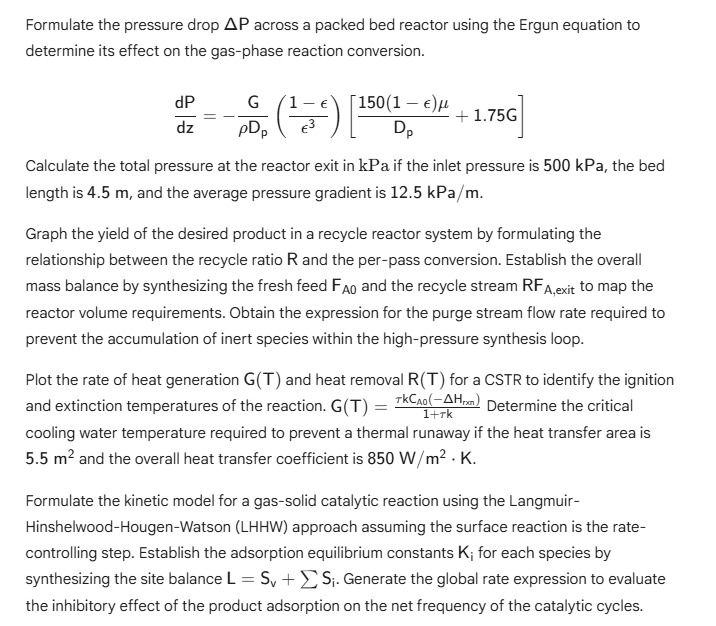 Formulate the pressure drop AP across a packed bed reactor using the Ergun equation to
determine its effect on the gas-phase reaction conversion.
dP G (1—e 150(1 —€
Sem 2a (F 100A 756
dz pb, \ € D,
Calculate the total pressure at the reactor exit in kPa if the inlet pressure is 500 kPa, the bed
length is 4.5 m, and the average pressure gradient is 12.5 kPa/m.
Graph the yield of the desired product in a recycle reactor system by formulating the
relationship between the recycle ratio R and the per-pass conversion. Establish the overall
mass balance by synthesizing the fresh feed Fag and the recycle stream RF p eit to map the
reactor volume requirements. Obtain the expression for the purge stream flow rate required to
prevent the accumulation of inert species within the high-pressure synthesis loop.
Plot the rate of heat generation G(T) and heat removal R(T) for a CSTR to identify the ignition
and extinction temperatures of the reaction. G(T) = 4-8") petermine the critical
cooling water temperature required to prevent a thermal runaway if the heat transfer area is
5.5 m2 and the overall heat transfer coefficient is 850 W/m? - K.
Formulate the kinetic model for a gas-solid catalytic reaction using the Langmuir-
Hinshelwood-Hougen-Watson (LHHW) approach assuming the surface reaction is the rate-
controlling step. Establish the adsorption equilibrium constants K; for each species by
synthesizing the site balance L = S, + }_ Si. Generate the global rate expression to evaluate
the inhibitory effect of the product adsorption on the net frequency of the catalytic cycles.
Asked by: francis
Created at: 2026-01-08 08:21:44
Final Answer:
📢 Instructions:
- Ask anything relatd to above question only.
- For new Question goto :