 VIPSolutions
Give step-by-step solution with explanation and final answer:-~ SL eT ST ee— (9) Using plate and frame filter press, the experimental data obtained from the plot of dt/dV vs V at two different pressure drops are given below, where V is in litre, Slurry contains 18 g/L of CaCO, in water. sat Calculate the total area of filtration. (b) If one square frame have 30 cm length, find the total fio. of plates used in the experiment, (Mygaser = 1 cp and ay, (initial specific cake resistance) =1.2 x 10"2m/kg). ApQVen’) | slope | imereep_| 6 25 26.5 24647 7
Question:
Give step-by-step solution with explanation and final answer: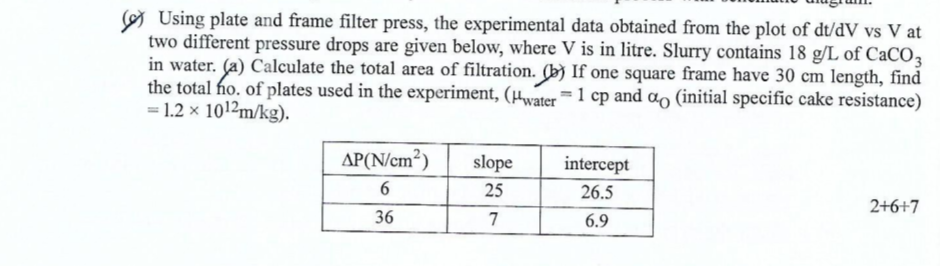 -~ SL eT ST ee—
(9) Using plate and frame filter press, the experimental data obtained from the plot of dt/dV vs V at
two different pressure drops are given below, where V is in litre, Slurry contains 18 g/L of CaCO,
in water. sat Calculate the total area of filtration. (b) If one square frame have 30 cm length, find
the total fio. of plates used in the experiment, (Mygaser = 1 cp and ay, (initial specific cake resistance)
=1.2 x 10"2m/kg).
ApQVen’) | slope | imereep_|
6 25 26.5 24647
7
This is AI generated Response.
Asked by: Francis
Created at: 2026-01-07 00:34:07
Asked by: Francis
Created at: 2026-01-07 00:34:07
Final Answer:
Rendered
Raw Text
Did you like this answer?
Let's break the problem into its parts and solve step by step.
---
## **Given Data**
- **Slurry concentration**: 18 g/L CaCO₃ in water
- **μ (water viscosity)**: 1 cp = \( 1 \times 10^{-3} \) Pa·s
- **α₀ (initial specific cake resistance)**: \( 1.2 \times 10^{12} \) m/kg
- **Frame size**: 1 square frame, 30 cm side = .3 m
- **ΔP, slope, intercept:**
| ΔP (N/cm²) | slope | intercept |
|------------|-------|-----------|
| 6 | 25 | 26.5 |
| 36 | 7 | 6.9 |
- \( V \) is in **liters**
---
## **Background**
The general filtration equation using a plate and frame filter press is:
\[
\frac{dt}{dV} = \frac{\mu}{A^2 \Delta P} \left[ \alpha_ C_s V + R_m \right]
\]
- \( \frac{dt}{dV} \): Slope from the filtration plot
- \( \mu \): Viscosity (kg/m·s)
- \( A \): Total filter area (m²)
- \( \Delta P \): Pressure drop (N/m²)
- \( \alpha_ \): Specific cake resistance (m/kg)
- \( C_s \): Mass of solids per volume of filtrate (kg/m³)
- \( R_m \): Resistance of filter medium
The plot of \( \frac{dt}{dV} \) vs \( V \) gives:
- Slope = \( \frac{\mu \alpha_ C_s}{A^2 \Delta P} \)
- Intercept = \( \frac{\mu R_m}{A^2 \Delta P} \)
---
## **Step 1: Convert Units and Data**
### **Pressure**
- 1 N/cm² = \( 10^4 \) N/m² (Pa)
- ΔP₁ = 6 N/cm² = \( 6 \times 10^4 \) Pa
- ΔP₂ = 36 N/cm² = \( 36 \times 10^4 \) Pa
### **Concentration**
\( C_s = 18 \) g/L = \( .018 \) kg/L = \( 18 \) kg/m³
### **Slope Units**
- Slope is in min/L (from \( dt/dV \) vs \( V \), with \( V \) in L and \( t \) in min).
- Convert to seconds and cubic meters as needed for SI consistency.
---
## **Step 2: Write Slope Equations**
\[
\text{Slope} = \frac{\mu \alpha_ C_s}{A^2 \Delta P}
\]
For both data points:
### **At ΔP = 6 N/cm²:**
\[
25 = \frac{(1 \times 10^{-3}) \times (1.2 \times 10^{12}) \times 18}{A^2 \times 6 \times 10^4}
\]
### **At ΔP = 36 N/cm²:**
\[
7 = \frac{(1 \times 10^{-3}) \times (1.2 \times 10^{12}) \times 18}{A^2 \times 36 \times 10^4}
\]
---
## **Step 3: Solve for A (Total Area)**
Let’s use the equation for ΔP = 6 N/cm².
### **First, resolve units:**
- Slope needs to be in s/m³ (since SI units):
\[
25~(\text{min}/\text{L}) = 25 \times 60~\text{s}/100~\text{m}^3 = 1.5~\text{s}/\text{m}^3
\]
### **Plug values:**
\[
1.5 = \frac{(1 \times 10^{-3}) \times (1.2 \times 10^{12}) \times 18}{A^2 \times 6 \times 10^4}
\]
Calculate numerator:
\[
(1 \times 10^{-3}) \times (1.2 \times 10^{12}) \times 18 = 1.2 \times 18 \times 10^9 = 21.6 \times 10^9 = 2.16 \times 10^{10}
\]
So,
\[
1.5 = \frac{2.16 \times 10^{10}}{A^2 \times 6 \times 10^4}
\]
\[
A^2 = \frac{2.16 \times 10^{10}}{1.5 \times 6 \times 10^4}
= \frac{2.16 \times 10^{10}}{9 \times 10^4}
= \frac{2.16}{9} \times 10^{10-4}
= .24 \times 10^6
= 2.4 \times 10^5
\]
\[
A = \sqrt{2.4 \times 10^5} = \sqrt{2.4} \times 10^{2.5}
\]
\[
\sqrt{2.4} \approx 1.549
\]
\[
10^{2.5} = 10^2 \times 10^{.5} = 100 \times 3.16 = 316
\]
\[
A = 1.549 \times 316 \approx 489.5~\text{m}^2
\]
---
## **Step 4: Number of Plates**
- Each plate is a square of 30 cm = .3 m per side.
- Area per plate = \( .3 \times .3 = .09~\text{m}^2 \)
\[
\text{Number of plates} = \frac{A}{A_{\text{plate}}} = \frac{489.5}{.09} \approx 5449
\]
---
## **Final Answers**
### **(a) Total Area of Filtration**
\[
\boxed{489.5~\text{m}^2}
\]
### **(b) Total Number of Plates**
\[
\boxed{5449}
\]
---
### **Summary Table**
| Part | Quantity | Value | Units |
|------|----------|--------------|--------------|
| (a) | Area | 489.5 | m² |
| (b) | Plates | 5449 | plates |
---
If you have any follow-up or want the calculation using the other data point or for intercept, let me know!
📢 Instructions:
- Ask anything relatd to above question only.
- For new Question goto :