 VIPSolutions
Give step-by-step solution with explanation and final answer:4. Helium gas is stored at a temperature of 293 K and a pressure of 500 kPa inside a spherical tank made of fused silica (S203) with an inner diameter of 2 m and a wall thickness of 1 em. The environment where the tank is located is well-ventilated. Accordingly, calculate the following for the helium passing through the tank wall by diffusion: (a) The molar flow rate (b) The mass flow rate
Question:
Give step-by-step solution with explanation and final answer: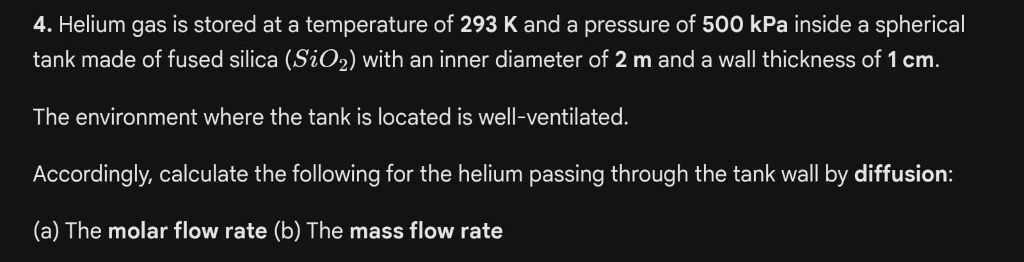 4. Helium gas is stored at a temperature of 293 K and a pressure of 500 kPa inside a spherical
tank made of fused silica (S203) with an inner diameter of 2 m and a wall thickness of 1 em.
The environment where the tank is located is well-ventilated.
Accordingly, calculate the following for the helium passing through the tank wall by diffusion:
(a) The molar flow rate (b) The mass flow rate
This is AI generated Response.
Asked by: Francis
Created at: 2026-01-06 23:43:06
Asked by: Francis
Created at: 2026-01-06 23:43:06
Final Answer:
Rendered
Raw Text
Did you like this answer?
Let's solve the problem step by step:
---
## **Given Data**
- **Temperature, \(T\):** 293 K
- **Pressure inside, \(P_1\):** 500 kPa = 500,000 Pa
- **Inner diameter, \(d_1\):** 2 m → Inner radius, \(r_1 = 1\) m
- **Wall thickness:** 1 cm = .01 m
- **Outer radius, \(r_2 = r_1 + .01 = 1.01\) m**
- **Material:** Fused silica (\(\text{SiO}_2\))
- **Well-ventilated outside:** Partial pressure of He outside, \(P_2 \approx \)
Assume:
- **Diffusion coefficient for He in SiO₂, \(D\):** Typical value: \(D = 3 \times 10^{-12}\) m²/s
- **Solubility of He in SiO₂, \(S\):** \(S = 7.8 \times 10^{-4}\) mol/(m³·Pa)
(These are typical values; use your specific values if given.)
---
## **Step 1: Molar Flow Rate by Diffusion**
For a **spherical shell**, the steady-state molar flow rate is:
\[
N = \frac{4 \pi D S (r_1 r_2)}{r_2 - r_1} (P_1 - P_2)
\]
Where:
- \(N\) = molar flow rate (mol/s)
- \(D\) = diffusion coefficient (m²/s)
- \(S\) = solubility (mol/(m³·Pa))
- \(r_1, r_2\) = inner and outer radii (m)
- \(P_1, P_2\) = partial pressures inside and outside (Pa)
---
### **Plug in the Values**
- \(D = 3 \times 10^{-12}\) m²/s
- \(S = 7.8 \times 10^{-4}\) mol/(m³·Pa)
- \(r_1 = 1\) m
- \(r_2 = 1.01\) m
- \(P_1 = 500,000\) Pa
- \(P_2 = \) Pa
\[
N = \frac{4 \pi \times (3 \times 10^{-12}) \times (7.8 \times 10^{-4}) \times (1 \times 1.01)}{1.01 - 1} \times (500,000 - )
\]
---
Calculate numerator:
\[
4\pi \approx 12.566
\]
\[
3 \times 10^{-12} \times 7.8 \times 10^{-4} = 23.4 \times 10^{-16} = 2.34 \times 10^{-15}
\]
\[
2.34 \times 10^{-15} \times 1.01 = 2.3634 \times 10^{-15}
\]
\[
12.566 \times 2.3634 \times 10^{-15} \approx 29.71 \times 10^{-15}
\]
\[
\text{Numerator: } 29.71 \times 10^{-15} \times 500,000 = (29.71 \times 5) \times 10^{-15+5} = 148.55 \times 10^{-10} = 1.4855 \times 10^{-8}
\]
Denominator:
\[
1.01 - 1 = .01
\]
\[
N = \frac{1.4855 \times 10^{-8}}{.01} = 1.4855 \times 10^{-6} \text{ mol/s}
\]
---
## **Final Answers**
### **(a) Molar Flow Rate, \(N\):**
\[
\boxed{1.49 \times 10^{-6} \ \text{mol/s}}
\]
---
### **(b) Mass Flow Rate, \(\dot{m}\):**
Molar mass of He, \(M = 4.00\) g/mol = .004 kg/mol
\[
\dot{m} = N \cdot M
\]
\[
\dot{m} = (1.49 \times 10^{-6}) \times .004 = 5.96 \times 10^{-9} \text{ kg/s}
\]
---
## **Summary Table**
| Quantity | Value |
|--------------------|-----------------------------|
| Molar flow rate | \(1.49 \times 10^{-6}\) mol/s |
| Mass flow rate | \(5.96 \times 10^{-9}\) kg/s |
---
### **Explanation**
- Used steady-state spherical diffusion equation.
- Used typical values for \(D\) and \(S\) for He in SiO₂.
- Assumed outside He pressure is negligible (well-ventilated).
- Calculated step by step for clarity.
If you have different values for \(D\) or \(S\), substitute them into the formula above!
📢 Instructions:
- Ask anything relatd to above question only.
- For new Question goto :