 VIPSolutions
Give step-by-step solution with explanation and final answer:The irreversible gas-phase reaction A—R is being carried out at steady state in a fixed-bed catalytic reactor that operates as an ideal, plug flow reactor (PFR) where the reaction is internal-diffusion-limited. The reaction is second- order in A and the value of the rate constant is 50 m°.(mol.g cat.s)!. The concentration of A in the feed to the reactor is 0.2 mol.L! with superficial velocity of Sm/s. The catalyst particles are spherical with a diameter of 0.4 cm. The bulk density of bed, Pb is 1.2 x 10° g.m™ , the porosity is about 0.4 and the effective diffusivity of A in the particle is 3 x 10° ms". The internal surface area of the catalyst is 400 m2.g"'. i) Estimate the value of the effectiveness factor. ii) Calculate the weight of catalyst and the length of the bed required to achieve a conversion of 90%. Given A = 4.77 x 10” m?. ______________________________________________________________ iii) Two engineers are having an argument about how to decrease the size of reactor for the reaction mentioned above. Engineer A proposes to operate the reactor at constant velocity but to change the catalyst particle size. Engineer B disagrees and proposes that the reactor should be operated at higher velocity while maintaining the size of the catalyst. Which engineer do you think is correct? State your reasons.
Question:
Give step-by-step solution with explanation and final answer: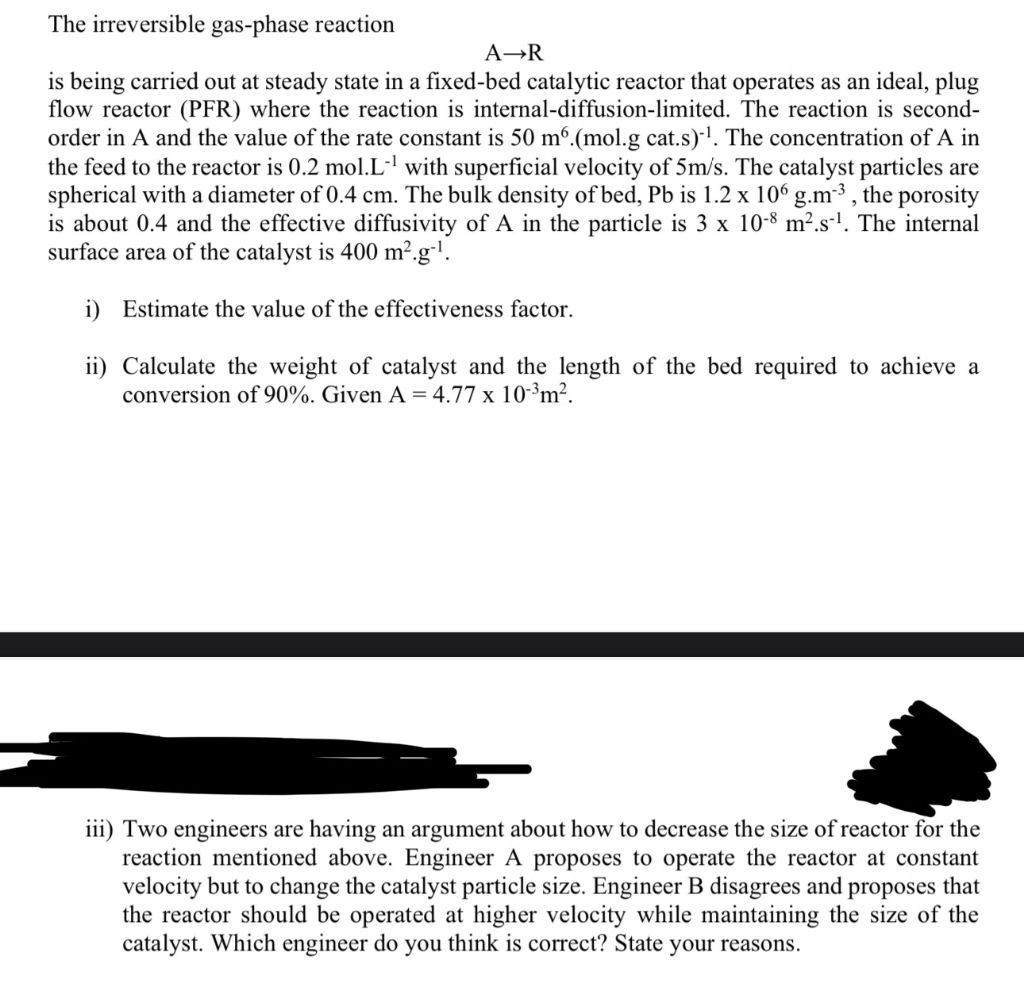 The irreversible gas-phase reaction
A—R
is being carried out at steady state in a fixed-bed catalytic reactor that operates as an ideal, plug
flow reactor (PFR) where the reaction is internal-diffusion-limited. The reaction is second-
order in A and the value of the rate constant is 50 m°.(mol.g cat.s)!. The concentration of A in
the feed to the reactor is 0.2 mol.L! with superficial velocity of Sm/s. The catalyst particles are
spherical with a diameter of 0.4 cm. The bulk density of bed, Pb is 1.2 x 10° g.m™ , the porosity
is about 0.4 and the effective diffusivity of A in the particle is 3 x 10° ms". The internal
surface area of the catalyst is 400 m2.g"'.
i) Estimate the value of the effectiveness factor.
ii) Calculate the weight of catalyst and the length of the bed required to achieve a
conversion of 90%. Given A = 4.77 x 10” m?.
______________________________________________________________
iii) Two engineers are having an argument about how to decrease the size of reactor for the
reaction mentioned above. Engineer A proposes to operate the reactor at constant
velocity but to change the catalyst particle size. Engineer B disagrees and proposes that
the reactor should be operated at higher velocity while maintaining the size of the
catalyst. Which engineer do you think is correct? State your reasons.
Asked by: francis
Created at: 2026-01-05 20:30:23
Final Answer:
📢 Instructions:
- Ask anything relatd to above question only.
- For new Question goto :