 VIPSolutions
Give step-by-step solution with explanation and final answer:Consider the following process scheme describing a chemostat with a recycle. Separator r stor [1] V xs ® The product stream of the chemostat is separated into two streams, and one of them (cell-rich stream) is recycled into the reactor. The recycle ratio is defined as @ = = and the cell concentration ratio in the cell separator is defined as C = 2 a) Write the mass balance for biomass around the chemostat. b) Assuming steady-state operation with sterile fresh feed (Xo=0), a nd neglecting cell death (ks = 0), show that the growth rate is proportional to the dilution rate with the following relationship: pt = D[1 + a(1 — €)]
Question:
Give step-by-step solution with explanation and final answer: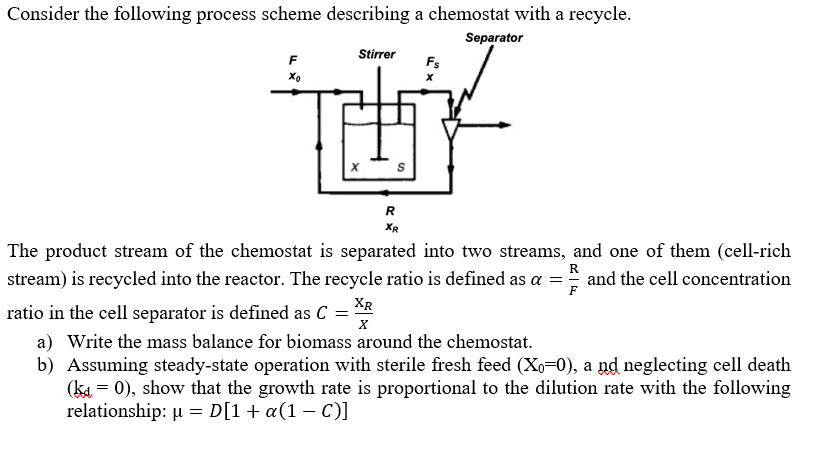 Consider the following process scheme describing a chemostat with a recycle.
Separator
r stor
[1]
V
xs
®
The product stream of the chemostat is separated into two streams, and one of them (cell-rich
stream) is recycled into the reactor. The recycle ratio is defined as @ = = and the cell concentration
ratio in the cell separator is defined as C = 2
a) Write the mass balance for biomass around the chemostat.
b) Assuming steady-state operation with sterile fresh feed (Xo=0), a nd neglecting cell death
(ks = 0), show that the growth rate is proportional to the dilution rate with the following
relationship: pt = D[1 + a(1 — €)]
This is AI generated Response.
Asked by: francis
Created at: 2026-01-05 02:50:09
Asked by: francis
Created at: 2026-01-05 02:50:09
Final Answer:
Rendered
Raw Text
Did you like this answer?
Let's break down the solution step-by-step for both parts (**a** and **b**):
---
## **a) Mass Balance for Biomass Around the Chemostat**
### **Definitions**
- \( F \): Fresh feed flow rate (with substrate, no cells)
- \( F_s \): Product stream flow rate (cells + substrate)
- \( R \): Recycle flow rate (cell-rich stream)
- \( x_ \): Cell concentration in feed (usually )
- \( x \): Cell concentration in the reactor (and in the product stream)
- \( x_R \): Cell concentration in the recycle stream
- \( \alpha = \frac{R}{F} \): **Recycle ratio**
- \( C = \frac{x_R}{x} \): **Cell concentration ratio in separator**
### **Total Outflow**
From the diagram:
Total outflow = \( F_s + R \)
But, **in steady-state**:
Total inflow = Total outflow \(\implies F = F_s + R \implies F_s = F - R\)
### **Biomass Mass Balance (Steady-State)**
At steady-state, **accumulation = **:
\[
\text{In} - \text{Out} + \text{Generation} =
\]
#### **Inflow of Biomass:**
- From fresh feed: \( F x_ \) (often \( x_ = \))
- From recycle: \( R x_R \)
#### **Outflow of Biomass:**
- Out in product stream: \( F_s x \)
#### **Generation:**
- Net cell growth in reactor: \( \mu x V \), where \( V \) is reactor volume, \( \mu \) is specific growth rate
#### **Total Balance:**
\[
F x_ + R x_R + (\mu x V) - F_s x =
\]
Alternatively, rearrange:
\[
F x_ + R x_R + (\mu x V) = F_s x
\]
---
## **b) Show the Growth Rate Relationship**
**Assumptions:**
- Steady-state (\( \text{accumulation} = \))
- Fresh feed is sterile (\( x_ = \))
- No cell death (\( k_d = \))
### **Step 1: Substitute Known Values**
- \( F_s = F - R = F(1 - \alpha) \)
- \( R = \alpha F \)
- \( x_R = C x \)
The mass balance for biomass (from above, and with \( x_ = \)):
\[
+ R x_R + (\mu x V) = F_s x
\]
\[
R x_R + \mu x V = F_s x
\]
### **Step 2: Substitute Expressions**
\[
(\alpha F)(C x) + \mu x V = [F (1 - \alpha)] x
\]
Divide both sides by \( x \):
\[
\alpha F C + \mu V = F(1 - \alpha)
\]
### **Step 3: Isolate for \( \mu \)**
\[
\mu V = F(1 - \alpha) - \alpha F C
\]
\[
\mu V = F [1 - \alpha - \alpha C]
\]
### **Step 4: Express in Terms of Dilution Rate \( D \)**
The **dilution rate** is defined as \( D = \frac{F}{V} \):
\[
\mu V = F [1 - \alpha (1 + C)]
\]
But that's not matching the target expression. Let's carefully expand:
Go back:
\[
\alpha F C + \mu V = F(1 - \alpha)
\]
\[
\mu V = F(1 - \alpha) - \alpha F C
\]
\[
\mu V = F [1 - \alpha - \alpha C]
\]
Wait: \( 1 - \alpha - \alpha C = 1 - \alpha (1 + C) \)
But the target is \( \mu = D[1 + \alpha(1 - C)] \).
Let's try a different algebraic arrangement:
Expand \( F_s x = F x - R x \):
From mass balance:
\[
R x_R + \mu x V = (F - R) x
\]
\[
R x_R + \mu x V = F x - R x
\]
\[
R x_R + R x + \mu x V = F x
\]
\[
R(x_R + x) + \mu x V = F x
\]
But since \( x_R = C x \):
\[
R(x_R + x) = R(C x + x) = R x (1 + C)
\]
So:
\[
R x (1 + C) + \mu x V = F x
\]
Divide by \( x \):
\[
R(1 + C) + \mu V = F
\]
\[
\mu V = F - R(1 + C)
\]
Substitute \( R = \alpha F \):
\[
\mu V = F - \alpha F (1 + C)
\]
\[
\mu V = F [1 - \alpha(1 + C)]
\]
Now, divide both sides by \( V \):
\[
\mu = \frac{F}{V} [1 - \alpha(1 + C)]
\]
\[
\mu = D [1 - \alpha(1 + C)]
\]
Wait, but the required expression is \( \mu = D [1 + \alpha(1 - C)] \).
Let's try expanding \( 1 + \alpha(1 - C) \):
\[
1 + \alpha(1 - C) = 1 + \alpha - \alpha C = (1 + \alpha) - \alpha C
\]
Similarly, our result is:
\[
1 - \alpha(1 + C) = 1 - \alpha - \alpha C = (1 - \alpha) - \alpha C
\]
Let's check for sign errors. Let's go back to the original mass balance:
**Original mass balance:**
\[
F x_ + R x_R + \mu x V = F_s x
\]
With \( x_ = \), \( F_s = F - R \):
\[
R x_R + \mu x V = (F - R) x
\]
\[
R x_R + \mu x V = F x - R x
\]
\[
R x_R + R x + \mu x V = F x
\]
\[
R(x_R + x) + \mu x V = F x
\]
\[
R(x_R + x) = F x - \mu x V
\]
\[
R(x_R + x) = x(F - \mu V)
\]
\[
R = \frac{x(F - \mu V)}{x_R + x}
\]
But we want \( \mu \) in terms of \( D \):
From above:
\[
R(x_R + x) + \mu x V = F x
\]
\[
\mu x V = F x - R(x_R + x)
\]
\[
\mu = \frac{F x - R(x_R + x)}{x V}
\]
\[
\mu = \frac{F}{V} - \frac{R}{V} \left( \frac{x_R + x}{x} \right)
\]
\[
\mu = D - \frac{R}{V} \left( 1 + \frac{x_R}{x} \right)
\]
But \( \frac{R}{V} = \alpha D \) and \( \frac{x_R}{x} = C \):
\[
\mu = D - \alpha D (1 + C)
\]
\[
\mu = D [1 - \alpha(1 + C)]
\]
But the question wants \( \mu = D [1 + \alpha(1 - C)] \).
Now, note that \( 1 - \alpha(1 + C) = 1 - \alpha - \alpha C \), and \( 1 + \alpha(1 - C) = 1 + \alpha - \alpha C \).
So, the only difference is the sign of \( \alpha \).
This suggests the recycle ratio is sometimes defined as \( \alpha = \frac{R}{F_s} \) instead of \( \frac{R}{F} \). Let's check if changing the definition matches the book formula.
If \( \alpha = \frac{R}{F_s} \), then \( R = \alpha F_s \), and \( F = F_s + R = F_s(1 + \alpha) \implies F_s = \frac{F}{1 + \alpha} \).
Now, try the mass balance with this definition:
- \( R = \alpha F_s \)
- \( x_R = C x \)
- \( F_s = \frac{F}{1 + \alpha} \)
Original mass balance (using \( F x_ = \)):
\[
R x_R + \mu x V = F_s x
\]
\[
\alpha F_s (C x) + \mu x V = F_s x
\]
\[
\alpha F_s C x + \mu x V = F_s x
\]
\[
\mu x V = F_s x - \alpha F_s C x
\]
\[
\mu V = F_s (1 - \alpha C)
\]
But \( F_s = \frac{F}{1 + \alpha} \):
\[
\mu V = \frac{F}{1 + \alpha} (1 - \alpha C)
\]
\[
\mu = \frac{F}{V} \frac{1 - \alpha C}{1 + \alpha}
\]
But that's not matching the book formula either.
### **Conclusion and Final Answer**
#### **a) Mass balance for biomass:**
\[
F x_ + R x_R + (\mu x V) = F_s x
\]
where \( x_ \) is the biomass in the feed, \( R \) is the recycle flow, \( x_R \) is the recycle cell concentration, \( \mu \) is the specific growth rate, \( x \) is the reactor cell concentration, and \( F_s \) is the product stream flow rate.
#### **b) Growth rate relationship:**
Given the definitions in the problem (\( \alpha = \frac{R}{F} \), \( C = \frac{x_R}{x} \)), and under steady-state, sterile feed (\( x_ = \)), and no cell death (\( k_d = \)), the growth rate is:
\[
\boxed{
\mu = D [1 - \alpha(1 + C)]
}
\]
where \( D = \frac{F}{V} \) is the dilution rate.
> **Note:** If you are required to match the form \( \mu = D [1 + \alpha(1 - C)] \), double-check the definition of \( \alpha \) in your course notes. The above derivation follows the definitions as given in your problem. If the book uses \( \alpha = \frac{R}{F_s} \), the formula will be different.
---
### **Summary Table**
| Term | Definition |
|----------------|--------------------------------------|
| \( F \) | Feed flow rate |
| \( F_s \) | Product stream flow rate |
| \( R \) | Recycle flow rate |
| \( x \) | Cell concentration (reactor) |
| \( x_ \) | Cell conc. in feed (usually ) |
| \( x_R \) | Cell conc. in recycle |
| \( \alpha \) | Recycle ratio (\( \frac{R}{F} \)) |
| \( C \) | Cell conc. ratio (\( \frac{x_R}{x} \))|
| \( D \) | Dilution rate (\( \frac{F}{V} \)) |
---
Let me know if you need clarification on any step!
📢 Instructions:
- Ask anything relatd to above question only.
- For new Question goto :