 VIPSolutions
Give step-by-step solution with explanation and final answer:Tomato juice containing 6% dry matter will be concentrated using a single effect evaporator. Steam is available at 200 kPa (gauge). The pressure in the evaporator is 40 kPa (absolute). The overall heat-transfer coefficient is 600 J m> 5 oc” and the heat-transfer surface area of the evaporator is 12 m’. If the tomato juice is fed at boiling point by 850 kg/h, what is the concentration of final product after evaporation? (30p)
Question:
Give step-by-step solution with explanation and final answer: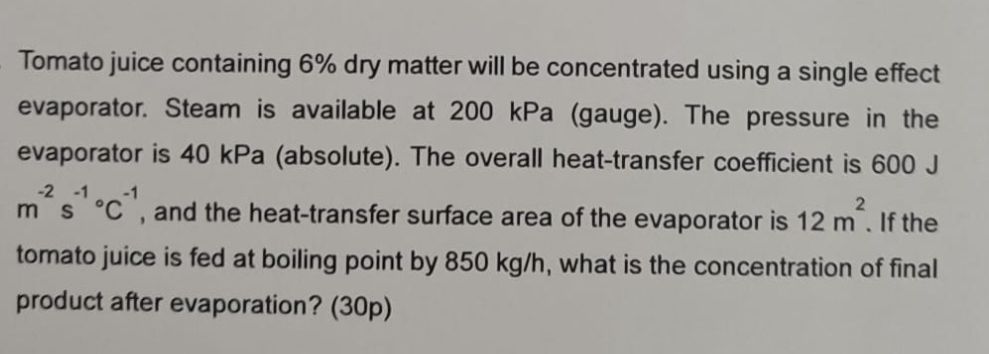 Tomato juice containing 6% dry matter will be concentrated using a single effect
evaporator. Steam is available at 200 kPa (gauge). The pressure in the
evaporator is 40 kPa (absolute). The overall heat-transfer coefficient is 600 J
m> 5 oc” and the heat-transfer surface area of the evaporator is 12 m’. If the
tomato juice is fed at boiling point by 850 kg/h, what is the concentration of final
product after evaporation? (30p)
This is AI generated Response.
Asked by: Francis
Created at: 2026-01-04 21:28:29
Asked by: Francis
Created at: 2026-01-04 21:28:29
Final Answer:
Rendered
Raw Text
Did you like this answer?
Let's break down and solve the problem step by step.
---
## **Given Data**
- **Feed rate (\( F \))** = 850 kg/h
- **Initial dry matter concentration (\( x_f \))** = 6% = .06
- **Steam pressure (gauge)** = 200 kPa ⟶ **Absolute** = 200 + 101 = **301 kPa**
- **Evaporator pressure (absolute)** = 40 kPa
- **Overall heat transfer coefficient (\( U \))** = 600 J/(m²·s·°C)
- **Heat transfer area (\( A \))** = 12 m²
---
## **Step 1: Mass Balance**
Let:
- \( F = \) Feed (850 kg/h)
- \( P = \) Product (kg/h, to be found)
- \( V = \) Vapor (kg/h, to be found)
- \( x_f = \) Feed concentration = .06
- \( x_p = \) Product concentration (to be found)
### **Total Mass Balance**
\[
F = P + V
\]
### **Solute (dry matter) Mass Balance**
\[
F x_f = P x_p
\]
\[
P = \frac{F x_f}{x_p}
\]
---
## **Step 2: Boiling Point in the Evaporator**
The evaporator operates at **40 kPa (absolute)**.
- At 40 kPa, the boiling point of water ≈ **75°C** (from steam tables).
---
## **Step 3: Steam Conditions**
- Steam is available at **301 kPa (absolute)**.
- At 301 kPa, the saturation temperature, \( T_{steam} \), ≈ **134°C** (from steam tables).
---
## **Step 4: Energy (Heat) Balance**
Latent heat required to vaporize water at 75°C:
- \( \lambda_{75°C} \) ≈ **230 kJ/kg** (from steam tables).
### **Heat Required to Vaporize Water**
\[
Q = V \cdot \lambda_{75°C}
\]
- \( Q \) = Heat supplied (kJ/h)
- \( V \) = Amount of vapor (kg/h)
### **Heat Supplied by Condensing Steam**
\[
Q = U \cdot A \cdot \Delta T \cdot t
\]
Where:
- \( U = 600 \) J/(m²·s·°C)
- \( A = 12 \) m²
- \( \Delta T = T_{steam} - T_{boiling} = 134^\circ C - 75^\circ C = 59^\circ C \)
- Time, \( t = 1 \) hour = 360 seconds
\[
Q = 600 \cdot 12 \cdot 59 \cdot 360 \ \text{J}
\]
Calculate:
\[
Q = 600 \cdot 12 = 720
\]
\[
Q = 720 \cdot 59 = 424,800
\]
\[
Q = 424,800 \cdot 360 = 1,529,280,000 \ \text{J}
\]
Convert J to kJ:
\[
Q = 1,529,280,000 \ \text{J} \div 100 = 1,529,280 \ \text{kJ}
\]
---
## **Step 5: Amount of Water Evaporated**
\[
Q = V \cdot \lambda_{75^\circ C}
\]
\[
V = \frac{Q}{\lambda_{75^\circ C}}
\]
\[
V = \frac{1,529,280}{230} = 665.8 \ \text{kg/h}
\]
---
## **Step 6: Find Final Product Concentration**
Recall:
- \( F = 850 \) kg/h
- \( V = 665.8 \) kg/h
\[
P = F - V = 850 - 665.8 = 184.2 \ \text{kg/h}
\]
Solute balance:
\[
F x_f = P x_p
\]
\[
850 \times .06 = 184.2 \times x_p
\]
\[
51 = 184.2 x_p
\]
\[
x_p = \frac{51}{184.2} = .277
\]
---
## **Step 7: Final Answer**
\[
\boxed{\text{The concentration of the final product after evaporation is } 27.7\% \text{ dry matter.}}
\]
---
### **Summary Table**
| Parameter | Value |
|-----------------------|------------------|
| Feed rate (\( F \)) | 850 kg/h |
| Feed conc. (\( x_f \))| 6% |
| Product rate (\( P \))| 184.2 kg/h |
| Product conc. (\( x_p \)) | **27.7%** |
| Water evaporated (\( V \)) | 665.8 kg/h |
📢 Instructions:
- Ask anything relatd to above question only.
- For new Question goto :