Give step-by-step solution with explanation and final answer:[MAR3037]
3.
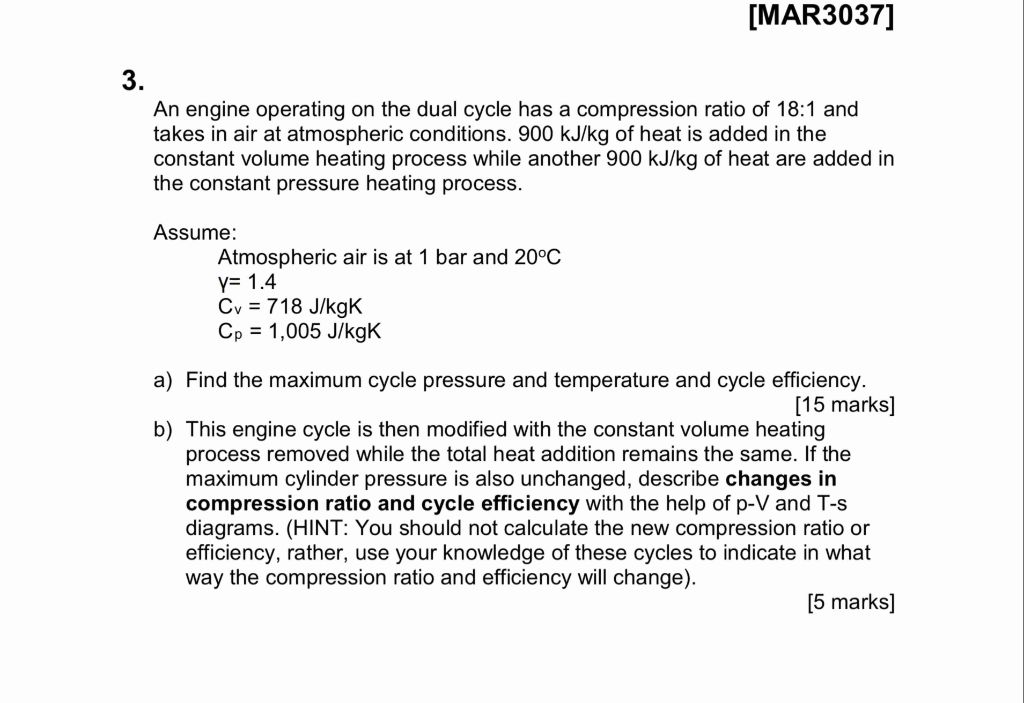
An engine operating on the dual cycle has a compression ratio of 18:1 and
takes in air at atmospheric conditions. 900 kJ/kg of heat is added in the
constant volume heating process while another 900 kJ/kg of heat are added in
the constant pressure heating process.
Assume:
Atmospheric air is at 1 bar and 20°C
y=14
Cv =718 J/kgK
Cp = 1,005 J/kgK
a) Find the maximum cycle pressure and temperature and cycle efficiency.
[15 marks]
b) This engine cycle is then modified with the constant volume heating
process removed while the total heat addition remains the same. If the
maximum cylinder pressure is also unchanged, describe changes in
compression ratio and cycle efficiency with the help of p-V and T-s
diagrams. (HINT: You should not calculate the new compression ratio or
efficiency, rather, use your knowledge of these cycles to indicate in what
way the compression ratio and efficiency will change).
[5 marks]
Question:
Give step-by-step solution with explanation and final answer:[MAR3037]
3.
An engine operating on the dual cycle has a compression ratio of 18:1 and
takes in air at atmospheric conditions. 900 kJ/kg of heat is added in the
constant volume heating process while another 900 kJ/kg of heat are added in
the constant pressure heating process.
Assume:
Atmospheric air is at 1 bar and 20°C
y=14
Cv =718 J/kgK
Cp = 1,005 J/kgK
a) Find the maximum cycle pressure and temperature and cycle efficiency.
[15 marks]
b) This engine cycle is then modified with the constant volume heating
process removed while the total heat addition remains the same. If the
maximum cylinder pressure is also unchanged, describe changes in
compression ratio and cycle efficiency with the help of p-V and T-s
diagrams. (HINT: You should not calculate the new compression ratio or
efficiency, rather, use your knowledge of these cycles to indicate in what
way the compression ratio and efficiency will change).
[5 marks]
This is AI generated Response.
Asked by: Rahul
Created at: 2026-01-04 19:38:32
Final Answer:
RenderedRaw Text
Did you like this answer?
# Solution to Dual Cycle Engine Problem
## Given Data
- **Compression ratio (\( r \))**: 18:1
- **Initial air conditions**: 1 bar, 20°C (293 K)
- **Specific heats**: \( C_v = 718 \) J/kgK, \( C_p = 1005 \) J/kgK
- **Ratio of specific heats (\( \gamma \))**: 1.4
- **Heat added at constant volume (\( Q_{in,cv} \))**: 900 kJ/kg = 900,000 J/kg
- **Heat added at constant pressure (\( Q_{in,cp} \))**: 900 kJ/kg = 900,000 J/kg
---
## a) **Find the Maximum Cycle Pressure, Temperature, and Cycle Efficiency**
Let's break down the Dual cycle:
### **Cycle Sequence**
1. **1 → 2:** Isentropic Compression
2. **2 → 3:** Constant Volume Heat Addition
3. **3 → 4:** Constant Pressure Heat Addition
4. **4 → 5:** Isentropic Expansion
5. **5 → 1:** Constant Volume Heat Rejection
Let's define:
- State 1: Start of compression (ambient)
- State 2: End of isentropic compression
- State 3: End of constant volume heat addition
- State 4: End of constant pressure heat addition (max P & T)
- State 5: End of isentropic expansion
### **Step 1: State 1 (Initial State)**
- \( P_1 = 1 \) bar = 100,000 Pa
- \( T_1 = 20^\circ C = 293 \) K
---
### **Step 2: State 2 (End of Isentropic Compression)**
For isentropic compression:
\[
\frac{T_2}{T_1} = r^{\gamma-1}
\]
\[
T_2 = T_1 \cdot r^{\gamma-1}
\]
\[
T_2 = 293 \times 18^{.4}
\]
Calculate \( 18^{.4} \):
\[
\ln 18 = 2.8904
\]
\[
.4 \times 2.8904 = 1.1562
\]
\[
e^{1.1562} = 3.177
\]
\[
T_2 = 293 \times 3.177 = 930.9~K
\]
---
### **Step 3: State 3 (After Constant Volume Heat Addition)**
At constant volume:
\[
Q_{in,cv} = m C_v (T_3 - T_2)
\]
Assume \( m = 1 \) kg for simplicity.
\[
900,000 = 718 \times (T_3 - 930.9)
\]
\[
T_3 - 930.9 = \frac{900,000}{718} = 1,253.5
\]
\[
T_3 = 930.9 + 1,253.5 = 2,184.4~K
\]
---
### **Step 4: State 4 (After Constant Pressure Heat Addition - Maximum T and P)**
At constant pressure:
\[
Q_{in,cp} = m C_p (T_4 - T_3)
\]
\[
900,000 = 1,005 \times (T_4 - 2,184.4)
\]
\[
T_4 - 2,184.4 = \frac{900,000}{1,005} = 895.5
\]
\[
T_4 = 2,184.4 + 895.5 = 3,079.9~K
\]
#### **Maximum Temperature:**
\[
\boxed{T_{max} = T_4 = 3,080~K}
\]
---
#### **Find Maximum Pressure \( P_3 \) and \( P_4 \):**
#### **At State 2:**
\[
\frac{P_2}{P_1} = r^{\gamma}
\]
\[
P_2 = P_1 \times r^{\gamma} = 1 \times 18^{1.4}
\]
\[
1.4 \times \ln 18 = 1.4 \times 2.8904 = 4.0466
\]
\[
e^{4.0466} = 57.1
\]
\[
P_2 = 1 \times 57.1 = 57.1~bar
\]
#### **At State 3 (Constant Volume, so \( P_3/T_3 = P_2/T_2 \)):**
\[
\frac{P_3}{T_3} = \frac{P_2}{T_2}
\Rightarrow P_3 = P_2 \times \frac{T_3}{T_2}
\]
\[
P_3 = 57.1 \times \frac{2,184.4}{930.9} = 57.1 \times 2.346 = 134.1~bar
\]
#### **At State 4 (Constant Pressure, so \(P_4 = P_3\)):**
\[
P_4 = P_3 = 134.1~bar
\]
#### **Maximum Pressure:**
\[
\boxed{P_{max} = P_3 = P_4 = 134~\text{bar}}
\]
---
### **Step 5: Cycle Efficiency**
Net Work Output = Total Heat Added - Heat Rejected
#### **Heat Rejected (at constant volume from 5 to 1):**
First, we need \( T_5 \).
#### **Isentropic Expansion (4 to 5):**
\[
\frac{T_5}{T_4} = \left( \frac{V_4}{V_5} \right)^{\gamma - 1}
\]
But \( V_5 = V_1 \) (back to start), \( V_4 = V_3 \) (end of heat addition at const P).
From \( V_3 \) to \( V_4 \), at constant pressure:
\[
\frac{T_4}{T_3} = \frac{V_4}{V_3} \Rightarrow \frac{V_4}{V_3} = \frac{T_4}{T_3}
\]
So:
\[
\frac{T_5}{T_4} = \left( \frac{V_4}{V_5} \right)^{\gamma - 1} = \left( \frac{V_4}{V_1} \right)^{\gamma - 1}
\]
But:
\[
\frac{V_4}{V_1} = \frac{V_4}{V_3} \cdot \frac{V_3}{V_2} \cdot \frac{V_2}{V_1}
\]
- \( \frac{V_4}{V_3} = \frac{T_4}{T_3} \) (const P)
- \( \frac{V_3}{V_2} = 1 \) (const V)
- \( \frac{V_2}{V_1} = \frac{1}{r} \)
So,
\[
\frac{V_4}{V_1} = \frac{T_4}{T_3} \times \frac{1}{r}
\]
Therefore,
\[
T_5 = T_4 \left( \frac{T_4}{T_3} \cdot \frac{1}{r} \right)^{\gamma - 1}
\]
Plug in values:
- \( T_4 = 3,080 \) K
- \( T_3 = 2,184.4 \) K
- \( r = 18 \)
- \( \gamma - 1 = .4 \)
\[
\frac{T_4}{T_3} = \frac{3,080}{2,184.4} = 1.409
\]
\[
\left( \frac{T_4}{T_3} \cdot \frac{1}{r} \right) = \frac{1.409}{18} = .0783
\]
\[
(.0783)^{.4}
\]
Take log:
\[
\ln(.0783) = -2.546
\]
\[
-2.546 \times .4 = -1.018
\]
\[
e^{-1.018} = .361
\]
\[
T_5 = 3,080 \times .361 = 1,112~K
\]
---
#### **Heat Rejected:**
\[
Q_{out} = m C_v (T_5 - T_1)
\]
\[
Q_{out} = 718 \times (1,112 - 293) = 718 \times 819 = 587,142~J/kg = 587.1~kJ/kg
\]
---
#### **Cycle Efficiency:**
\[
\eta_{cycle} = \frac{\text{Net Work}}{\text{Total Heat Input}} = \frac{Q_{in} - Q_{out}}{Q_{in}}
\]
\[
Q_{in} = 900 + 900 = 1,800~kJ/kg
\]
\[
\eta_{cycle} = \frac{1,800 - 587.1}{1,800} = \frac{1,212.9}{1,800} = .6749 = 67.5\%
\]
---
### **Final Answers (a):**
- **Maximum Cycle Pressure:** \(\boxed{134~\text{bar}}\)
- **Maximum Cycle Temperature:** \(\boxed{3,080~K}\)
- **Cycle Efficiency:** \(\boxed{67.5\%}\)
---
## b) **Changes if Constant Volume Heating is Removed**
**Given:**
- All heat addition is now at constant pressure.
- Total heat addition remains the same (\(1,800~kJ/kg\)).
- Maximum cylinder pressure is unchanged.
### **Explanation:**
1. **Compression Ratio:**
- In a constant pressure cycle, for the same maximum pressure, the temperature at the end of compression (\(T_2\)) must be lower.
- Thus, the compression ratio must be lower to keep the maximum pressure the same (since pressure depends on \( r^\gamma \)).
2. **Cycle Efficiency:**
- Removing constant volume heating and shifting all heat addition to constant pressure reduces efficiency.
- The efficiency of the dual cycle lies between that of the Otto (all at constant volume) and Diesel (all at constant pressure) cycles.
- So, the modified cycle’s efficiency will **decrease**.
3. **p-V and T-s Diagrams:**
- On the p-V diagram, the heat addition moves to a horizontal line (constant pressure) rather than a vertical (constant volume).
- On the T-s diagram, the heat addition occurs at a lower pressure, and the area (representing net work) is reduced.
---
### **Summary Table**
| Parameter | Original Dual Cycle | All-Constant Pressure (Diesel) |
|------------------------|--------------------|-------------------------------|
| Compression Ratio | Higher | Lower |
| Maximum Pressure | Same | Same |
| Cycle Efficiency | Higher | Lower |
---
### **Final Points (b):**
- **Compression ratio decreases** to maintain the same maximum pressure.
- **Cycle efficiency decreases** because the constant pressure cycle is less efficient than the dual cycle for the same heat input.
---
## **Summary of Answers**
### a)
- **Maximum Cycle Pressure:** \(\boxed{134~\text{bar}}\)
- **Maximum Cycle Temperature:** \(\boxed{3,080~K}\)
- **Cycle Efficiency:** \(\boxed{67.5\%}\)
### b)
- **Compression ratio decreases** (for same max pressure).
- **Cycle efficiency decreases** (since all heat is added at constant pressure).
- **p-V and T-s diagrams:** Show lower area (work output) and lower efficiency for all-constant pressure heat addition.
---
If you have any follow-up or need diagrams, let me know!
VIPSolutions focuses on clear, step‑by‑step explanations so you can learn quickly. Whether you need an AI‑generated walkthrough or a short hint to get unstuck, each solution is organized for fast reading and easy review later.
Search similar questions, compare approaches, and bookmark the best answers for revision. Our goal is simple: quick, reliable study help that feels natural—not noisy.
 VIPSolutions
 [MAR3037]
3.
An engine operating on the dual cycle has a compression ratio of 18:1 and
takes in air at atmospheric conditions. 900 kJ/kg of heat is added in the
constant volume heating process while another 900 kJ/kg of heat are added in
the constant pressure heating process.
Assume:
Atmospheric air is at 1 bar and 20°C
y=14
Cv =718 J/kgK
Cp = 1,005 J/kgK
a) Find the maximum cycle pressure and temperature and cycle efficiency.
[15 marks]
b) This engine cycle is then modified with the constant volume heating
process removed while the total heat addition remains the same. If the
maximum cylinder pressure is also unchanged, describe changes in
compression ratio and cycle efficiency with the help of p-V and T-s
diagrams. (HINT: You should not calculate the new compression ratio or
efficiency, rather, use your knowledge of these cycles to indicate in what
way the compression ratio and efficiency will change).
[5 marks]