 VIPSolutions
Give step-by-step solution with explanation and final answer:= = o = 8 = rv 4 °c oo oh SHE hin z GO (= 5 = ® 2 & © gE ~~ ’ = @ Seo oc & he Heal DUANoy ER Gad bac ie
Question:
Give step-by-step solution with explanation and final answer: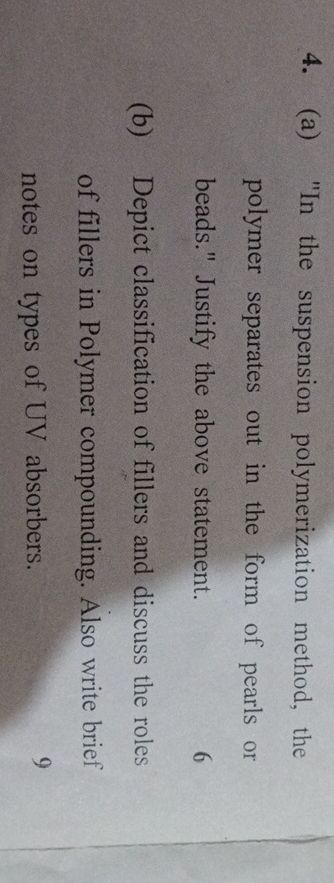 =
= o
= 8 =
rv
4 °c oo oh
SHE hin
z GO (=
5 = ® 2
& © gE ~~
’ = @
Seo oc &
he Heal DUANoy ER
Gad bac ie
This is AI generated Response.
Asked by: Francis
Created at: 2026-01-04 19:30:34
Asked by: Francis
Created at: 2026-01-04 19:30:34
Final Answer:
Rendered
Raw Text
Did you like this answer?
Let's address both parts of the question step by step.
---
## 4(a) Suspension Polymerization: "Polymer separates out in the form of pearls or beads."
### Explanation & Justification:
#### **1. What is Suspension Polymerization?**
- **Definition:** Suspension polymerization is a heterogeneous polymerization technique where the monomer is dispersed as droplets in a continuous aqueous phase.
- **Initiator:** The polymerization initiator is typically soluble in the monomer, not in water.
#### **2. Process:**
- The monomer (and initiator) is added to water containing a stabilizer (e.g., polyvinyl alcohol).
- **Agitation:** The mixture is vigorously agitated to form small droplets of monomer suspended in water.
- **Polymerization:** As the reaction proceeds, polymerization occurs within these droplets.
#### **3. Formation of Pearls/Beads:**
- **Droplet as Microreactor:** Each droplet acts as a tiny reactor, where polymerization occurs independently.
- **Shape:** Surface tension causes the droplets to be spherical.
- **Result:** The polymer forms as solid spherical particles, resembling pearls or beads.
#### **4. Why does the polymer separate as beads?**
- The immiscibility of the monomer and water, stabilized by surfactants, ensures each droplet remains discrete.
- Polymerization within droplets solidifies them, resulting in bead-like polymer particles.
- After polymerization, these beads are filtered, washed, and dried.
#### **Examples:**
- Polyvinyl chloride (PVC)
- Polystyrene beads
### **Final Justification Statement:**
> In suspension polymerization, the monomer droplets suspended in water act as individual reaction vessels. Polymerization within these droplets results in the formation of discrete, spherical polymer beads or pearls, which can be easily separated from the aqueous phase.
---
## 4(b) Fillers in Polymer Compounding & UV Absorbers
### **1. Classification of Fillers:**
| **Type** | **Examples** | **Purpose** |
|------------------|-------------------------|------------------------------------|
| Inorganic | Talc, calcium carbonate, clay, silica | Improve strength, reduce cost |
| Organic | Wood flour, cellulose | Modify mechanical properties |
| Functional | Carbon black, glass fibers | Enhance conductivity, strength |
| Specialty | Flame retardants, UV stabilizers | Impart specific properties |
---
### **2. Roles of Fillers in Polymer Compounding:**
- **Increase Bulk:** Reduce the cost by increasing the volume of the product.
- **Enhance Mechanical Properties:** Improve strength, stiffness, impact resistance.
- **Improve Processability:** Aid in molding and extrusion.
- **Impart Special Properties:** e.g., electrical conductivity, flame retardancy, UV resistance.
- **Modify Appearance:** Affect color, opacity, and surface finish.
---
### **3. Types of UV Absorbers (Brief Notes):**
- **Benzotriazoles:** Absorb UV radiation and dissipate it as heat; commonly used for plastics and coatings.
- **Benzophenones:** Stabilize polymers by absorbing UV light; used in PVC, polyesters.
- **Hindered Amine Light Stabilizers (HALS):** Do not absorb UV but scavenge free radicals formed by UV exposure, thus preventing degradation.
- **Salicylates:** Used in cellulose and polyvinyl chloride.
---
## **Summary Table**
| **Aspect** | **Details** |
|---------------------|-----------------------------------------------------------------------------|
| Suspension Polymerization | Polymer forms as beads due to polymerization in suspended droplets. |
| Fillers Classification | Inorganic, organic, functional, specialty. |
| Roles of Fillers | Enhance properties, reduce cost, modify processing/appearance. |
| UV Absorbers | Benzotriazoles, benzophenones, HALS, salicylates (protect against UV). |
---
## **Final Answers:**
### **(a):**
> In suspension polymerization, polymer forms as pearls or beads because the monomer droplets suspended in water act as microreactors. Each droplet polymerizes independently, solidifying into a bead or pearl shape due to surface tension, which can then be separated easily.
### **(b):**
> Fillers are classified into inorganic, organic, functional, and specialty types. They are added to polymers to enhance mechanical properties, reduce cost, improve processability, and impart special functions. UV absorbers like benzotriazoles, benzophenones, HALS, and salicylates are used to protect polymers from degradation by absorbing or neutralizing harmful UV radiation.
📢 Instructions:
- Ask anything relatd to above question only.
- For new Question goto :