 VIPSolutions
Give step-by-step solution with explanation and final answer:oo 7. (a) What is viscoelasticity ? Discuss the two 5 a : Ce viscoelastic models. : 2 onl cae bv ne (b) What is Rheology ? Write short note on the tyy of rheometers, er {ade 8 (a) Derive Voigt model for stress relaxation as we I | (b) Discuss the effect of temperature as well SEE Cel a olecular weight and its distribution, on visco : sre Ae SISA LAU SILAS
Question:
Give step-by-step solution with explanation and final answer: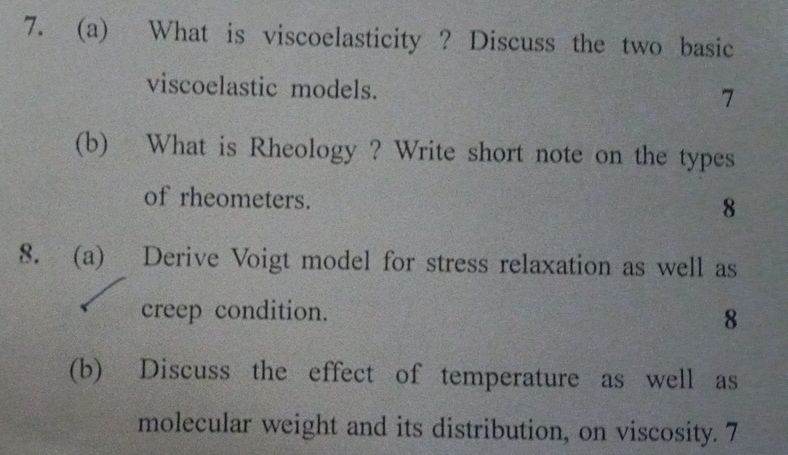 oo
7. (a) What is viscoelasticity ? Discuss the two 5 a
: Ce
viscoelastic models. : 2 onl
cae bv ne
(b) What is Rheology ? Write short note on the tyy
of rheometers, er {ade
8 (a) Derive Voigt model for stress relaxation as we I |
(b) Discuss the effect of temperature as well
SEE Cel a
olecular weight and its distribution, on visco
: sre Ae SISA LAU SILAS
This is AI generated Response.
Asked by: Francis
Created at: 2026-01-04 18:49:51
Asked by: Francis
Created at: 2026-01-04 18:49:51
Final Answer:
Rendered
Raw Text
Did you like this answer?
Let's solve **Question 8(a): Derive Voigt model for stress relaxation as well as creep condition.**
---
# Voigt (Kelvin-Voigt) Model for Viscoelasticity
The **Voigt model** (also known as the Kelvin-Voigt model) consists of a **spring (elastic element)** and a **dashpot (viscous element)** connected **in parallel**.
## 1. **Constitutive Equation**
Let:
- \( \sigma(t) \) = stress at time \( t \)
- \( \epsilon(t) \) = strain at time \( t \)
- \( E \) = Young's modulus of the spring
- \( \eta \) = viscosity of the dashpot
**Voigt Model equation:**
\[
\sigma(t) = E \epsilon(t) + \eta \frac{d\epsilon(t)}{dt}
\]
---
## 2. **Creep Condition (Constant Stress)**
**Creep** is the increase of strain over time when a constant stress is suddenly applied.
- Apply constant stress: \( \sigma(t) = \sigma_ \) for \( t \geq \)
- Initial condition: \( \epsilon() = \) (assume initially unstrained)
**Differential Equation:**
\[
\sigma_ = E\epsilon(t) + \eta \frac{d\epsilon(t)}{dt}
\]
**Rearrange:**
\[
\frac{d\epsilon(t)}{dt} + \frac{E}{\eta}\epsilon(t) = \frac{\sigma_}{\eta}
\]
**Solution (Using Integrating Factor):**
Let \( \tau = \frac{\eta}{E} \) (relaxation time).
\[
\epsilon(t) = \frac{\sigma_}{E} \left( 1 - e^{-t/\tau} \right)
\]
### **Interpretation**
- At \( t = \): \( \epsilon() = \) (no instantaneous deformation).
- As \( t \rightarrow \infty \): \( \epsilon(\infty) = \frac{\sigma_}{E} \) (reaches a steady value).
**Creep curve**: Exponential approach to the steady strain.
---
## 3. **Stress Relaxation Condition (Constant Strain)**
**Stress relaxation** is the decrease in stress under a constant applied strain.
- Apply constant strain: \( \epsilon(t) = \epsilon_ \) for \( t \geq \)
- Initial stress: \( \sigma() = E\epsilon_ \)
**From the model:**
\[
\sigma(t) = E\epsilon_ + \eta \frac{d\epsilon_}{dt}
\]
But, since \( \epsilon_ \) is constant, \( \frac{d\epsilon_}{dt} = \):
\[
\sigma(t) = E\epsilon_
\]
### **Interpretation**
- **No stress relaxation** occurs in the Voigt model for a constant strain; the stress remains constant.
---
## 4. **Summary Table**
| Condition | Differential Equation | Solution | Behavior |
|---------------------|--------------------------------------------------------|----------------------------------|--------------------------------------|
| **Creep** | \( \sigma_ = E\epsilon + \eta \frac{d\epsilon}{dt} \) | \( \epsilon(t) = \frac{\sigma_}{E}(1-e^{-t/\tau}) \) | Strain increases to steady value |
| **Stress Relaxation** | \( \sigma(t) = E\epsilon_ \) (as \( d\epsilon/dt = \)) | \( \sigma(t) = E\epsilon_ \) | Stress stays constant |
---
# **Final Answers**
### **Voigt Model for Creep:**
\[
\boxed{
\epsilon(t) = \frac{\sigma_}{E}\left[1 - \exp\left(-\frac{E}{\eta} t\right)\right]
}
\]
### **Voigt Model for Stress Relaxation:**
\[
\boxed{
\sigma(t) = E \epsilon_
}
\]
(No relaxation: stress remains constant for a constant strain.)
📢 Instructions:
- Ask anything relatd to above question only.
- For new Question goto :