 VIPSolutions
Give step-by-step solution with explanation and final answer:1 Aye cect se porns emesis sd pete orp Er ET te A 4 A y k = 'b) Accounting for pressure drop using the analytical approach could be used in the packed terres Se mr re Teme pack he catalyst in shorter recta with ice th pipe diameter. fall other cn remain the same, is ths suggestion correct? Show t mathematically 10 po
Question:
Give step-by-step solution with explanation and final answer: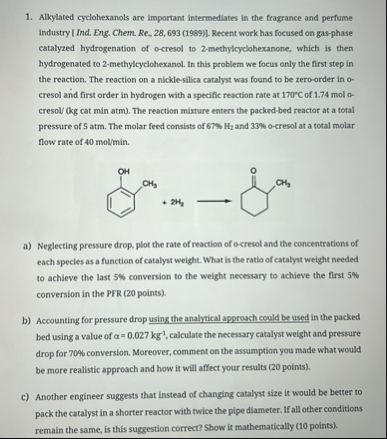 1 Aye cect se porns emesis sd pete
orp
Er
ET
te
A
4 A
y k
=
'b) Accounting for pressure drop using the analytical approach could be used in the packed
terres
Se mr
re
Teme
pack he catalyst in shorter recta with ice th pipe diameter. fall other cn
remain the same, is ths suggestion correct? Show t mathematically 10 po
This is AI generated Response.
Asked by: Francis
Created at: 2026-01-04 18:23:24
Asked by: Francis
Created at: 2026-01-04 18:23:24
Final Answer:
Rendered
Raw Text
Did you like this answer?
Let's break down and solve the problem step by step:
---
## Given
- **Reaction:**
\[
\text{o-cresol} + 2 \text{H}_2 \rightarrow \text{2-methylcyclohexanol}
\]
- **Catalyst:** Nickel-silica
- **Reaction conditions:** 170°C, 1.74 mol cresol/(kg cat min)
- **Feed gas composition:** 67% H₂, 33% o-cresol (molar basis)
- **Total molar flow rate:** 40 mol/min
- **Packed bed reactor total pressure:** 5 atm
- **Packing void fraction:** Not given (assume standard if needed)
- **Rate constant (for part b):** \( a = .027 \, \text{kg}^{-1} \)
- **Desired conversion:** 5%
---
## (a) **Plot Rate and Concentrations as a Function of Catalyst Weight**
### 1. **Write the Rate Law**
Given: zero-order in cresol, first-order in H₂
\[
r = k C_{H_2}
\]
But the specific reaction rate is given as:
\[
\text{Specific rate} = 1.74 \frac{\text{mol cresol}}{\text{kg cat} \cdot \text{min}}
\]
(Assume this is under standard feed conditions.)
### 2. **Mole Balances for a PFR**
For a packed bed reactor:
\[
\frac{dF_A}{dW} = -r_A
\]
where \( F_A \) is the molar flow of A (o-cresol), \( W \) is the catalyst weight.
- **Initial o-cresol feed:** \( F_{A} = .33 \times 40 = 13.2 \) mol/min
- **\( X \) = conversion of o-cresol:** \( X = \frac{F_{A} - F_A}{F_{A}} \)
\[
\frac{dX}{dW} = \frac{-r_A}{F_{A}}
\]
### 3. **Express \( r_A \) in Terms of \( X \)**
- **Hydrogen:** \( F_{H_2,} = .67 \times 40 = 26.8 \) mol/min
- For 5% conversion: \( X = .05 \), so \( F_A = F_{A}(1 - X) \)
- For every 1 mol o-cresol, 2 mol H₂ are consumed.
- At conversion \( X \):
\[
F_{H_2} = F_{H_2,} - 2F_{A}X
\]
- **Total molar flow at \( X \):**
\[
F_{tot} = F_{A}(1 - X) + F_{H_2,} - 2F_{A}X + F_P
\]
where \( F_P \) is the product flow.
But for small conversion, \( F_{tot} \approx 40 \) mol/min.
- **Partial Pressure of H₂ at conversion \( X \):**
\[
y_{H_2} = \frac{F_{H_2}}{F_{tot}}
\]
\[
P_{H_2} = y_{H_2} P_{tot}
\]
\[
C_{H_2} = \frac{P_{H_2}}{RT}
\]
But since the rate is given as a specific rate, we can use it to directly relate to W.
### 4. **Calculate Required Catalyst for 5% Conversion**
From material balance:
\[
F_{A} X = r \cdot W
\]
\[
W = \frac{F_{A} X}{r}
\]
Given \( r = 1.74 \) mol/(kg·min), \( F_{A} = 13.2 \) mol/min, \( X = .05 \):
\[
W = \frac{13.2 \times .05}{1.74} = \frac{.66}{1.74} = .379 \text{ kg}
\]
**Ratio of catalyst weight needed to achieve 5% conversion:**
- **Required catalyst: .379 kg**
#### **Plotting (conceptually):**
- As catalyst weight increases, conversion increases linearly at low conversion (since zero-order in o-cresol).
- \( X = \frac{r}{F_{A}} W \)
- H₂ will decrease slightly, but for small X, \( C_{H_2} \) is nearly constant.
---
## (b) **Including Pressure Drop: Analytical Approach**
**Given:**
- \( a = .027 \, \text{kg}^{-1} \) (Ergun parameter, not rate constant!)
- Use Ergun equation for pressure drop.
### 1. **Ergun Equation (Simplified):**
For pressure drop in packed bed:
\[
\frac{dP}{dW} = -a P
\]
where \( a = .027 \, \text{kg}^{-1} \).
### 2. **Integrate to Find Pressure Profile:**
\[
\frac{dP}{P} = -a dW
\]
\[
\ln\left(\frac{P}{P_}\right) = -a W
\]
\[
P = P_ e^{-aW}
\]
### 3. **Effect on Rate:**
- As \( P \) drops, \( C_{H_2} \) drops (since \( C_{H_2} = y_{H_2} P/(RT) \))
- Thus, rate drops along the bed.
### 4. **Material Balance Including Pressure Drop:**
\[
F_{A} dX = r dW
\]
But now \( r = k C_{H_2} \), and \( C_{H_2} \propto P \):
\[
C_{H_2}(W) = C_{H_2,} e^{-aW}
\]
\[
r(W) = r_ e^{-aW}
\]
\[
F_{A} dX = r_ e^{-aW} dW
\]
Integrate from \( X= \) to \( X=.05 \), \( W= \) to \( W=W_f \):
\[
F_{A} \int_^{.05} dX = r_ \int_^{W_f} e^{-aW} dW
\]
\[
F_{A} (.05) = \frac{r_}{-a} (e^{-aW_f} - 1)
\]
\[
F_{A} (.05) = \frac{r_}{a} (1 - e^{-aW_f})
\]
\[
\frac{F_{A} (.05)a}{r_} = 1 - e^{-aW_f}
\]
\[
e^{-aW_f} = 1 - \frac{F_{A} (.05)a}{r_}
\]
\[
-aW_f = \ln\left(1 - \frac{F_{A} (.05)a}{r_}\right)
\]
\[
W_f = -\frac{1}{a} \ln\left(1 - \frac{F_{A} (.05)a}{r_}\right)
\]
#### Plug in values:
- \( F_{A} = 13.2 \) mol/min
- \( a = .027 \) kg⁻¹
- \( r_ = 1.74 \) mol/(kg·min)
- \( X = .05 \)
\[
\frac{F_{A} (.05) a}{r_} = \frac{13.2 \times .05 \times .027}{1.74}
= \frac{.01782}{1.74}
= .01024
\]
So,
\[
W_f = -\frac{1}{.027} \ln(1 - .01024)
= -37.04 \ln(.98976)
= -37.04 \times (-.01029)
= .381 \text{ kg}
\]
**Comparing to (a):**
- Without pressure drop: \( W = .379 \) kg
- With pressure drop: \( W_f = .381 \) kg
**Conclusion:** Pressure drop has a very small effect at low conversion and short beds.
---
## (c) **Increase Bed Diameter vs. Increase Catalyst**
**Idea:**
Increasing bed diameter reduces pressure drop more effectively than simply increasing catalyst weight (since pressure drop is inversely proportional to the square of the diameter in the Ergun equation).
**Mathematical Justification:**
- **Ergun equation:**
\[
\Delta P \propto \frac{L}{d_p^2} \left(\frac{1}{D^2}\right)
\]
where \( D \) is reactor diameter.
- **If you double the bed diameter, pressure drop decreases by factor of 4 (since \( \Delta P \propto 1/D^2 \)).**
- **Just adding more catalyst increases length (W), raising pressure drop exponentially (from \( P = P_ e^{-aW} \)).**
**Conclusion:**
**It is more efficient to increase bed diameter rather than just increasing catalyst weight to maintain conversion with lower pressure drop.**
---
## **Summary of Answers**
### **(a)**
- **Plot:** Conversion increases linearly with catalyst weight (at low conversion).
- **Ratio for 5% conversion:** \( W = .379 \) kg
### **(b)**
- **With pressure drop:** \( W_f = .381 \) kg
- **Effect:** Slight increase in catalyst weight needed for same conversion.
### **(c)**
- **Increasing diameter is more efficient** than just increasing catalyst weight, since pressure drop decreases with the square of diameter.
---
If you need the actual plot or a sample calculation for a different conversion, let me know!
Question:
give me simple steps, answer must be in simple mot lengthly
This is AI generated Response.
Asked by: Francis
Created at: 2026-01-04 18:29:28
Asked by: Francis
Created at: 2026-01-04 18:29:28
Final Answer:
Rendered
Raw Text
Did you like this answer?
# Step-by-Step Solution
## Given Information
- **Reaction:**
\[
\text{o-cresol} + 2 \text{H}_2 \rightarrow \text{2-methylcyclohexanol}
\]
- **Catalyst:** Nickel-silica
- **Conditions:** 170°C, 1.74 mol cresol/(kg cat min)
- **Feed Composition:** 67% H₂, 33% o-cresol
- **Total Flow Rate:** 40 mol/min
- **Pressure:** 5 atm
- **Rate Constant:** \( a = 0.027 \, \text{kg}^{-1} \)
- **Desired Conversion:** 5%
---
## (a) Calculate Required Catalyst for 5% Conversion
1. **Initial Molar Flow Rates:**
- o-Cresol:
\[
F_A = 0.33 \times 40 = 13.2 \, \text{mol/min}
\]
- H₂:
\[
F_{H_2} = 0.67 \times 40 = 26.8 \, \text{mol/min}
\]
2. **Calculate Required Catalyst (W):**
- Conversion \( X = 0.05 \):
\[
W = \frac{F_A \times X}{r} = \frac{13.2 \times 0.05}{1.74} = 0.379 \text{ kg}
\]
---
## (b) Effect of Pressure Drop on Catalyst Weight
1. **Using Ergun Equation:**
- Pressure drop affects concentration and thus reaction rate.
- Integrate to find:
\[
W_f = -\frac{1}{a} \ln\left(1 - \frac{F_A \times X \times a}{r}\right)
\]
2. **Calculate \( W_f \):**
\[
W_f = -\frac{1}{0.027} \ln(1 - 0.01024) \approx 0.381 \text{ kg}
\]
---
## (c) Diameter vs. Catalyst Weight
- **Increasing Diameter:**
- Reduces pressure drop significantly.
- Pressure drop decreases with the square of the diameter:
\[
\Delta P \propto \frac{1}{D^2}
\]
- **Conclusion:**
- Increasing bed diameter is preferred over just increasing catalyst weight for maintaining conversion with lower pressure drop.
---
## **Final Summary**
- **Catalyst Weight for 5% Conversion:** \( 0.379 \, \text{kg} \) (without pressure drop)
- **Catalyst Weight with Pressure Drop:** \( 0.381 \, \text{kg} \)
- **Recommendation:** Increase bed diameter for better efficiency.
📢 Instructions:
- Ask anything relatd to above question only.
- For new Question goto :