 VIPSolutions
Give step-by-step solution with explanation and final answer:QUESTION 1: # A contiquesly stirred tank reactor with (CSTR) is volume 1.5 m*is fed with first-order irvet-orible liquid-phase reaction A > B. The inlet concentration of A = 2 mol/L and volurtiow rate k = 01 m?/s volumetic flow rate. k =01 m3s~. Assuming constant density, caculate steady-state conversion of A and the outter-tration of A and conceniration of Aa/B (CB). yi Pe ry 1 NL [Eke ANA/at = FAFA + AV dt =FAo —FA +r. ye K=05 52 Inet CSStR et 7 Sw X= (FA -FA + roo rA = —kCA NS
Question:
Give step-by-step solution with explanation and final answer: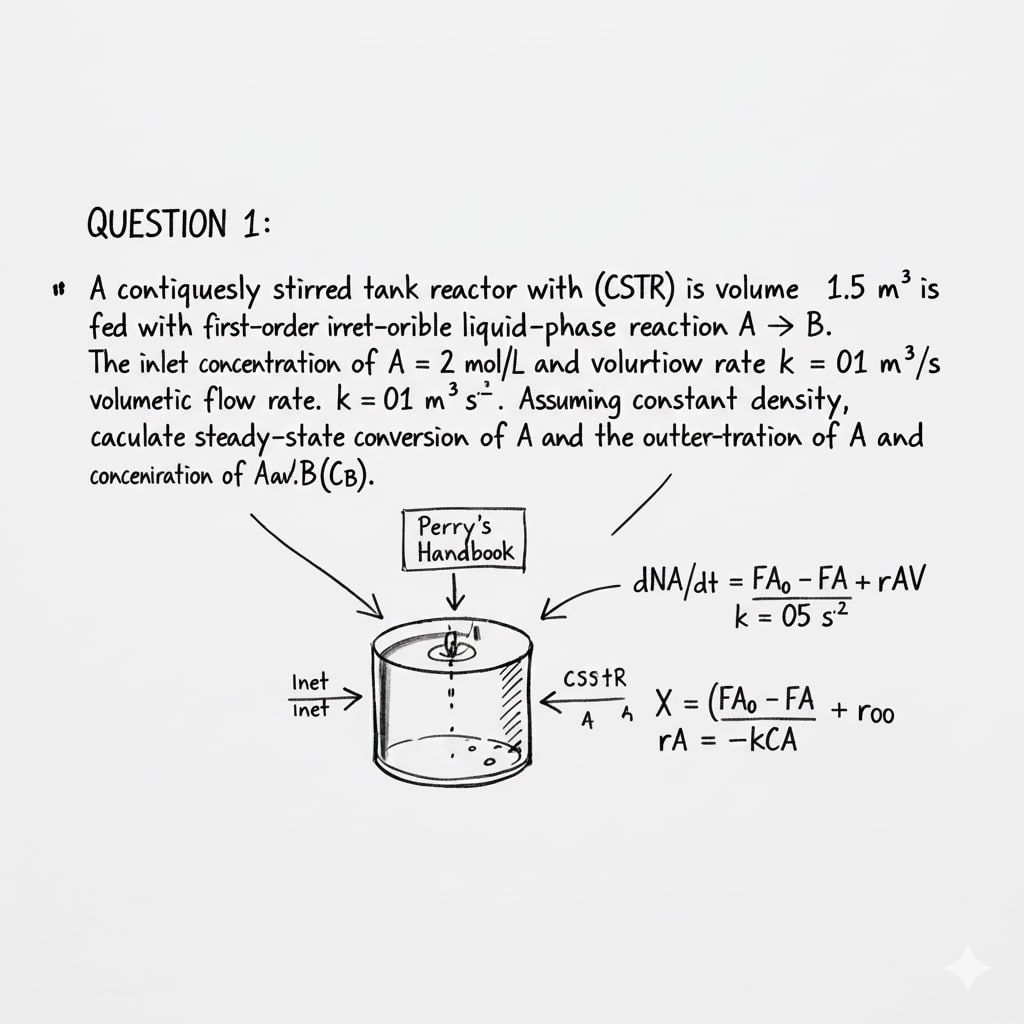 QUESTION 1:
# A contiquesly stirred tank reactor with (CSTR) is volume 1.5 m*is
fed with first-order irvet-orible liquid-phase reaction A > B.
The inlet concentration of A = 2 mol/L and volurtiow rate k = 01 m?/s
volumetic flow rate. k =01 m3s~. Assuming constant density,
caculate steady-state conversion of A and the outter-tration of A and
conceniration of Aa/B (CB). yi
Pe ry 1
NL [Eke ANA/at = FAFA + AV
dt =FAo —FA +r.
ye K=05 52
Inet CSStR
et 7 Sw X= (FA -FA + roo
rA = —kCA
NS
This is AI generated Response.
Asked by: Francis
Created at: 2026-01-03 18:25:36
Asked by: Francis
Created at: 2026-01-03 18:25:36
Final Answer:
Rendered
Raw Text
Did you like this answer?
Let's solve the CSTR problem step-by-step:
---
## **Given Data**
- **Volume of reactor, \( V \) = 1.5 m³**
- **Inlet concentration of A, \( C_{A} = 2 \) mol/L = 200 mol/m³** (since 1 L = .001 m³)
- **Volumetric flow rate, \( q = .1 \) m³/s**
- **First-order rate constant, \( k = .5 \) s⁻¹**
---
## **Step 1: Material Balance for CSTR (Steady-State)**
\[
\text{General mole balance: }
\frac{dN_A}{dt} = F_{A} - F_A + r_A V
\]
At steady-state, \(\frac{dN_A}{dt} = \):
\[
= F_{A} - F_A + r_A V
\]
Where:
- \( F_{A} = \) inlet molar flow rate of A \( = q \cdot C_{A} \)
- \( F_A = \) outlet molar flow rate of A \( = q \cdot C_A \)
- \( r_A = \) rate of reaction of A (disappearance) \( = -k C_A \)
- \( V = \) volume of reactor
---
## **Step 2: Substitute Values**
\[
= q C_{A} - q C_A - k C_A V
\]
\[
q C_{A} = q C_A + k C_A V
\]
\[
q C_{A} = C_A (q + k V)
\]
\[
C_A = \frac{q C_{A}}{q + k V}
\]
---
### **Plug in Numbers**
- \( q = .1 \) m³/s
- \( C_{A} = 200 \) mol/m³
- \( k = .5 \) s⁻¹
- \( V = 1.5 \) m³
\[
C_A = \frac{.1 \times 200}{.1 + .5 \times 1.5}
\]
\[
C_A = \frac{200}{.1 + .75}
\]
\[
C_A = \frac{200}{.85} \approx 235.29 \text{ mol/m}^3
\]
---
## **Step 3: Calculate Conversion of A**
\[
X = \frac{C_{A} - C_A}{C_{A}}
\]
\[
X = \frac{200 - 235.29}{200}
\]
\[
X = \frac{1764.71}{200} = .882
\]
So, **conversion of A is approximately 88.2%**
---
## **Step 4: Outlet Concentration of B ( \( C_B \) )**
For every mole of A consumed, 1 mole of B is produced (from stoichiometry):
\[
C_B = C_{A} - C_A
\]
\[
C_B = 200 - 235.29 = 1764.71 \text{ mol/m}^3
\]
---
## **Final Answers**
### **1. Steady-state conversion of A:**
\[
\boxed{X = .882 \ \text{or} \ 88.2\%}
\]
### **2. Outlet concentration of A:**
\[
\boxed{C_A = 235.29 \ \text{mol/m}^3}
\]
### **3. Outlet concentration of B:**
\[
\boxed{C_B = 1764.71 \ \text{mol/m}^3}
\]
---
**Summary Table:**
| Quantity | Value |
|----------------------------|-------------------|
| Conversion of A (\(X\)) | .882 (88.2%) |
| Outlet \(C_A\) | 235.29 mol/m³ |
| Outlet \(C_B\) | 1764.71 mol/m³ |
📢 Instructions:
- Ask anything relatd to above question only.
- For new Question goto :