 VIPSolutions
Give step-by-step solution with explanation and final answer:) (a) The standard heat of formation and standard free energy of formation of . ammonia at 298 K are -46100 J/mol and -16500 J/mol respectively. Calculate the equilibrium constant for the reaction N2(g) + 3 Ha (g) > 2 NHa (g) At 500 K assuming that the standard heat of reaction is constant in the temperature range 298 to 500 K. (6.5) $1 (b) Derive the relationship for the equilibrium constant, K = 7; (2) ' (3.5) i WRT —
Question:
Give step-by-step solution with explanation and final answer: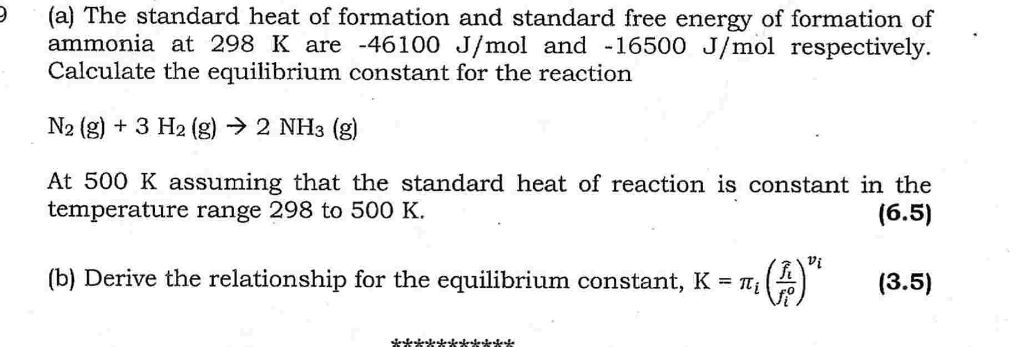 ) (a) The standard heat of formation and standard free energy of formation of .
ammonia at 298 K are -46100 J/mol and -16500 J/mol respectively.
Calculate the equilibrium constant for the reaction
N2(g) + 3 Ha (g) > 2 NHa (g)
At 500 K assuming that the standard heat of reaction is constant in the
temperature range 298 to 500 K. (6.5)
$1
(b) Derive the relationship for the equilibrium constant, K = 7; (2) ' (3.5)
i
WRT —
This is AI generated Response.
Asked by: Francis
Created at: 2026-01-03 16:47:01
Asked by: Francis
Created at: 2026-01-03 16:47:01
Final Answer:
Rendered
Raw Text
Did you like this answer?
Let's break down the solution step by step---
# **a) Calculation Equilibrium Constant at K**
##Given Data**
Standard heat of formation of NH₃ at 298 K, ΔHf°(NH₃, 298) = **–46100 J/mol**
- Standard free energy of formation of NH₃ at 298 K, ΔGf°(NH₃, 298) = **–16500 J/mol**
- Temperature for equilibrium constant calculation, **T = 500 K**
- Reaction:
\(\mathrm{N_2(g) + 3 H_2(g) \rightarrow 2 NH_3(g)}\)
## **Step 1: Calculate Standard Free Energy Change (ΔG°) for the Reaction at 298 K**
The standard free energy change:
\[
\Delta G^\circ_{298} = \sum \nu_i \Delta G_f^\circ (\text{products}) - \sum \nu_j \Delta G_f^\circ (\text{reactants})
\]
For the reaction,
- ΔGf°(N₂) = (element in standard state)
- ΔGf°(H₂) = (element in standard state)
- ΔGf°(NH₃) = –16500 J/mol
\[
\Delta G^\circ_{298} = [2 \times (-16500)] - [ + 3 \times ] = -33000\, \text{J/mol}
\]
---
## **Step 2: Calculate ΔH° for the Reaction at 298 K**
Similarly,
- ΔHf°(N₂) =
- ΔHf°(H₂) =
- ΔHf°(NH₃) = –46100 J/mol
\[
\Delta H^\circ_{298} = [2 \times (-46100)] - [ + 3 \times ] = -92200\, \text{J/mol}
\]
---
## **Step 3: Calculate ΔG° at 500 K Using the van't Hoff Equation**
Assume ΔH° is **constant** from 298 K to 500 K.
The temperature dependence of ΔG° is given by:
\[
\Delta G^\circ_T = \Delta H^\circ - T \Delta S^\circ
\]
First, calculate ΔS° at 298 K:
\[
\Delta G^\circ_{298} = \Delta H^\circ_{298} - 298 \Delta S^\circ
\]
\[
-33000 = -92200 - 298 \Delta S^\circ
\]
\[
298 \Delta S^\circ = -92200 + 33000 = -59200
\]
\[
\Delta S^\circ = \frac{-59200}{298} = -198.66\, \text{J/mol·K}
\]
Now, calculate ΔG° at 500 K:
\[
\Delta G^\circ_{500} = \Delta H^\circ_{298} - 500 \cdot \Delta S^\circ
\]
\[
= -92200 - 500 \times (-198.66)
\]
\[
= -92200 + 99330
\]
\[
= 713\, \text{J/mol}
\]
---
## **Step 4: Calculate the Equilibrium Constant \( K \) at 500 K**
\[
\Delta G^\circ = -RT \ln K
\]
\[
K = \exp\left(-\frac{\Delta G^\circ}{RT}\right)
\]
Where \( R = 8.314 \) J/mol·K, \( T = 500 \) K, \( \Delta G^\circ = 713 \) J/mol,
\[
K = \exp\left(-\frac{713}{8.314 \times 500}\right)
\]
\[
= \exp\left(-\frac{713}{4157}\right)
\]
\[
= \exp(-1.715)
\]
\[
= .180
\]
---
### **Final Answer for (a):**
\[
\boxed{K = .18}
\]
**at 500 K (to 2 significant figures)**
---
# **(b) Derivation of Relationship for Equilibrium Constant**
The general relationship for the equilibrium constant in terms of activities or fugacities is:
\[
K = \prod_i \left(\frac{f_i}{f_i^}\right)^{\nu_i}
\]
Where:
- \( f_i \) = fugacity of component \( i \)
- \( f_i^ \) = standard-state fugacity of component \( i \)
- \( \nu_i \) = stoichiometric coefficient (positive for products, negative for reactants)
This is the standard thermodynamic relationship for the equilibrium constant in terms of fugacities.
---
### **Final Answers (Summary):**
**(a) The equilibrium constant at 500 K is** \(\boxed{.18}\).
**(b) The relationship for the equilibrium constant is**
\[
K = \prod_i \left(\frac{f_i}{f_i^}\right)^{\nu_i}
\]
📢 Instructions:
- Ask anything relatd to above question only.
- For new Question goto :