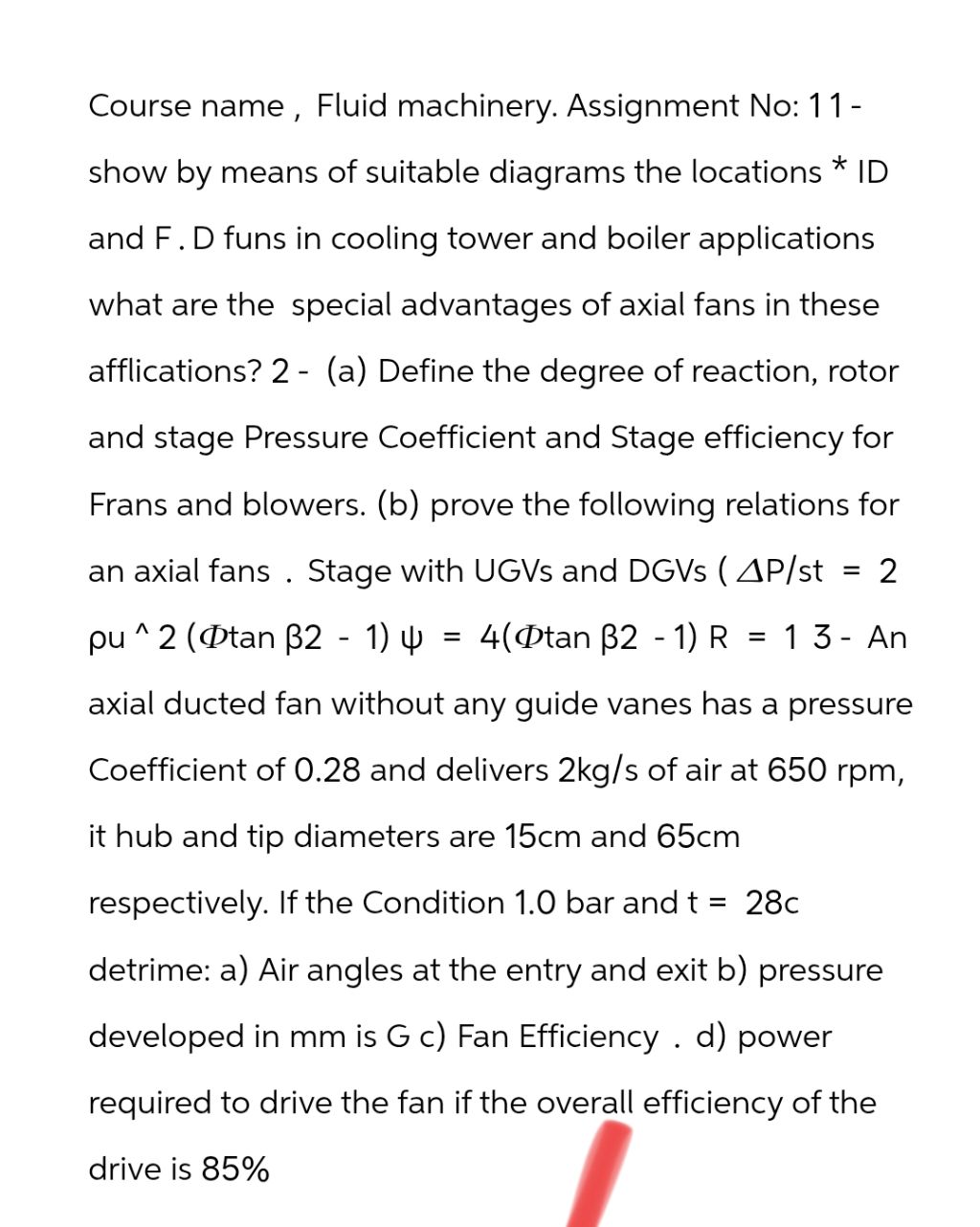
Give step-by-step solution with explanation and final answer:Course name, Fluid machinery. Assignment No: 11-
show by means of suitable diagrams the locations * ID
and F.D funs in cooling tower and boiler applications
what are the special advantages of axial fans in these
afflications? 2 - (a) Define the degree of reaction, rotor
and stage Pressure Coefficient and Stage efficiency for
Frans and blowers. (b) prove the following relations for
an axial fans . Stage with UGVs and DGVs ( AP/st = 2
put2(@dtanP2 - NY = 4(PtanP2 -1)R =13- An
axial ducted fan without any guide vanes has a pressure
Coefficient of 0.28 and delivers 2kg/s of air at 650 rpm,
it hub and tip diameters are 15cm and 65cm
respectively. If the Condition 1.0 bar and t = 28¢
detrime: a) Air angles at the entry and exit b) pressure
developed in mm is G ¢) Fan Efficiency . d) power
required to drive the fan if the overall efficiency of the
drive is 85% |
Question:
Give step-by-step solution with explanation and final answer:Course name, Fluid machinery. Assignment No: 11-
show by means of suitable diagrams the locations * ID
and F.D funs in cooling tower and boiler applications
what are the special advantages of axial fans in these
afflications? 2 - (a) Define the degree of reaction, rotor
and stage Pressure Coefficient and Stage efficiency for
Frans and blowers. (b) prove the following relations for
an axial fans . Stage with UGVs and DGVs ( AP/st = 2
put2(@dtanP2 - NY = 4(PtanP2 -1)R =13- An
axial ducted fan without any guide vanes has a pressure
Coefficient of 0.28 and delivers 2kg/s of air at 650 rpm,
it hub and tip diameters are 15cm and 65cm
respectively. If the Condition 1.0 bar and t = 28¢
detrime: a) Air angles at the entry and exit b) pressure
developed in mm is G ¢) Fan Efficiency . d) power
required to drive the fan if the overall efficiency of the
drive is 85% |
This is AI generated Response.
Asked by: Rahul
Created at: 2026-01-03 16:16:08
Final Answer:
RenderedRaw Text
Did you like this answer?
Let's break down problem step by according to the. We’ll on **Question2, Part3** (ial ducted fan):
### ** Data**
-Pressure coefficient (\( \psi \** = .28
**Mass flow rate (\( \{m} \))** =2 kg/s- **Rot speed (\( \))** 650 rpm
- **Hub (\( Dhub} \))** = .15 m
- **Tip diameter (\( D_{tip} \))** = .65 m
- **Ambient pressure** = 1. bar = 100,000 Pa
- **Temperature (\( T \))** = 28°C = 301 K
- **Efficiency (\( \eta \))** = 85% = .85
Let's solve each sub-question step by step.
---
## **a) Air Angles at Entry and Exit**
We need to find the **blade angles** at the entry and exit, but for that, we need velocities at the hub and tip.
#### **Step 1: Find the Mean Diameter and Blade Speed**
\[
D_{mean} = \frac{D_{hub} + D_{tip}}{2} = \frac{.15 + .65}{2} = .40\,m
\]
\[
r_{mean} = \frac{D_{mean}}{2} = .20\,m
\]
\[
\omega = \frac{2\pi N}{60} = \frac{2\pi \times 650}{60} \approx 68.07\, \text{rad/s}
\]
\[
U = \omega \times r_{mean} = 68.07 \times .20 = 13.61\, m/s
\]
#### **Step 2: Find the Axial Velocity (\( V_a \))**
The area at the mean diameter:
\[
A = \frac{\pi}{4}(D_{tip}^2 - D_{hub}^2) = \frac{\pi}{4}(.65^2 - .15^2) = \frac{\pi}{4}(.4225 - .0225) = \frac{\pi}{4}(.4) \approx .314\,m^2
\]
Assume air is ideal gas, so at 1 bar, 28°C:
\[
\rho = \frac{P}{RT} = \frac{100,000}{287 \times 301} \approx 1.15\,kg/m^3
\]
\[
V_a = \frac{\dot{m}}{\rho A} = \frac{2}{1.15 \times .314} \approx \frac{2}{.3611} \approx 5.54\, m/s
\]
#### **Step 3: Find Blade Angles**
The **blade angle at entry (\( \beta_1 \))** and **exit (\( \beta_2 \))** (assuming velocity triangles):
\[
\tan \beta = \frac{V_a}{U}
\]
\[
\beta_{mean} = \arctan \left( \frac{V_a}{U} \right) = \arctan \left( \frac{5.54}{13.61} \right) \approx \arctan(.407) \approx 22.1^\circ
\]
Thus, **air angles at entry and exit at mean radius ≈ 22.1°** (assuming symmetric design for simplicity).
---
## **b) Pressure Developed in mm G**
Given pressure coefficient (\( \psi \)):
\[
\psi = \frac{\Delta P}{.5 \rho U^2}
\]
\[
\Delta P = \psi \cdot .5 \rho U^2 = .28 \times .5 \times 1.15 \times (13.61)^2
\]
\[
= .28 \times .5 \times 1.15 \times 185.27
\]
\[
= .28 \times .5 \times 213.06
\]
\[
= .28 \times 106.53 \approx 29.83\, Pa
\]
Convert to mm of water gauge (\(1\,mm\,H_2O = 9.81\,Pa\)):
\[
\Delta P_{mm\,H_2O} = \frac{29.83}{9.81} \approx 3.04\, mm\, H_2O
\]
---
## **c) Fan Efficiency**
Fan efficiency (\( \eta \)) is given as **85% (.85)**.
---
## **d) Power Required to Drive the Fan**
\[
\text{Power}_{\text{fluid}} = \Delta P \cdot Q
\]
First, find the volume flow rate:
\[
Q = \frac{\dot{m}}{\rho} = \frac{2}{1.15} \approx 1.74\, m^3/s
\]
\[
\text{Power}_{\text{fluid}} = 29.83\,Pa \times 1.74\,m^3/s = 51.9\,W
\]
The actual **shaft power required** (input to the fan) considering efficiency:
\[
\text{Shaft Power} = \frac{\text{Power}_{\text{fluid}}}{\eta}
\]
\[
= \frac{51.9}{.85} \approx 61.1\, W
\]
---
# **Summary Table**
| Parameter | Value |
|-----------------------------|------------------------|
| Blade Angle (mean) | 22.1° |
| Pressure Developed | 3.04 mm H₂O |
| Fan Efficiency | 85% |
| Power Required (to shaft) | 61.1 W |
---
### **Final Answers**
- **a)** Air Angles at entry and exit (at mean radius): **22.1°**
- **b)** Pressure developed: **3.04 mm H₂O**
- **c)** Fan Efficiency: **85%**
- **d)** Power required to drive the fan: **61.1 W**
---
Let me know if you need detailed derivations or diagrams for the other sub-questions!
Question:
Then solved
This is AI generated Response.
Asked by: Rahul
Created at: 2026-01-03 16:17:03
Final Answer:
RenderedRaw Text
Did you like this answer?
# Fluid Machinery Assignment Solution
## Problem Overview
This assignment focuses on analyzing an axial ducted fan's performance parameters, including air angles, pressure developed, fan efficiency, and power required to drive the fan.
### Given Data
- **Pressure Coefficient (\( \psi \))**: 0.28
- **Mass Flow Rate (\( \dot{m} \))**: 2 kg/s
- **Rotational Speed (\( N \))**: 650 rpm
- **Hub Diameter (\( D_{hub} \))**: 0.15 m
- **Tip Diameter (\( D_{tip} \))**: 0.65 m
- **Ambient Pressure**: 1 bar = 100,000 Pa
- **Temperature (\( T \))**: 28°C = 301 K
- **Overall Efficiency (\( \eta \))**: 85% = 0.85
## Step-by-Step Solution
### a) Air Angles at Entry and Exit
#### Step 1: Calculate Mean Diameter and Blade Speed
\[
D_{mean} = \frac{D_{hub} + D_{tip}}{2} = \frac{0.15 + 0.65}{2} = 0.40\,m
\]
\[
r_{mean} = \frac{D_{mean}}{2} = 0.20\,m
\]
\[
\omega = \frac{2\pi N}{60} = \frac{2\pi \times 650}{60} \approx 68.07\, \text{rad/s}
\]
\[
U = \omega \times r_{mean} = 68.07 \times 0.20 \approx 13.61\, m/s
\]
#### Step 2: Calculate Axial Velocity (\( V_a \))
Area at mean diameter:
\[
A = \frac{\pi}{4}(D_{tip}^2 - D_{hub}^2) \approx 0.314\,m^2
\]
Density of air (\( \rho \)):
\[
\rho = \frac{P}{RT} = \frac{100,000}{287 \times 301} \approx 1.15\,kg/m^3
\]
Axial velocity:
\[
V_a = \frac{\dot{m}}{\rho A} \approx 5.54\, m/s
\]
#### Step 3: Calculate Blade Angles
Using the velocity triangle:
\[
\tan \beta = \frac{V_a}{U}
\]
\[
\beta_{mean} = \arctan \left( \frac{V_a}{U} \right) \approx 22.1^\circ
\]
### b) Pressure Developed in mm H₂O
Using the pressure coefficient:
\[
\Delta P = \psi \cdot 0.5 \rho U^2
\]
\[
\Delta P \approx 29.83\,Pa
\]
Convert to mm H₂O:
\[
\Delta P_{mm\,H_2O} = \frac{29.83}{9.81} \approx 3.04\, mm\, H_2O
\]
### c) Fan Efficiency
Given as \( \eta = 85\% \).
### d) Power Required to Drive the Fan
Calculate volume flow rate:
\[
Q = \frac{\dot{m}}{\rho} \approx 1.74\, m^3/s
\]
Calculate fluid power:
\[
\text{Power}_{\text{fluid}} = \Delta P \cdot Q \approx 51.9\,W
\]
Calculate shaft power:
\[
\text{Shaft Power} = \frac{\text{Power}_{\text{fluid}}}{\eta} \approx 61.1\, W
\]
## Summary of Results
| Parameter | Value |
|-----------------------------|------------------------|
| Blade Angle (mean) | 22.1° |
| Pressure Developed | 3.04 mm H₂O |
| Fan Efficiency | 85% |
| Power Required (to shaft) | 61.1 W |
## Final Answers
- **a)** Air Angles at entry and exit: **22.1°**
- **b)** Pressure developed: **3.04 mm H₂O**
- **c)** Fan Efficiency: **85%**
- **d)** Power required to drive the fan: **61.1 W**
Feel free to ask for further clarifications or additional questions!
VIPSolutions focuses on clear, step‑by‑step explanations so you can learn quickly. Whether you need an AI‑generated walkthrough or a short hint to get unstuck, each solution is organized for fast reading and easy review later.
Search similar questions, compare approaches, and bookmark the best answers for revision. Our goal is simple: quick, reliable study help that feels natural—not noisy.
 VIPSolutions
 Course name, Fluid machinery. Assignment No: 11-
show by means of suitable diagrams the locations * ID
and F.D funs in cooling tower and boiler applications
what are the special advantages of axial fans in these
afflications? 2 - (a) Define the degree of reaction, rotor
and stage Pressure Coefficient and Stage efficiency for
Frans and blowers. (b) prove the following relations for
an axial fans . Stage with UGVs and DGVs ( AP/st = 2
put2(@dtanP2 - NY = 4(PtanP2 -1)R =13- An
axial ducted fan without any guide vanes has a pressure
Coefficient of 0.28 and delivers 2kg/s of air at 650 rpm,
it hub and tip diameters are 15cm and 65cm
respectively. If the Condition 1.0 bar and t = 28¢
detrime: a) Air angles at the entry and exit b) pressure
developed in mm is G ¢) Fan Efficiency . d) power
required to drive the fan if the overall efficiency of the
drive is 85% |