 VIPSolutions
Give step-by-step solution with explanation and final answer:A» } a5 EBREO TO S88 8% 2d F5°8 2. 8.88% ZR Bol Homo 825 mop 8g Sg SE Q o 0g g SRilS og { vera WEo "uo Ngo 0 = 0" BE SSR E BES 5d ao hy @ of 528.322 L*Rg 53
Question:
Give step-by-step solution with explanation and final answer: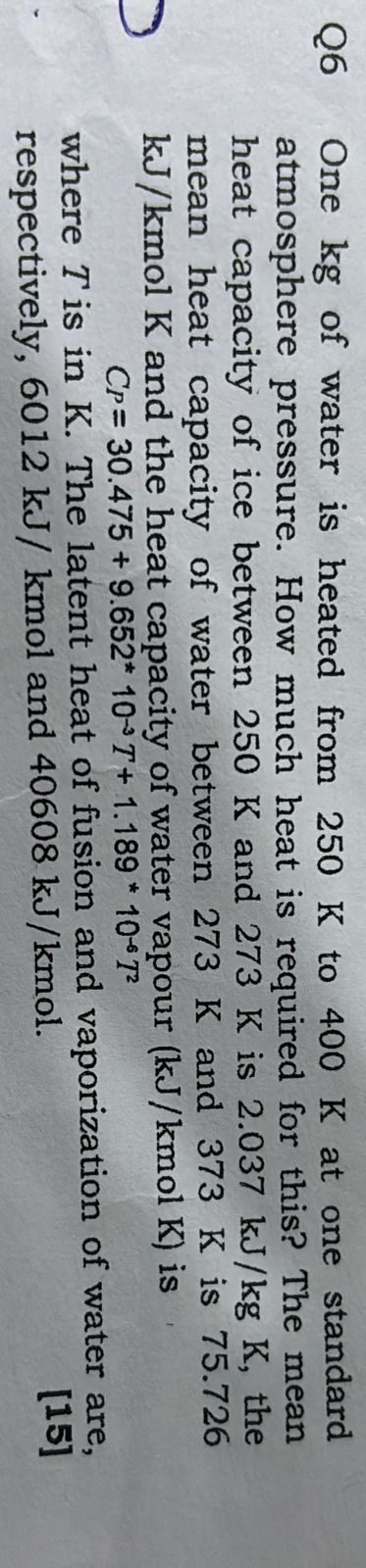 A» }
a5 EBREO
TO S88 8%
2d F5°8
2. 8.88%
ZR Bol Homo
825 mop 8g
Sg SE
Q
o 0g g
SRilS og
{ vera WEo "uo
Ngo 0 = 0"
BE SSR E
BES 5d ao
hy @ of
528.322
L*Rg 53
This is AI generated Response.
Asked by: Francis
Created at: 2026-01-03 00:34:43
Asked by: Francis
Created at: 2026-01-03 00:34:43
Final Answer:
Rendered
Raw Text
Did you like this answer?
Let's solve the problem step by step.
---
## **Given Data**
- Mass of water (\( m \)) = **1 kg**
- Initial temperature (\( T_1 \)) = **250 K**
- Final temperature (\( T_5 \)) = **400 K**
- Standard atmospheric pressure.
- Heat capacity of ice (250 K to 273 K) = **2.037 kJ/kg·K**
- Mean heat capacity of liquid water (273 K to 373 K) = **75.726 kJ/kmol·K**
- Heat capacity of water vapor (\( C \), kJ/kmol·K):
\( C = 30.475 + 9.652 \times 10^{-3} T + 1.189 \times 10^{-7} T^2 \)
- Latent heat of fusion = **6012 kJ/kmol**
- Latent heat of vaporization = **40608 kJ/kmol**
- Molar mass of water (\( M \)) = **18 kg/kmol**
---
## **Step 1: Calculate the heat required in different steps**
### **Step 1: Heating ice from 250 K to 273 K**
\[
Q_1 = m \cdot c_{ice} \cdot (273 - 250)
\]
\[
Q_1 = 1 \cdot 2.037 \cdot (273 - 250)
\]
\[
Q_1 = 2.037 \cdot 23 = \boxed{46.85 \text{ kJ}}
\]
---
### **Step 2: Melting ice at 273 K (fusion)**
\[
Q_2 = n \cdot \Delta H_{fus}
\]
where \( n = \frac{m}{M} = \frac{1}{18} \) kmol
\[
Q_2 = \frac{1}{18} \cdot 6012 = \boxed{334 \text{ kJ}}
\]
---
### **Step 3: Heating water from 273 K to 373 K**
Use mean heat capacity of 75.726 kJ/kmol·K.
\[
Q_3 = n \cdot c_{water} \cdot (373 - 273)
\]
\[
Q_3 = \frac{1}{18} \cdot 75.726 \cdot 100
\]
\[
Q_3 = .05556 \cdot 7572.6 = \boxed{420.7 \text{ kJ}}
\]
---
### **Step 4: Vaporizing water at 373 K**
\[
Q_4 = n \cdot \Delta H_{vap}
\]
\[
Q_4 = \frac{1}{18} \cdot 40608 = \boxed{2256 \text{ kJ}}
\]
---
### **Step 5: Heating vapor from 373 K to 400 K**
\[
Q_5 = n \int_{373}^{400} C_{vapor} dT
\]
Where \( C_{vapor} = 30.475 + 9.652 \times 10^{-3}T + 1.189 \times 10^{-7}T^2 \)
Let’s integrate:
\[
\int_{373}^{400} \left( 30.475 + 9.652 \times 10^{-3}T + 1.189 \times 10^{-7}T^2 \right) dT
\]
\[
= 30.475 (T_2 - T_1) + \frac{9.652 \times 10^{-3}}{2}(T_2^2 - T_1^2) + \frac{1.189 \times 10^{-7}}{3}(T_2^3 - T_1^3)
\]
Plugging in \( T_2 = 400 \), \( T_1 = 373 \):
#### 1. \( 30.475 \times (400-373) = 30.475 \times 27 = 822.825 \)
#### 2. \( T_2^2 - T_1^2 = 400^2 - 373^2 = 160000 - 139129 = 20871 \)
\[
\frac{9.652 \times 10^{-3}}{2} \times 20871 = .004826 \times 20871 = 100.7
\]
#### 3. \( T_2^3 - T_1^3 = 64,000,000 - 51,876,317 = 12,123,683 \)
\[
\frac{1.189 \times 10^{-7}}{3} \times 12,123,683 = 3.963 \times 10^{-8} \times 12,123,683 = .4806
\]
Add these:
\[
822.825 + 100.7 + .4806 = 924.01 \text{ kJ/kmol}
\]
Now, multiply by \( n \):
\[
Q_5 = \frac{1}{18} \times 924.01 = \boxed{51.33 \text{ kJ}}
\]
---
## **Step 6: Total Heat Required**
\[
Q_{total} = Q_1 + Q_2 + Q_3 + Q_4 + Q_5
\]
\[
Q_{total} = 46.85 + 334 + 420.7 + 2256 + 51.33
\]
\[
Q_{total} = \boxed{3108.88 \text{ kJ}}
\]
---
## **Final Answer**
\[
\boxed{3109 \ \text{ kJ}}
\]
(rounding to 4 significant digits)
---
### **Summary Table**
| Step | Description | Heat (kJ) |
|------|-------------------------------------|-----------|
| 1 | Ice: 250 K → 273 K | 46.85 |
| 2 | Melt ice (fusion) | 334 |
| 3 | Water: 273 K → 373 K | 420.7 |
| 4 | Vaporize at 373 K | 2256 |
| 5 | Vapor: 373 K → 400 K | 51.33 |
| | **Total** | **3109** |
---
**The heat required to heat 1 kg of water from 250 K to 400 K at 1 atm is approximately \( \boxed{3109 \text{ kJ}} \).**
📢 Instructions:
- Ask anything relatd to above question only.
- For new Question goto :