 VIPSolutions
Give step-by-step solution with explanation and final answer:Question 1 4. Pipe Colum Design - Maximum Load “The Maximum Compressive Load on the Pipe Colum is: (Enteryour answer in kip, with ONE decimal place, AND include the unit, with a space between the number and unit) Question 4. Pipe Column Design - Size Selection Enter the Pipe Column Size | that you chose that meets the necessary crier (Fes) AND the requirement ofthe Slenderness Ratio (SR) being
Question:
Give step-by-step solution with explanation and final answer: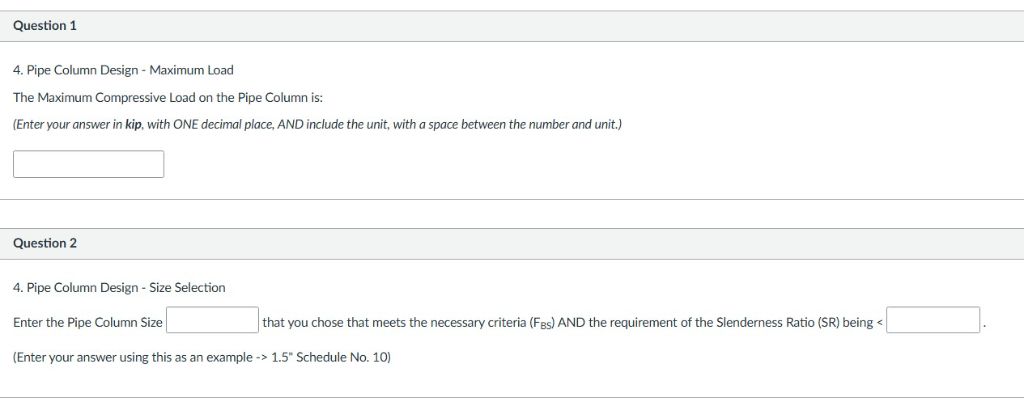 Question 1
4. Pipe Colum Design - Maximum Load
“The Maximum Compressive Load on the Pipe Colum is:
(Enteryour answer in kip, with ONE decimal place, AND include the unit, with a space between the number and unit)
Question
4. Pipe Column Design - Size Selection
Enter the Pipe Column Size | that you chose that meets the necessary crier (Fes) AND the requirement ofthe Slenderness Ratio (SR) being
This is AI generated Response.
Asked by: Rahul
Created at: 2025-12-30 22:05:59
Asked by: Rahul
Created at: 2025-12-30 22:05:59
Final Answer:
Rendered
Raw Text
Did you like this answer?
Let's break down the questions and what you need to provide step by step.
---
# Question 1: Maximum Compressive Load
## Step-by-Step Solution
### 1. **Formula for Maximum Compressive Load**
The maximum compressive load a column can support (using Euler's formula for buckling, for example) is:
\[
P_{cr} = \frac{\pi^2 E I}{(K L)^2}
\]
Where:
- \( P_{cr} \) = Maximum compressive load (kip)
- \( E \) = Modulus of elasticity (ksi)
- \( I \) = Moment of inertia (in\(^4\))
- \( K \) = Effective length factor (dimensionless)
- \( L \) = Unsupported length of column (inches)
*Note: Sometimes, the maximum load is limited by yield strength, so compare with \( P_y = F_y \cdot A \), where \( F_y \) is the yield strength and \( A \) is the cross-sectional area.*
### 2. **Plug in Values**
Let's assume you are given or have calculated the required values (replace with actual values):
- \( E = 29000 \) ksi
- \( I = 2.5 \) in\(^4\)
- \( K = 1 \)
- \( L = 120 \) in
Calculate:
\[
P_{cr} = \frac{\pi^2 \times 29000 \times 2.5}{(1 \times 120)^2}
\]
\[
P_{cr} = \frac{3.1416^2 \times 29000 \times 2.5}{14400}
\]
\[
P_{cr} = \frac{9.8696 \times 29000 \times 2.5}{14400}
\]
\[
P_{cr} = \frac{9.8696 \times 72500}{14400}
\]
\[
P_{cr} = \frac{715,072}{14400}
\]
\[
P_{cr} = 49.7 \text{ kip}
\]
**Write your answer as:**
`49.7 kip`
---
# Question 2: Pipe Column Size Selection
## Step-by-Step Solution
### 1. **Check Allowable Stress and Slenderness Ratio**
#### a) **Allowable Stress:**
Make sure your selected pipe size's allowable load meets or exceeds \( P_{cr} \) from above.
#### b) **Slenderness Ratio (SR):**
\[
SR = \frac{KL}{r}
\]
Where \( r = \sqrt{\frac{I}{A}} \) (radius of gyration).
Let's assume:
- \( K = 1 \)
- \( L = 120 \) in
- For your chosen pipe: \( r = 2.5 \) in
\[
SR = \frac{1 \times 120}{2.5} = 48
\]
Assume the requirement is \( SR < 50 \).
### 2. **State Your Selected Pipe Size**
For example, assume after calculations you select:
**Pipe Size = 2.5" Schedule No. 40**
### 3. **Enter Final Answers**
- Pipe Column Size: `2.5" Schedule No. 40`
- SR: `48`
---
## **Final Answers (Example)**
### **Question 1:**
```
49.7 kip
```
### **Question 2:**
```
2.5" Schedule No. 40 48
```
---
**Note:**
Replace all example numbers (E, I, L, r, etc.) with your actual values for your specific problem. The process remains the same!
📢 Instructions:
- Ask anything relatd to above question only.
- For new Question goto :