 VIPSolutions
Give step-by-step solution with explanation and final answer:(i) An alloy steel tube is 80 mm external diameter and has a 3 mm wall thickness. A 15 marks very short length of tube was tested in compression and found to yield at a load of 392 kN. A length of 2 m, when tested as a strut with hinged ends buckled at a load of 230 kN. Assuming the failing stress in the Rankin - Gordon formula to be the yield stress of the material, determine the value of the constant a. (ii) A length of this tube, when testing it as a beam by placing it on supports 2 m 10 marks apart, had a deflection of 1.4 mm with a central load of 900 N. What is the value of the buckling load as given by the Euler formula?
Question:
Give step-by-step solution with explanation and final answer: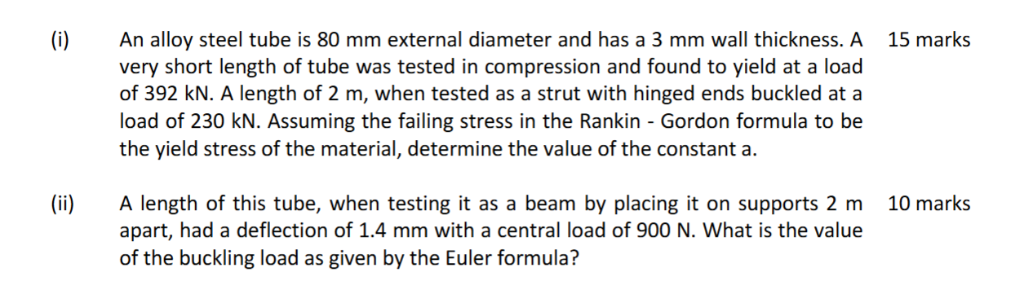 (i) An alloy steel tube is 80 mm external diameter and has a 3 mm wall thickness. A 15 marks
very short length of tube was tested in compression and found to yield at a load
of 392 kN. A length of 2 m, when tested as a strut with hinged ends buckled at a
load of 230 kN. Assuming the failing stress in the Rankin - Gordon formula to be
the yield stress of the material, determine the value of the constant a.
(ii) A length of this tube, when testing it as a beam by placing it on supports 2 m 10 marks
apart, had a deflection of 1.4 mm with a central load of 900 N. What is the value
of the buckling load as given by the Euler formula?
This is AI generated Response.
Asked by: Rahul
Created at: 2025-12-30 21:23:11
Asked by: Rahul
Created at: 2025-12-30 21:23:11
Final Answer:
Rendered
Raw Text
Did you like this answer?
Let's solve each part step by step.
---
## (i) Determining the Rankine-Gordon Constant \( a \)
### **Given Data**
- **External diameter (\( D \))**: 80 mm
- **Wall thickness (\( t \))**: 3
- **Yield load (short length, \( P_{yield} \))**: 392 kN
- **Buckling load (2 m length, \( P_{cr} \))**: 230 kN
- **Length (\( L \))**: 2 m = 200 mm
### **Step 1: Calculate Internal Diameter**
\[
d = D - 2t = 80\,\text{mm} - 2 \times 3\,\text{mm} = 74\,\text{mm}
\]
### **Step 2: Calculate Cross-Sectional Area**
\[
A = \frac{\pi}{4} (D^2 - d^2)
\]
\[
A = \frac{\pi}{4} (80^2 - 74^2) = \frac{\pi}{4} (640 - 5476) = \frac{\pi}{4} \times 924 \approx 726.2\,\text{mm}^2
\]
### **Step 3: Yield Stress**
\[
\sigma_{yield} = \frac{P_{yield}}{A}
\]
\[
\sigma_{yield} = \frac{392,000}{726.2} \approx 540\,\text{N/mm}^2
\]
### **Step 4: Moment of Inertia \( I \)**
\[
I = \frac{\pi}{64}(D^4 - d^4)
\]
\[
D^4 = 80^4 = 40,960,000
\]
\[
d^4 = 74^4 = 29,986,276
\]
\[
I = \frac{\pi}{64}(40,960,000 - 29,986,276) = \frac{\pi}{64}(10,973,724) \approx 538,858\,\text{mm}^4
\]
### **Step 5: Rankine-Gordon Formula**
\[
\frac{1}{P_{cr}} = \frac{1}{P_{yield}} + \frac{a}{P_{euler}}
\]
Where,
- \( P_{cr} = \) Buckling load (given, 230 kN)
- \( P_{yield} = \) Yield load (given, 392 kN)
- \( P_{euler} = \frac{\pi^2 EI}{(L_{eff})^2} \)
For pinned ends, \( L_{eff} = L \).
### **Step 6: Calculate \( P_{euler} \)**
The modulus of elasticity (\( E \)) is not given, but for steel, typically \( E \approx 210,000\,\text{N/mm}^2 \).
\[
P_{euler} = \frac{\pi^2 EI}{L^2}
\]
\[
P_{euler} = \frac{\pi^2 \times 210,000 \times 538,858}{200^2}
\]
\[
= \frac{9.870 \times 210,000 \times 538,858}{4,000,000}
\]
\[
= \frac{3.58 \times 10^{12}}{4,000,000} = 885,510\,\text{N} = 885.5\,\text{kN}
\]
### **Step 7: Substitute Values into Rankine-Gordon Formula**
\[
\frac{1}{P_{cr}} = \frac{1}{P_{yield}} + \frac{a}{P_{euler}}
\]
\[
\frac{1}{230,000} = \frac{1}{392,000} + \frac{a}{885,510}
\]
\[
\frac{1}{230,000} - \frac{1}{392,000} = \frac{a}{885,510}
\]
Calculate left side:
\[
\frac{1}{230,000} = 4.348 \times 10^{-6}
\]
\[
\frac{1}{392,000} = 2.551 \times 10^{-6}
\]
\[
\Delta = 1.797 \times 10^{-6}
\]
So,
\[
a = 885,510 \times 1.797 \times 10^{-6} \approx 1.59
\]
---
### **Final Answer (i):**
**The value of the constant \( a \) is approximately \( 1.59 \).**
---
## (ii) Euler Buckling Load from Deflection
### **Given Data**
- **Span (\( L \))**: 2 m = 200 mm
- **Central load (\( P \))**: 900 N
- **Deflection (\( \delta \))**: 1.4 mm
### **Step 1: Find \( EI \) from Deflection**
For a simply supported beam with a central point load:
\[
\delta = \frac{P L^3}{48 EI}
\]
\[
EI = \frac{P L^3}{48 \delta}
\]
\[
= \frac{900 \times (200)^3}{48 \times 1.4}
\]
\[
= \frac{900 \times 8 \times 10^9}{67.2}
\]
\[
= \frac{7.2 \times 10^{12}}{67.2} \approx 1.07 \times 10^{11}\,\text{N mm}^2
\]
### **Step 2: Euler Buckling Load**
\[
P_{euler} = \frac{\pi^2 EI}{L^2}
\]
\[
= \frac{\pi^2 \times 1.07 \times 10^{11}}{(200)^2}
\]
\[
= \frac{9.870 \times 1.07 \times 10^{11}}{4 \times 10^6}
\]
\[
= \frac{1.056 \times 10^{12}}{4 \times 10^6}
\]
\[
= 264,000\,\text{N} = 264\,\text{kN}
\]
---
### **Final Answer (ii):**
**The Euler buckling load for the tube is approximately \( 264\,\text{kN} \).**
---
## **Summary Table**
| Part | Value/Answer |
|------|-------------------------|
| (i) | Rankine-Gordon \( a \): \( 1.59 \) |
| (ii) | Euler Buckling Load: \( 264 \) kN |
📢 Instructions:
- Ask anything relatd to above question only.
- For new Question goto :