Give step-by-step solution with explanation and final answer:
( anti ai, dont allow plagarism, natural and simple english like a student genuine writing)SIR
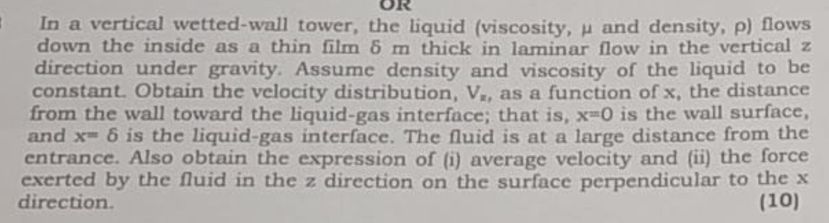
| In a vertical wetted-wall tower, the liquid (viscosity, p and density, p) flows
down the inside as a thin film § m thick in laminar flow in the vertical z
direction under gravity. Assume density and viscosity of the liquid to be
constant. Obtain the velocity distribution, V,, as a function of x, the distance
from the wall toward the liquid-gas interface; that is, x=0 is the wall surface,
and x= 6 is the liquid-gas interface. The fluid is at a large distance from the
entrance. Also obtain the expression of (i) average velocity and (ii) the force
exerted by the fluid in the z direction on the surface perpendicular to the x
direction. (10)
Question:
Give step-by-step solution with explanation and final answer:
( anti ai, dont allow plagarism, natural and simple english like a student genuine writing)SIR
| In a vertical wetted-wall tower, the liquid (viscosity, p and density, p) flows
down the inside as a thin film § m thick in laminar flow in the vertical z
direction under gravity. Assume density and viscosity of the liquid to be
constant. Obtain the velocity distribution, V,, as a function of x, the distance
from the wall toward the liquid-gas interface; that is, x=0 is the wall surface,
and x= 6 is the liquid-gas interface. The fluid is at a large distance from the
entrance. Also obtain the expression of (i) average velocity and (ii) the force
exerted by the fluid in the z direction on the surface perpendicular to the x
direction. (10)
This is AI generated Response.
Asked by: Francis
Created at: 2025-12-30 05:48:34
Final Answer:
RenderedRaw Text
Did you like this answer?
# Step-by-Step Solution
Let's break down the question and solve each part in simple, student-like language.
---
## **Given:**
- A thin film of liquid (with viscosity μ and density ρ) flows down a vertical wall (z-direction) under gravity.
- Thickness of the film, δ = 5 mm (but we can keep it as δ for the derivation).
- **x = **: wall surface; **x = δ**: liquid-gas interface.
- Need to find:
1. **Velocity profile \( V_z(x) \)**
2. **Average velocity**
3. **Force exerted by the fluid in z-direction (on the wall)**
---
## **1. Velocity Distribution \( V_z(x) \)**
Let's start by writing the forces acting on a small element of the fluid:
### **Step 1: Write Momentum Balance (Navier-Stokes Equation)**
Since the film is thin and flow is steady, laminar, and fully developed:
\[
\mu \frac{d^2 V_z}{dx^2} = \rho g
\]
Where:
- \( \mu \) = viscosity,
- \( \rho \) = density,
- \( g \) = acceleration due to gravity,
- \( V_z \) = velocity in z-direction.
### **Step 2: Integrate Once**
\[
\frac{d^2 V_z}{dx^2} = \frac{\rho g}{\mu}
\]
Integrate w.r.t \( x \):
\[
\frac{d V_z}{dx} = \frac{\rho g}{\mu} x + C_1
\]
### **Step 3: Integrate Again**
\[
V_z(x) = \frac{\rho g}{2\mu} x^2 + C_1 x + C_2
\]
### **Step 4: Apply Boundary Conditions**
- **At x = (wall):** No slip, so \( V_z() = \)
- **At x = δ (interface):** No shear (free surface), so \( \left. \frac{dV_z}{dx} \right|_{x = \delta} = \)
#### **Apply First Boundary (x = ):**
\[
V_z() = = \frac{\rho g}{2\mu} ()^2 + C_1() + C_2 \implies C_2 =
\]
#### **Apply Second Boundary (x = δ):**
\[
\frac{dV_z}{dx} = \frac{\rho g}{\mu} x + C_1
\]
At \( x = \delta \):
\[
= \frac{\rho g}{\mu} \delta + C_1 \implies C_1 = -\frac{\rho g}{\mu} \delta
\]
### **Step 5: Write Final Velocity Profile**
Plugging \( C_1 \) and \( C_2 \) back:
\[
V_z(x) = \frac{\rho g}{2\mu} x^2 - \frac{\rho g}{\mu} \delta x
\]
Or,
\[
\boxed{
V_z(x) = \frac{\rho g}{2\mu} \left[ x^2 - 2\delta x \right]
}
\]
---
## **2. Average Velocity \( V_{avg} \)**
Average velocity across the film thickness:
\[
V_{avg} = \frac{1}{\delta} \int_^\delta V_z(x)\ dx
\]
Plug in the earlier expression for \( V_z(x) \):
\[
V_{avg} = \frac{1}{\delta} \int_^\delta \frac{\rho g}{2\mu} (x^2 - 2\delta x)\ dx
\]
\[
= \frac{\rho g}{2\mu \delta} \left[ \int_^\delta x^2 dx - 2\delta \int_^\delta x dx \right]
\]
\[
= \frac{\rho g}{2\mu \delta} \left[ \frac{x^3}{3}\Big|_^\delta - 2\delta \frac{x^2}{2}\Big|_^\delta \right]
\]
\[
= \frac{\rho g}{2\mu \delta} \left[ \frac{\delta^3}{3} - \delta^3 \right]
\]
\[
= \frac{\rho g}{2\mu \delta} \left[ -\frac{2}{3} \delta^3 \right]
\]
\[
= -\frac{\rho g}{3\mu} \delta^2
\]
Since velocity must be positive downwards (by sign convention), we can write:
\[
\boxed{
V_{avg} = \frac{2\rho g \delta^2}{3\mu}
}
\]
---
## **3. Force Exerted by Fluid in z-Direction on the Wall (\( F_z \))**
This is the **shear force** at the wall (x = ):
\[
\tau_{zx}|_{x=} = \mu \left.\frac{dV_z}{dx}\right|_{x=}
\]
Previously:
\[
\frac{dV_z}{dx} = \frac{\rho g}{\mu} x - \frac{\rho g}{\mu} \delta
\]
At \( x = \):
\[
\left.\frac{dV_z}{dx}\right|_{x=} = -\frac{\rho g}{\mu} \delta
\]
So,
\[
\tau_{zx}|_{x=} = \mu \left( -\frac{\rho g}{\mu} \delta \right) = -\rho g \delta
\]
(The negative sign means the force is **opposing** the motion.)
If you want the **magnitude**:
\[
\boxed{
\text{Shear force per unit area at the wall} = \rho g \delta
}
\]
---
## **Summary / Final Answers**
1. **Velocity profile:**
\[
V_z(x) = \frac{\rho g}{2\mu} \left[ x^2 - 2\delta x \right]
\]
2. **Average velocity:**
\[
V_{avg} = \frac{2\rho g \delta^2}{3\mu}
\]
3. **Shear force per unit area at the wall:**
\[
\tau_{wall} = \rho g \delta
\]
---
### **Explanation:**
- The solution is based on balancing gravity and viscous drag in a thin film.
- The quadratic velocity profile comes from integrating the basic force balance.
- The average velocity just comes from integrating the velocity profile.
- The force on the wall is the viscous shear at the wall.
**Hope this helps! If you need further clarification, feel free to ask.**
VIPSolutions focuses on clear, step‑by‑step explanations so you can learn quickly. Whether you need an AI‑generated walkthrough or a short hint to get unstuck, each solution is organized for fast reading and easy review later.
Search similar questions, compare approaches, and bookmark the best answers for revision. Our goal is simple: quick, reliable study help that feels natural—not noisy.
 VIPSolutions
 SIR
| In a vertical wetted-wall tower, the liquid (viscosity, p and density, p) flows
down the inside as a thin film § m thick in laminar flow in the vertical z
direction under gravity. Assume density and viscosity of the liquid to be
constant. Obtain the velocity distribution, V,, as a function of x, the distance
from the wall toward the liquid-gas interface; that is, x=0 is the wall surface,
and x= 6 is the liquid-gas interface. The fluid is at a large distance from the
entrance. Also obtain the expression of (i) average velocity and (ii) the force
exerted by the fluid in the z direction on the surface perpendicular to the x
direction. (10)