Question:
Give step-by-step solution with explanation and final answer:
Did you like this answer?
👍 0
👎 0
Let's break down the **adiabatic reactor** problem step-by-step.
---
## **Given Data**
### **Reaction**
\[
\text{Cyclopentadiene (C)} + \text{Benzoquinone (B)} \rightarrow \text{Product (M)}
\]
### **Kinetic Data**
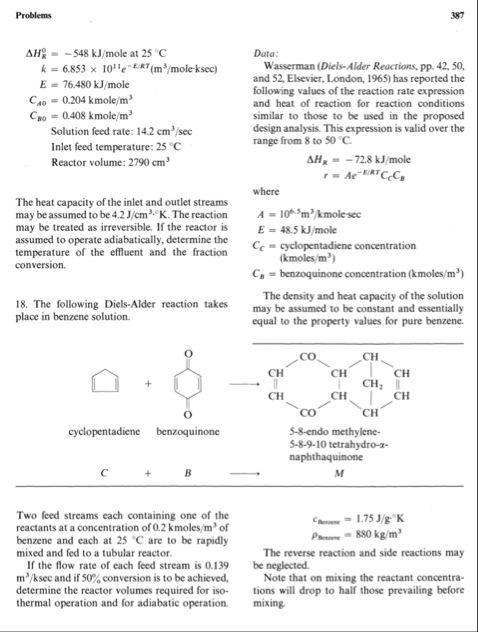
- \( k = 6.853 \times 10^{11} e^{-E/RT} \) (m³/mole·ksec)
- \( E = 76.480 \) kJ/mole
- \( C_{A} = .204 \) kmole/m³ (Cyclopentadiene)
- \( C_{B} = .408 \) kmole/m³ (Benzoquinone)
- **Feed rate**: \( 142 \) cm³/sec \( = 1.42 \times 10^{-4} \) m³/sec
- **Reactor volume**: \( 279 \) cm³ \( = 2.79 \) L \( = 2.79 \times 10^{-3} \) m³
- **Inlet temperature**: \( 25^\circ C = 298 \) K
### **Thermodynamics**
- \( \Delta H_R^\circ = -548 \) kJ/mole at 25°C
- \( C_p = 4.2 \) J/cm³·K \( = 420 \) J/L·K \( = 420 \) kJ/m³·K
---
## **To Find**
- **(a)** Final (effluent) temperature, \( T \)
- **(b)** Fractional conversion, \( X \)
---
## **Step 1: Moles of Reactants per Second**
**Volumetric flow rate**: \( Q = 1.42 \times 10^{-4} \) m³/sec
\[
\text{Moles of C/sec} = C_{A} \cdot Q = .204 \times 1.42 \times 10^{-4} = 2.90 \times 10^{-5} \text{ kmol/sec}
\]
\[
\text{Moles of B/sec} = C_{B} \cdot Q = .408 \times 1.42 \times 10^{-4} = 5.79 \times 10^{-5} \text{ kmol/sec}
\]
---
## **Step 2: Adiabatic Energy Balance**
For **adiabatic** reactors:
\[
\text{Enthalpy change} = \text{Heat of reaction} \times \text{moles reacted}
\]
\[
\Delta T = \frac{-\Delta H_R \cdot n_{reacted}}{C_p \cdot Q}
\]
Let \( X \) = fractional conversion of limiting reactant (Cyclopentadiene).
\[
n_{reacted}/\text{sec} = X \cdot \text{moles of C entering/sec}
\]
So,
\[
\Delta T = \frac{-\Delta H_R \cdot (C_{A} Q X)}{C_p Q}
= \frac{-\Delta H_R \cdot C_{A} X}{C_p}
\]
\[
T = T_{inlet} + \Delta T = 298 + \frac{-(-548,000) \cdot .204 \cdot X}{4,200,000}
\]
\[
T = 298 + \frac{111,792 X}{4,200}
\]
\[
T = 298 + 26.62 X
\]
---
## **Step 3: Reactor Design Equation (CSTR)**
For **CSTR**:
\[
\text{Mole balance: } F_{A} - F_{A} + r V =
\]
\[
F_{A} - F_{A} = \text{rate of disappearance of A}
\]
\[
F_{A} = F_{A}(1 - X)
\]
\[
r = k(T) C_{A} C_{B}
\]
\[
C_{A} = C_{A}(1 - X)
\]
\[
C_{B} = C_{B} - C_{A} X
\]
\[
X = \frac{\text{rate} \times V}{F_{A}}
= \frac{k(T) C_{A} C_{B} V}{C_{A} Q}
\]
---
## **Step 4: Arrhenius Equation for \( k(T) \)**
\[
k(T) = 6.853 \times 10^{11} \exp\left(-\frac{76,480}{8.314 T}\right)
\]
---
## **Step 5: Solve Simultaneously**
1. **Expression for \( T \):**
\[
T = 298 + 26.62 X
\]
2. **Expression for \( X \):**
\[
X = \frac{k(T) C_{A} C_{B} V}{C_{A} Q}
\]
where
- \( C_{A} = C_{A}(1 - X) \)
- \( C_{B} = C_{B} - C_{A} X \)
- \( V = 2.79 \times 10^{-3} \) m³
- \( Q = 1.42 \times 10^{-4} \) m³/sec
---
## **Step 6: Substitute Values**
\[
X = \frac{k(T) \cdot .204 (1 - X) \cdot (.408 - .204 X) \cdot 2.79 \times 10^{-3}}{.204 \cdot 1.42 \times 10^{-4}}
\]
\[
X = \frac{k(T) \cdot (1 - X) \cdot (.408 - .204 X) \cdot 2.79 \times 10^{-3}}{1.42 \times 10^{-4}}
\]
---
## **Step 7: Iterative Solution**
### **Guess values of \( X \) and solve for \( T \), then use \( T \) to solve for \( k(T) \) and substitute back until convergence.**
#### **Try \( X = .5 \) (50% conversion):**
\[
T = 298 + 26.62 \times .5 = 311.3 \text{ K}
\]
\[
k(311.3) = 6.853 \times 10^{11} \exp\left(-\frac{76,480}{8.314 \times 311.3}\right)
\]
\[
\frac{76,480}{8.314 \times 311.3} = \frac{76,480}{2,588.3} = 29.55
\]
\[
k(311.3) = 6.853 \times 10^{11} \exp(-29.55) = 6.853 \times 10^{11} \times 1.45 \times 10^{-13} = .099 \text{ m}^3/(\text{mol·ksec})
\]
Now,
\[
C_A = .204(1-.5) = .102
\]
\[
C_B = .408 - .204 \times .5 = .306
\]
\[
X = \frac{.099 \times .102 \times .306 \times 2.79 \times 10^{-3}}{1.42 \times 10^{-4}}
\]
\[
= \frac{.099 \times .102 \times .306 \times 2.79 \times 10^{-3}}{1.42 \times 10^{-4}}
\]
Calculate numerator:
- \( .099 \times .102 = .010098 \)
- \( .010098 \times .306 = .0030899 \)
- \( .0030899 \times 2.79 \times 10^{-3} = 8.6248 \times 10^{-6} \)
\( X = \frac{8.6248 \times 10^{-6}}{1.42 \times 10^{-4}} = .0608 \)
This value is much less than the assumed .5. Let's try a smaller \( X \).
---
#### **Try \( X = .1 \):**
\[
T = 298 + 26.62 \times .1 = 300.66 \text{ K}
\]
\[
k(300.66) = 6.853 \times 10^{11} \exp\left(-\frac{76,480}{8.314 \times 300.66}\right)
\]
\[
8.314 \times 300.66 = 2,501.5
\]
\[
\frac{76,480}{2,501.5} = 30.59
\]
\[
\exp(-30.59) = 5.20 \times 10^{-14}
\]
\[
k = 6.853 \times 10^{11} \times 5.20 \times 10^{-14} = .0356
\]
Now:
\[
C_A = .204 \times .9 = .1836
\]
\[
C_B = .408 - .204 \times .1 = .3876
\]
\[
X = \frac{.0356 \times .1836 \times .3876 \times 2.79 \times 10^{-3}}{1.42 \times 10^{-4}}
\]
Calculate numerator:
- \( .0356 \times .1836 = .00654 \)
- \( .00654 \times .3876 = .002537 \)
- \( .002537 \times 2.79 \times 10^{-3} = 7.083 \times 10^{-6} \)
\[
X = \frac{7.083 \times 10^{-6}}{1.42 \times 10^{-4}} = .0499
\]
Still too low. Let's try \( X = .05 \):
---
#### **Try \( X = .05 \):**
\[
T = 298 + 26.62 \times .05 = 299.33 \text{ K}
\]
\[
8.314 \times 299.33 = 2,488.6
\]
\[
\frac{76,480}{2,488.6} = 30.74
\]
\[
\exp(-30.74) = 4.72 \times 10^{-14}
\]
\[
k = 6.853 \times 10^{11} \times 4.72 \times 10^{-14} = .0323
\]
\[
C_A = .204 \times .95 = .1938
\]
\[
C_B = .408 - .204 \times .05 = .3978
\]
\[
X = \frac{.0323 \times .1938 \times .3978 \times 2.79 \times 10^{-3}}{1.42 \times 10^{-4}}
\]
Numerator:
- \( .0323 \times .1938 = .006263 \)
- \( .006263 \times .3978 = .002492 \)
- \( .002492 \times 2.79 \times 10^{-3} = 6.954 \times 10^{-6} \)
\[
X = \frac{6.954 \times 10^{-6}}{1.42 \times 10^{-4}} = .049
\]
So, at \( X \approx .05 \), the calculation is consistent.
---
## **Step 8: Final Answers**
### **(a) Temperature of effluent:**
\[
T = 298 + 26.62 \times .05 = 299.33~\text{K} = 26.2^\circ C
\]
### **(b) Fraction conversion:**
\[
X = .05 = 5\%
\]
---
## **Summary Table**
| Quantity | Value |
|----------|-------|
| **Fractional Conversion (X)** | **.05** or **5%** |
| **Effluent Temperature (T)** | **299.3 K** or **26.2°C** |
---
### **Conclusion**
- **Fractional conversion** is **5%**.
- **Effluent temperature** is **26.2°C**.
**Note:** For higher conversion, you would need either higher inlet temperature or a larger reactor volume.
---
Let me know if you need the calculation for the **fractional conversion in a batch reactor** or **for the mixed-feed (adiabatic operation)**!
 VIPSolutions
 Prien »
A sit mea 35°C Da
Boa x le tiny m Lasie Ee a par A
: - London, 169 ha por
& = 76480 /molc lowing vos of the rescion rate presion
Cao = 0208 klein? and het of reaction ko reaction souls
Con = 0408 kmolem Sma to those to be wid 1 the poponed
Solution fd rt; 142 cnc. eignanays Th cprsion valid ovr the
Inet fod tmpersture: 25°C ge bum $10 50°C.
Reactor volume: 290? Atty = 728 km
Tm ACC,
es
he best capacity of he et and outlet streams
may boned toed 2m K Thereacion 4 = 10°%m ke sec
hay be rated as reverie. I the reacor 8 — 485 mole
sumed ope scahaticaly, deeming te i
empertre of th sae 1nd te acon C¢ pened concn
in. Co = beasoquaces concentration mola’)
dens a wcltion
I8. The following Dic AK en 1468 ay be sd 1 ono ad cl
lace i benzene solution. Sata to the property sau fo pars bene.
°
ENN
a” a” | en
a+ —3§ a,
aa Te
o ©” ar
repeats besioquioons Stead methyiene-
S830 embyr-
capitan
EE
Two eed seams exch conan one of the ae = UTI
eta concentration of 12 esl? of Ri
eens 4nd ach at 25 °C are 1a be apy Frome = $90 kif
mined and fd 08 tabular rector The reves reaction and side renctions may
1h ow rate of cach od scam is 0139 be nego
mAs and 0 conversions tobe achieved, Not that on mixing th reactant concentra:
cermin th eis voles rund fo oo. ion will deo 10 A thos prealing bee
Dermal oprvion 1nd for scab operon. miki