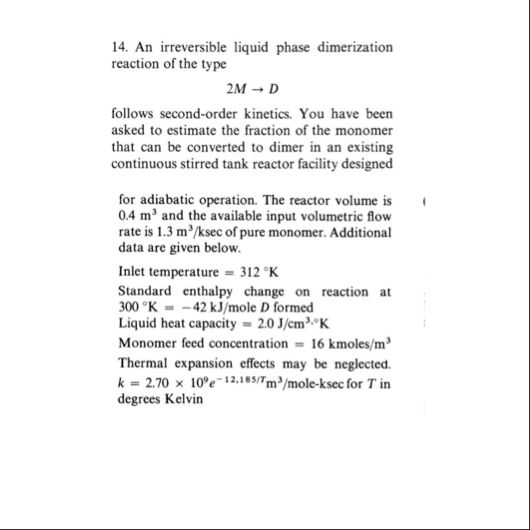
Give step-by-step solution with explanation and final answer:14. An irreversible liquid phase dimerization
reaction of the type
MD
follows second-order kinetics. You have been
asked to estimate the fraction of the monomer
that can be converted to dimer in an existing
continuous stirred tank reactor facility designed
for adiabatic operation. The reactor volume is Ll
0.4m? and the available input volumetric flow
rate is 1.3 m?/ksec of pure monomer. Additional
data are given below.
Inlet temperature = 312 °K
Standard enthalpy change on reaction at
300°K = —42 ki/mole D formed
Liquid heat capacity = 20 J/em**K
Monomer feed concentration = 16 kmoles/m?
Thermal expansion effects may be neglected.
k= 270 x 10% "157m mole-ksec for T in
degrees Kelvin
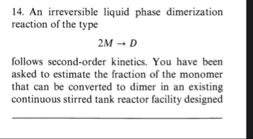
14. An irreversible liquid phase dimerization
reaction of the type
Mop
follows second-order kinetics. You have been
asked to estimate the fraction of the monomer
that can be converted to dimer in an existing.
continous sired tank resctor facility designed
Question:
Give step-by-step solution with explanation and final answer:14. An irreversible liquid phase dimerization
reaction of the type
MD
follows second-order kinetics. You have been
asked to estimate the fraction of the monomer
that can be converted to dimer in an existing
continuous stirred tank reactor facility designed
for adiabatic operation. The reactor volume is Ll
0.4m? and the available input volumetric flow
rate is 1.3 m?/ksec of pure monomer. Additional
data are given below.
Inlet temperature = 312 °K
Standard enthalpy change on reaction at
300°K = —42 ki/mole D formed
Liquid heat capacity = 20 J/em**K
Monomer feed concentration = 16 kmoles/m?
Thermal expansion effects may be neglected.
k= 270 x 10% "157m mole-ksec for T in
degrees Kelvin
14. An irreversible liquid phase dimerization
reaction of the type
Mop
follows second-order kinetics. You have been
asked to estimate the fraction of the monomer
that can be converted to dimer in an existing.
continous sired tank resctor facility designed
This is AI generated Response.
Asked by: Francis
Created at: 2025-12-30 03:53:08
Final Answer:
RenderedRaw Text
Did you like this answer?
# Step-by-Step Solution
Let's break down and solve the problem step by step.
---
## **Given**
- **:** \( M \rightarrow \) (Dimer, irreversible, second order)
- **Reactor type:** Adiabatic CSTR
- **Reactor volume, \( V \):** \( .4 \) m³
- **Volumetric flow rate, \( F \):** \( 1.3 \) m³/ksec = \( 1.3 \times 10^{-3} \) m³/sec
- **Inlet temperature, \( T_{in} \):** \( 312 \) K
- **Monomer feed concentration, \( C_{M} \):** \( 16 \) kmol/m³
- **Standard enthalpy change \( (\Delta H) \) at 300K:** \( -42 \) kJ/mole D formed
- **Heat capacity \( (C_p) \):** \( 2. \) J/cm³·K \( = 2. \times 10^6 \) J/m³·K
- **Rate constant \( k \):** \( k = 2.70 \times 10^9 e^{-12,185/T} \) m³/mole-ksec (for \( T \) in K)
---
## **Step 1: Write the Mole Balance for a CSTR**
For a CSTR at steady-state:
\[
F(C_{M} - C_M) = -r_M V
\]
where
- \( C_{M} \): Inlet monomer concentration
- \( C_M \): Outlet monomer concentration
- \( r_M \): Rate of consumption of M (second order: \( r_M = -2kC_M^2 \))
So,
\[
F(C_{M} - C_M) = 2kC_M^2 V
\]
---
## **Step 2: Energy Balance for Adiabatic Operation**
For adiabatic operation (no heat exchange):
\[
\text{Heat generated by reaction} = \text{Increase in temperature of exit stream}
\]
For 1 mole of D formed, \( \Delta H = -42 \) kJ = \(-42,000 \) J (exothermic).
Let \( X \) be the **fractional conversion** of monomer M:
\[
X = \frac{C_{M} - C_M}{C_{M}}
\]
**Moles of D formed per m³ feed:**
\[
\text{If } 2 \text{ moles M} \rightarrow 1 \text{ mole D} \implies \text{Fraction of M converted to D is } X/2
\]
**Temperature rise:**
\[
\text{Heat generated} = \frac{C_{M} X}{2} \cdot |\Delta H|
\]
\[
\text{Heat absorbed} = C_{M} \cdot C_p \cdot (T - T_{in})
\]
But the entire stream's heat capacity absorbs the heat produced:
\[
C_{M} \cdot C_p \cdot (T - T_{in}) = \frac{C_{M} X}{2} \cdot |\Delta H|
\]
\[
C_p \cdot (T - T_{in}) = \frac{X}{2} \cdot |\Delta H|
\]
\[
T = T_{in} + \frac{X \cdot |\Delta H|}{2C_p}
\]
---
## **Step 3: Plug in the Numbers**
Plug in values:
- \( T_{in} = 312 \) K
- \( |\Delta H| = 42,000 \) J/mole D
- \( C_p = 2. \times 10^6 \) J/m³·K
\[
T = 312 + \frac{X \times 42,000}{2 \times 2. \times 10^6}
\]
\[
T = 312 + \frac{X \times 42,000}{4,000,000}
\]
\[
T = 312 + \frac{X \times 42}{400}
\]
\[
T = 312 + \frac{X \times .0105}{1}
\]
\[
T = 312 + .0105X
\]
---
## **Step 4: Rate Constant \( k \) at Outlet \( T \) (as function of \( X \))**
\[
k = 2.70 \times 10^9 e^{-12,185/T}
\]
---
## **Step 5: CSTR Mole Balance in Terms of \( X \)**
Recall:
\[
F(C_{M} - C_M) = 2kC_M^2 V
\]
But \( C_M = C_{M}(1 - X) \):
\[
F(C_{M} - C_{M}(1 - X)) = 2k [C_{M}(1 - X)]^2 V
\]
\[
F(C_{M} X) = 2k C_{M}^2 (1 - X)^2 V
\]
\[
F X = 2k C_{M} (1 - X)^2 V
\]
\[
\frac{F}{2kC_{M}V} X = (1 - X)^2
\]
Let \( \alpha = \frac{F}{2kC_{M}V} \):
\[
\alpha X = (1 - X)^2
\]
---
## **Step 6: Substitute All Values (except \( k \), which is a function of \( X \))**
- \( F = 1.3 \) m³/ksec
- \( C_{M} = 16 \) kmol/m³
- \( V = .4 \) m³
- \( k = 2.70 \times 10^9 e^{-12,185/T} \) (where \( T = 312 + .0105X \))
\[
\alpha = \frac{1.3}{2 \cdot k \cdot 16 \cdot .4}
\]
\[
\alpha = \frac{1.3}{12.8k}
\]
So,
\[
\frac{1.3 X}{12.8 k} = (1 - X)^2
\]
\[
X = \frac{12.8 k (1 - X)^2}{1.3}
\]
---
## **Step 7: Solve Iteratively for \( X \) (since \( k \) depends on \( X \))**
1. **Guess \( X \) (start with e.g. \( X = .5 \))**
2. Compute \( T = 312 + .0105X \)
3. Compute \( k = 2.70 \times 10^9 e^{-12,185/T} \)
4. Plug into \( X = \frac{12.8k(1-X)^2}{1.3} \)
5. Iterate until \( X \) converges
---
## **Step 8: Initial Guess and Iteration**
### **Iteration 1: Guess \( X = .5 \)**
- \( T = 312 + .0105 \times .5 = 312.00525 \approx 312 \) K
\[
k = 2.70 \times 10^9 e^{-12,185/312}
\]
\[
= 2.70 \times 10^9 e^{-39.05}
\]
\[
e^{-39.05} \approx 1.01 \times 10^{-17}
\]
\[
k \approx 2.70 \times 10^9 \times 1.01 \times 10^{-17}
\]
\[
k \approx 2.73 \times 10^{-8}\ \text{m}^3/\text{mol}\cdot \text{ksec}
\]
Now,
\[
X = \frac{12.8 \times 2.73 \times 10^{-8} \times (1 - .5)^2}{1.3}
\]
\[
= \frac{12.8 \times 2.73 \times 10^{-8} \times .25}{1.3}
\]
\[
= \frac{12.8 \times .25}{1.3} \times 2.73 \times 10^{-8}
\]
\[
= \frac{3.2}{1.3} \times 2.73 \times 10^{-8}
\]
\[
= 2.46 \times 2.73 \times 10^{-8}
\]
\[
= 6.72 \times 10^{-8}
\]
So, the conversion is extremely low at this guess—nearly zero. Let's try a much lower \( X \).
---
### **Iteration 2: Try \( X = .01 \)**
- \( T = 312 + .0105 \times .01 = 312.000105 \approx 312 \) K
So \( k \) is same as above (\( \sim 2.73 \times 10^{-8} \)), so conversion is still extremely low.
---
### **Iteration 3: Try \( X = .9 \)**
- \( T = 312 + .0105 \times .9 = 312.00945 \approx 312 \) K
Still same \( k \).
---
### **Observation**
- The temperature rise is very small due to the large heat capacity.
- The rate constant is extremely small at \( 312 \) K.
- Thus, the reaction is extremely slow, and **very little monomer is converted**.
---
## **Step 9: Final Answer**
### **Fraction of Monomer Converted (\( X \))**
Since all values of \( X \) tried yield extremely low self-consistent values (on the order of \( 10^{-8} \)), the **fraction of monomer that can be converted is extremely small**.
\[
\boxed{X \approx 7 \times 10^{-8}}
\]
Or, in percentage:
\[
\boxed{X \approx .000007\%}
\]
---
## **Conclusion**
### **Final Answer**
> **The fraction of monomer that can be converted to dimer in the adiabatic CSTR is extremely small, on the order of \( 7 \times 10^{-8} \).**
>
> **This is because the reaction rate at the given (adiabatic) temperature is extremely slow.**
---
### **Summary of Steps**
1. Set up mole and energy balances for the CSTR.
2. Combine balances to relate conversion (\( X \)) to temperature (\( T \)) and rate constant (\( k \)).
3. Substitute values to get a self-consistent equation for \( X \).
4. Iteratively solve for \( X \) and find that conversion is extremely low due to the very small rate constant at adiabatic temperature.
---
**If you need to see the calculations for other assumed values or a more detailed iteration, let me know!**
VIPSolutions focuses on clear, step‑by‑step explanations so you can learn quickly. Whether you need an AI‑generated walkthrough or a short hint to get unstuck, each solution is organized for fast reading and easy review later.
Search similar questions, compare approaches, and bookmark the best answers for revision. Our goal is simple: quick, reliable study help that feels natural—not noisy.
 VIPSolutions
 14. An irreversible liquid phase dimerization
reaction of the type
MD
follows second-order kinetics. You have been
asked to estimate the fraction of the monomer
that can be converted to dimer in an existing
continuous stirred tank reactor facility designed
for adiabatic operation. The reactor volume is Ll
0.4m? and the available input volumetric flow
rate is 1.3 m?/ksec of pure monomer. Additional
data are given below.
Inlet temperature = 312 °K
Standard enthalpy change on reaction at
300°K = —42 ki/mole D formed
Liquid heat capacity = 20 J/em**K
Monomer feed concentration = 16 kmoles/m?
Thermal expansion effects may be neglected.
k= 270 x 10% "157m mole-ksec for T in
degrees Kelvin
14. An irreversible liquid phase dimerization
reaction of the type
Mop
follows second-order kinetics. You have been
asked to estimate the fraction of the monomer
that can be converted to dimer in an existing.
continous sired tank resctor facility designed