 VIPSolutions
Give step-by-step solution with explanation and final answer: ( answer must be in Anti Ai and humanised answer, give me in simple english not like a bot )Surniact. OR Q9 Heat conduction takes place through a composite cylindrical pipe with a fluid at temperature Ty inside the pipe and fluid temperature Ta outside the pipe. Take inner radius R and outer radius Rs of the pipe. The composite pipe is made up of two materials of different thicknesses and different thermal conductivities. Develop an expression for the heat flow from inside fluid to outside fluid through the wall. (10)
Question:
Give step-by-step solution with explanation and final answer:
( answer must be in Anti Ai and humanised answer, give me in simple english not like a bot )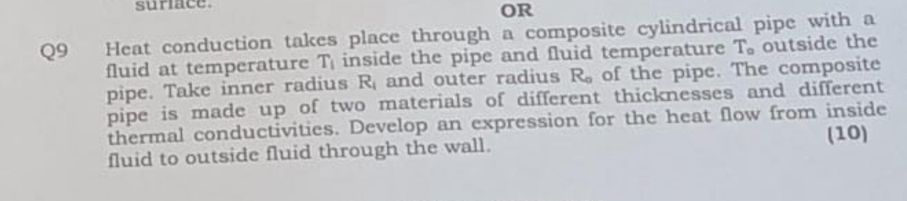 Surniact.
OR
Q9 Heat conduction takes place through a composite cylindrical pipe with a
fluid at temperature Ty inside the pipe and fluid temperature Ta outside the
pipe. Take inner radius R and outer radius Rs of the pipe. The composite
pipe is made up of two materials of different thicknesses and different
thermal conductivities. Develop an expression for the heat flow from inside
fluid to outside fluid through the wall. (10)
This is AI generated Response.
Asked by: Mallikarjun
Created at: 2025-12-30 01:21:40
Asked by: Mallikarjun
Created at: 2025-12-30 01:21:40
Final Answer:
Rendered
Raw Text
Did you like this answer?
Sure, let's break this down step by step in a simple, human way.
---
**Question Recap**
We have a pipe made of **two different materials** (like two layers), each with its **own thickness and thermal conductivity**. Hot fluid is **inside** (temperature \(T_i\)), and cooler fluid is **outside** (temperature \(T_o\)).
- **Inner radius:** \(R_i\)
- **Outer radius:** \(R_o\)
We need to **find the formula for heat flow** from inside to outside.
---
## **Step 1: Visualizing the Pipe**
Imagine the pipe is like an onion with two layers:
- **Layer 1:** From \(R_i\) to \(R_1\), conductivity = \(k_1\)
- **Layer 2:** From \(R_1\) to \(R_o\), conductivity = \(k_2\)
So, the pipe has:
- **Inner surface:** at \(R_i\) (temperature = \(T_i\))
- **Boundary between materials:** at \(R_1\)
- **Outer surface:** at \(R_o\) (temperature = \(T_o\))
---
## **Step 2: Formula for Heat Conduction Through a Cylinder**
For one layer, the heat flow rate (Q) is:
\[
Q = \frac{2\pi L k (T_\text{inside} - T_\text{outside})}{\ln(R_\text{outside}/R_\text{inside})}
\]
Where:
- \(L\) = length of the pipe
- \(k\) = thermal conductivity
- \(T\) = temperature
- \(R\) = radius
---
## **Step 3: For Two Layers (Composite Wall)**
Think of the two layers as **two resistances in series** (like two resistors in a row).
**Thermal resistance for a cylinder:**
\[
R_{th} = \frac{\ln(R_\text{outside}/R_\text{inside})}{2\pi L k}
\]
So:
- **Layer 1:** \(R_{th,1} = \frac{\ln(R_1/R_i)}{2\pi L k_1}\)
- **Layer 2:** \(R_{th,2} = \frac{\ln(R_o/R_1)}{2\pi L k_2}\)
**Total resistance:**
\[
R_{th, \text{total}} = R_{th,1} + R_{th,2}
\]
---
## **Step 4: Final Heat Flow Expression**
Now, total heat flow is:
\[
Q = \frac{T_i - T_o}{R_{th, \text{total}}}
\]
Substitute the resistances:
\[
Q = \frac{T_i - T_o}{\frac{\ln(R_1/R_i)}{2\pi L k_1} + \frac{\ln(R_o/R_1)}{2\pi L k_2}}
\]
Or, combine into one fraction:
\[
Q = \frac{2\pi L (T_i - T_o)}
{\frac{\ln(R_1/R_i)}{k_1} + \frac{\ln(R_o/R_1)}{k_2}}
\]
---
## **In Short: Final Answer**
\[
\boxed{
Q = \frac{2\pi L (T_i - T_o)}
{\frac{\ln(R_1/R_i)}{k_1} + \frac{\ln(R_o/R_1)}{k_2}}
}
\]
- \(T_i\): Inside fluid temperature
- \(T_o\): Outside fluid temperature
- \(R_i\): Inner radius
- \(R_1\): Radius between two layers
- \(R_o\): Outer radius
- \(k_1\): Conductivity of inner material
- \(k_2\): Conductivity of outer material
- \(L\): Length of pipe
---
### **In Simple Words:**
You add the "difficulty" for heat to pass through each layer (thermal resistance), then use the total to find how much heat moves from inside to outside.
Let me know if you want this with a real example or a diagram!
📢 Instructions:
- Ask anything relatd to above question only.
- For new Question goto :