 VIPSolutions
Give step-by-step solution with explanation and final answer:Specify the model of the bouncing ball shown in Fig. 2 as a formal hybrid process by listing all its components (states, inputs, outputs, mode-invariants, modes of operations, transitions, guards, and resets). Assume that the outputs of the process are the discrete bump events and the continuously updated height. Fall h:=hgvi=v( ; h=v; v=—g 0) (h=0) — h>0 bump!; v:i=—av Fig. 2 Bouncing ball hybrid process
Question:
Give step-by-step solution with explanation and final answer: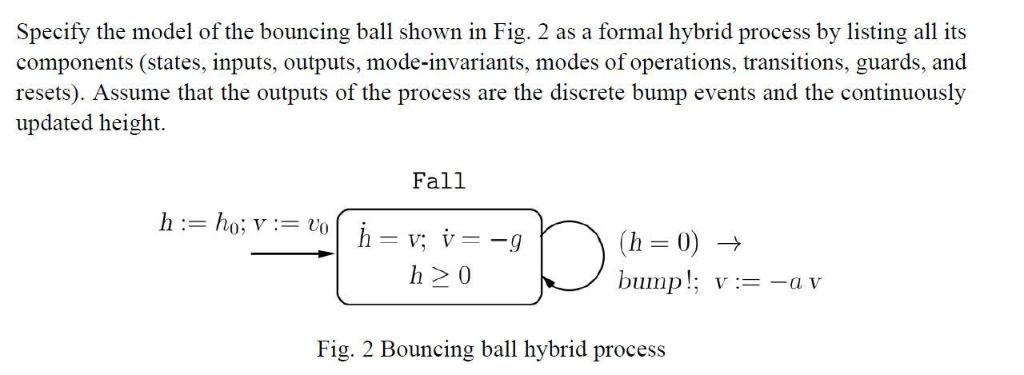 Specify the model of the bouncing ball shown in Fig. 2 as a formal hybrid process by listing all its
components (states, inputs, outputs, mode-invariants, modes of operations, transitions, guards, and
resets). Assume that the outputs of the process are the discrete bump events and the continuously
updated height.
Fall
h:=hgvi=v( ;
h=v; v=—g 0) (h=0) —
h>0 bump!; v:i=—av
Fig. 2 Bouncing ball hybrid process
This is AI generated Response.
Asked by: Francis
Created at: 2025-12-29 06:16:34
Asked by: Francis
Created at: 2025-12-29 06:16:34
Final Answer:
Rendered
Raw Text
Did you like this answer?
Let's break down the bouncing ball hybrid process shown in Fig. 2 and **formally specify it** as a hybrid automaton, listing all its components:
---
# 1. **States (Modes)**
- **Single mode:** `Fall`
---
# 2. **Continuous Variables**
- **Height** \(h\)
- **Velocity** \(v\)
---
# 3. **Inputs**
- No external inputs in this model (the system is autonomous).
---
# 4. **Outputs**
- **Discrete:** `bump!` (event when the ball hits the ground)
- **Continuous:** Height \(h\) (continuously updated)
---
# 5. **Mode Invariants**
- In `Fall` mode: \( h \geq \)
(the ball cannot go below the ground)
---
# 6. **Mode Dynamics (Flows)**
- In `Fall`:
\[
\dot{h} = v
\]
\[
\dot{v} = -g
\]
where \(g\) is gravitational acceleration.
---
# 7. **Transitions**
- **Guard:** \( h = \) (when the ball hits the ground)
- **Reset:**
- Issue the discrete event `bump!`
- Update velocity: \( v \coloneqq -a v \), where \( < a < 1 \) (coefficient of restitution; reverses direction and reduces speed)
---
# 8. **Initial Conditions**
- At \( t = \):
\[
h := h_, \quad v := v_
\]
---
# 9. **Formal Hybrid Automaton Specification**
| Component | Description |
|---------------------|------------------------------------------------------------------------------------------------------|
| **Modes** | `Fall` |
| **Variables** | \( h \) (height), \( v \) (velocity) |
| **Input** | None |
| **Output** | Discrete: `bump!`, Continuous: \( h \) |
| **Invariant** | \( h \geq \) |
| **Flow** | \( \dot{h} = v \), \( \dot{v} = -g \) |
| **Guard** | \( h = \) |
| **Reset** | `bump!`; \( v := -a v \) |
| **Init** | \( h := h_ \), \( v := v_ \) |
---
## **Step-by-Step Explanation**
1. **Initialization**: Set initial height \(h_\) and velocity \(v_\).
2. **Continuous Evolution**: While \(h > \), evolve according to \(\dot{h} = v\), \(\dot{v} = -g\).
3. **Guard Check**: When \(h = \), the guard triggers.
4. **Transition**: Issue the `bump!` event and reset velocity: \( v := -a v \).
5. **Repeat**: The process continues in the `Fall` mode with updated velocity.
---
## **Summary Table**
| Step | Description |
|--------------------------|--------------------------------------------------------------------|
| Initial state | \( h = h_, v = v_ \) |
| Mode (Fall) | \( \dot{h} = v, \dot{v} = -g, \ h \geq \) |
| Guard (Transition) | \( h = \) |
| Reset (on bump) | Issue `bump!`, set \( v := -a v \) |
| Output | Discrete: `bump!`, Continuous: \( h \) |
---
## **Final Answer**
The hybrid model consists of a single mode (`Fall`) with continuous variables \(h\) and \(v\), evolving according to gravity, constrained by \(h \geq \). When the ball hits the ground (\(h = \)), a transition is triggered: the `bump!` event is output, and velocity is updated to \(v := -a v\). The outputs of the process are the sequence of `bump!` events (discrete) and the continuously updated height \(h\) (continuous).
📢 Instructions:
- Ask anything relatd to above question only.
- For new Question goto :